Here's a confession: I used to think Meta ads didn't work for SaaS. I'd spent years watching SaaS companies try the same playbook that DTC brands use, polished lifestyle imagery, emotional storytelling, impulse-driven CTAs, and predictably fail. The CPAs were astronomical, the lead quality was garbage, and everyone concluded that "Facebook just isn't for B2B."
They were wrong. But not for the reason you'd think.
The problem was never the platform. Meta has 3+ billion monthly active users. Your ICP is on there, scrolling through Reels at 10pm, checking Marketplace on Saturday, reading articles shared by colleagues. The problem was the creative. SaaS companies were building ads designed for impulse purchases and wondering why they didn't generate demo requests for $50K/year enterprise software.
This guide is about building Meta ad creatives specifically for SaaS, the creative strategy that actually drives free trial signups, demo requests, and qualified pipeline. Not adapted from DTC playbooks. Built from the ground up for how B2B buyers actually make decisions. For the broader picture, campaign structure, targeting, benchmarks, and example ads, start with our Meta ads for SaaS hub.
Why SaaS Creative Is Fundamentally Different
A consumer sees a DTC ad for a $40 skincare product. If the hook is good and the testimonial is convincing, they might buy on the spot. The consideration cycle is minutes. The risk is $40. The decision-maker is the person seeing the ad.
A SaaS buyer sees your ad for project management software. Even if they're interested, they can't buy on the spot. They need to evaluate it against alternatives. They need to get buy-in from their team. They might need budget approval. The consideration cycle is weeks to months. The risk is thousands of dollars and organizational disruption. The decision-maker is rarely acting alone.
This fundamental difference means your creative has a completely different job. A DTC ad's job is to trigger an impulse purchase. A SaaS ad's job is to earn a micro-commitment, a free trial signup, a demo request, a content download, that starts the buyer on a consideration journey. Your creative isn't closing the deal. It's opening the conversation.
Every creative decision flows from this: you're not selling the product. You're selling the next step.
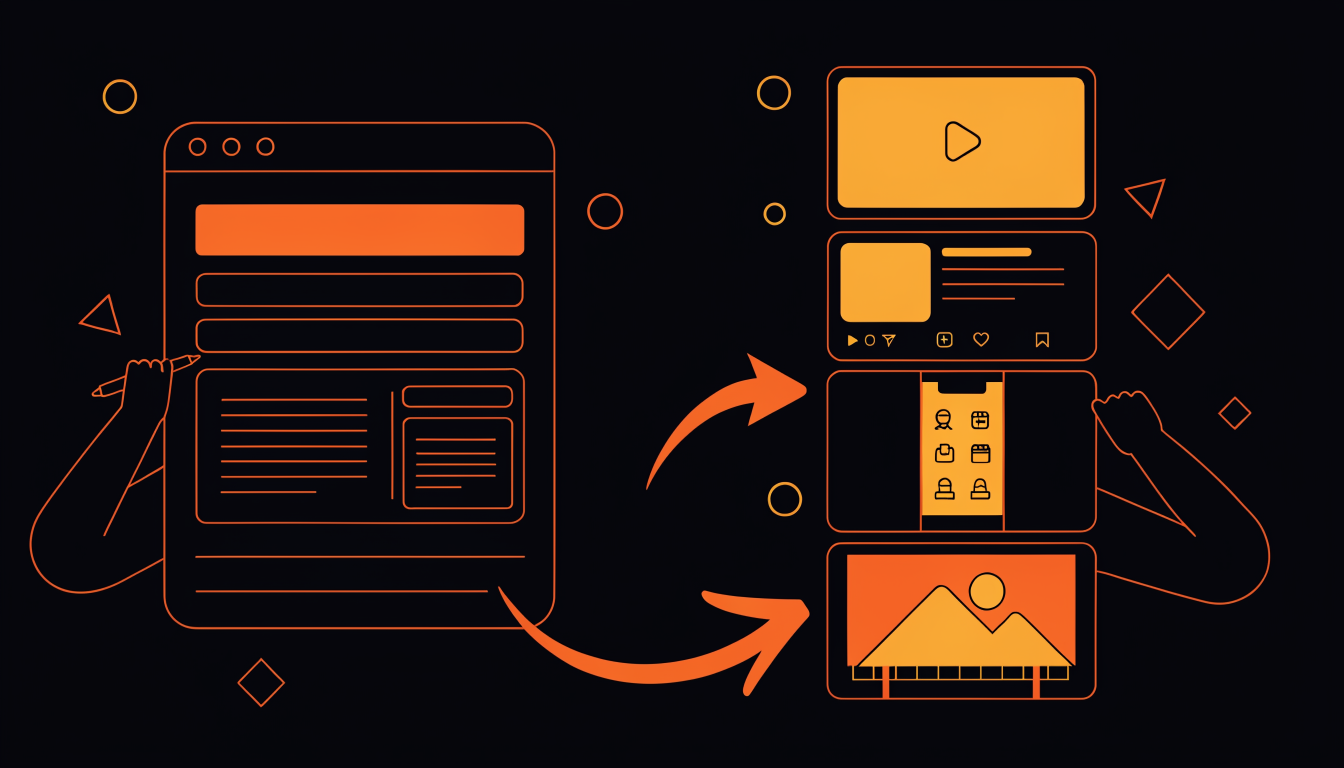
The Landing Page-to-Ad Pipeline
Here's the approach I've seen work consistently across SaaS companies spending $5K-$100K+ per month on Meta: start with your landing page, not a blank canvas.
Your landing page already contains the messaging, visuals, and proof points that convert visitors. It's been tested (or at least, it should have been). It represents your current best understanding of what resonates with your audience. Your ad creative should be an extension of that landing page, a compressed, scroll-stopping version of the same narrative.
Step 1: Audit Your Landing Page for Ad-Ready Elements
Go through your best-performing landing page and identify these specific elements.
Hero headline: This is usually your strongest value proposition statement. If your landing page hero says "Generate 50 ad creatives from any URL in 30 seconds," that's a tested headline that already converts. It should be a candidate for your ad hook, possibly verbatim, possibly compressed.
Pain point sections: Most SaaS landing pages have a "problems we solve" section. Those pain points, stated in your customer's language, are your ad copy angles. "Spending 4+ hours on a single ad creative?" is a pain point that probably already lives on your page. Pull it directly.
Social proof: Customer logos, testimonial quotes, specific metrics ("Saved 12 hours/week for the marketing team at Shopify"). These are the trust signals that your ad needs, especially in the first 3 seconds where a skeptical B2B buyer decides whether to keep scrolling.
Product screenshots or demos: The actual UI, the actual workflow, the actual output. For SaaS, showing the product is almost always more effective than showing lifestyle imagery. Your buyer wants to see what they're getting. They want to evaluate it visually before investing time in a demo.
Results or case study data: "Reduced CPA by 34% in 60 days" or "200+ agencies use this to manage creative production." Concrete outcomes that make the abstract tangible.
Step 2: Compress Into Ad-Sized Narratives
A landing page has 10-20 seconds of content. An ad has 2-3 seconds to earn attention and 5-10 seconds to convey value. You need to compress, not just crop.
The compression formula I use: one pain point + one proof point + one clear next step. That's it. Don't try to fit your entire value proposition into a single ad. Pick one angle and commit to it fully.
Example: Pain point: "Your team spends 6 hours creating one ad set." Proof point: "[Your product] generates 50 Meta-ready creatives in 30 minutes." Next step: "Start free, no credit card." That's a complete ad narrative. It identifies the problem, proves the solution works, and makes the next step frictionless.
Step 3: Build Visual Creative That Shows the Product
This is where SaaS companies make their biggest creative mistake. They use stock photos. They use abstract illustrations. They use generic "team collaboration" imagery. None of this converts.
What converts for SaaS is showing the actual product. Product UI screenshots with real data (or realistic demo data) in use. Screen recordings showing the workflow, especially the "magic moment" where the product delivers value. Before/after comparisons showing the old workflow vs. the new one. Output examples showing what the user gets (generated creatives, reports, dashboards, whatever your product produces).
I know this sounds obvious, but go look at the Meta Ad Library and search for SaaS companies. 70%+ of them are running generic lifestyle imagery or abstract graphics. The ones that show their actual product consistently outperform, and it makes sense. A SaaS buyer scrolling through their feed wants to evaluate your product visually. Give them something to evaluate.
The Five Creative Frameworks That Work for SaaS
Framework 1: The Product Demo Ad
A 15-30 second screen recording showing one specific workflow. Not a full product tour, one workflow that solves one pain point. Hook with the outcome ("Watch us generate 20 ad creatives in 45 seconds"), show the workflow, end with the result and CTA.
This is the highest-converting format I've seen for SaaS on Meta, period. It works because it gives the viewer a preview of the product experience. They can evaluate whether this is worth their time before committing to a demo or trial. The hook earns attention, the demo builds confidence, the CTA converts interest into action.
Pro tip: record the screen in 1:1 or 9:16 aspect ratio for mobile feeds. A desktop screenshot in landscape format loses 60% of the screen real estate on mobile, and 90%+ of Meta impressions are mobile.
Framework 2: The Pain-Agitation-Solution (PAS) Ad
Start with a specific, relatable pain your audience experiences daily. Agitate it, show what it costs them in time, money, or frustration. Then present your product as the solution with a specific proof point.
The key word is specific. "Marketing is hard" is not a pain point. "Your designer just told you the 8 ad variations you need won't be ready until next Thursday" is a pain point. The more specific and visceral the pain, the more it resonates with people who experience it, and the more it naturally repels people who don't, which is actually what you want. In SaaS, qualification matters as much as volume.
Copy structure: "Every Monday morning, the same email: 'Can we get 10 new ad creatives by Wednesday?' And every Wednesday, the same answer: 'We got 4 done. The rest will be next week.' [your product] generates 10 creatives from any product URL in under 5 minutes. No designer bottleneck. No production delays. Start free."
Framework 3: The Social Proof Wall
A static image or carousel showing customer logos, testimonial snippets, and specific metrics. The hook is the aggregate: "200+ agencies use [product] to manage creative production." The body is 3-5 specific testimonials with names, roles, and outcomes.
This framework works best for mid-funnel audiences, people who've visited your site, watched a previous ad, or engaged with your content. They already know what you do. They need proof that it works. The social proof wall provides that proof in a scannable, credible format.
One rule: never use fake testimonials. Real names, real companies, real outcomes. B2B buyers are sophisticated, they can smell fabricated social proof. If you don't have customer testimonials yet, run the product demo framework until you do.
Framework 4: The Comparison Ad
Side-by-side comparison: the old way vs. the new way. Old way: Canva template, 45 minutes per creative, generic output, no performance data. New way: AI-generated from your product URL, 30 seconds per creative, optimized for Meta algorithms, built-in performance predictions.
Comparison ads work for SaaS because B2B buyers are always evaluating alternatives. They're not asking "should I buy this?", they're asking "is this better than what I'm currently doing?" The comparison format mirrors their decision-making process.
Don't trash-talk competitors by name unless you have a solid strategic reason and legal clearance. The cleanest version is "manual process vs. [your product]" or "spreadsheet vs. [your product]." You're competing against the status quo, not just other tools.
Framework 5: The Results Showcase
Lead with a specific customer outcome. "How [Customer] reduced their ad creative production time by 80%." Show the before metrics, the product implementation, and the after metrics. This is essentially a mini case study compressed into an ad format.
The results showcase works because it answers the question every SaaS buyer is thinking: "What results will I actually get?" Not features, not promises, results. The more specific and verifiable, the better. "$34K saved in designer costs over 6 months" beats "saves you time and money."
Audience Strategy for SaaS on Meta
Andromeda changed targeting for everyone, but the implications for SaaS are particularly significant. The old B2B targeting approach, stacking job titles, company sizes, and industry interests, is increasingly less effective. Andromeda's creative-as-targeting mechanism means your creative does the qualification work.
Here's what works now: broad targeting with creative that self-qualifies. When your ad copy says "If you manage Meta ads for 5+ clients" or "For marketing teams spending $10K+/month on paid social," it naturally filters the audience. People who don't fit that description scroll past. People who do stop and engage. The algorithm learns from those engagement signals and finds more people who match the profile, often discovering segments you'd never have found with manual targeting.
The practical targeting setup I recommend: one Advantage+ campaign with broad targeting and 5-10 creatives that speak to different pain points and personas within your ICP. Let the algorithm figure out who responds to what. Supplement with a retargeting campaign hitting website visitors, free trial users who haven't converted, and video viewers with social proof and comparison creatives.
A note on Lead Ads vs. landing page conversions: Lead Ads (Meta's instant forms) generate higher volume at lower cost per lead. But lead quality is consistently lower, people fill out forms without fully understanding what they're signing up for. For SaaS, I generally recommend driving to your landing page for trial signups and demo requests. The friction of leaving the platform acts as a quality filter. Test both, but don't optimize purely for cost per lead without tracking downstream conversion rates.
The Full-Funnel Creative Map
SaaS buyers don't convert on first touch. Your creative strategy needs to map to the buyer's journey.
Top of funnel (cold audience): Product demo ads and PAS ads. The goal is awareness and first-click engagement. Focus on the biggest, most relatable pain point and the most impressive product capability. Copy should be educational and curiosity-driven, not salesy.
Mid funnel (warm audience, site visitors, video viewers, content engagers): Social proof walls and results showcases. These people know what you do. Now they need proof it works. Lead with credibility, not features. Retarget within 7-14 days of engagement, beyond 14 days, the intent has cooled.
Bottom funnel (hot audience, free trial users, pricing page visitors, demo no-shows): Comparison ads and urgency-driven CTAs. These people are actively evaluating. Your creative should address specific objections: "Still comparing tools? Here's how we stack up." or "Your free trial expires in 3 days, here's what you'll miss."
Each funnel stage should use different creative and different copy. Running the same ad to cold and warm audiences is one of the most common mistakes SaaS advertisers make on Meta.
Measuring What Matters: Beyond CPL
Cost per lead is the most tracked and least useful metric in SaaS Meta advertising. A $15 lead that never becomes a customer is infinitely more expensive than a $45 lead that closes at $50K ARR.
The metrics that actually matter: cost per qualified lead (not just any lead, a lead that meets your ICP criteria), cost per demo completed (not just booked, actually attended), trial-to-paid conversion rate by creative source (which creatives produce users who actually convert?), and pipeline generated per dollar of ad spend.
This requires passing conversion events back to Meta via the Conversions API, not just tracking the initial signup, but tracking when someone converts from trial to paid, hits usage milestones, or becomes a qualified opportunity. This closed-loop attribution teaches Meta's algorithm which audiences and creatives actually drive revenue, not just signups. The algorithmic benefit compounds over time: better signal data → better delivery optimization → higher quality leads → better signal data.
Production Speed: The SaaS Creative Bottleneck
The biggest constraint SaaS companies face with Meta ads isn't budget or targeting, it's creative production speed. Most SaaS marketing teams have limited design resources. Producing 5-10 ad creatives means competing for designer time with landing pages, email templates, social posts, and product marketing assets.
This bottleneck kills your testing velocity. If you can only produce 3 new creatives per month, you can only run 1 test cycle per month. At that rate, it takes 6 months to validate your hook, visual concept, format, and copy angle, and by then, your market context has shifted.
AI creative generation solves this bottleneck specifically for SaaS. At AdRiseLab, you paste your landing page URL, and the AI analyzes the page structure, messaging, visuals, and proof points, then generates ad creatives that compress that landing page narrative into ad-sized formats. Product screenshots get turned into scroll-stopping ad visuals. Value propositions get compressed into hooks. Social proof gets woven into the creative.
The result: a full test batch in minutes instead of weeks. That production speed is the difference between 1 test cycle per month and 4+. And as we covered in the testing framework, more test cycles means more validated learnings, which means better creative, which means better performance.
Build your SaaS creative pipeline. Get started with AdRiseLab — plans from $39/mo, cancel any time.
Related Reading
See the complete creative testing framework for how to structure your tests and make data-driven decisions. Learn how the Andromeda algorithm evaluates creative signals and why creative diversity matters more than audience targeting. And explore creative fatigue detection to know exactly when your SaaS ads need refreshing.