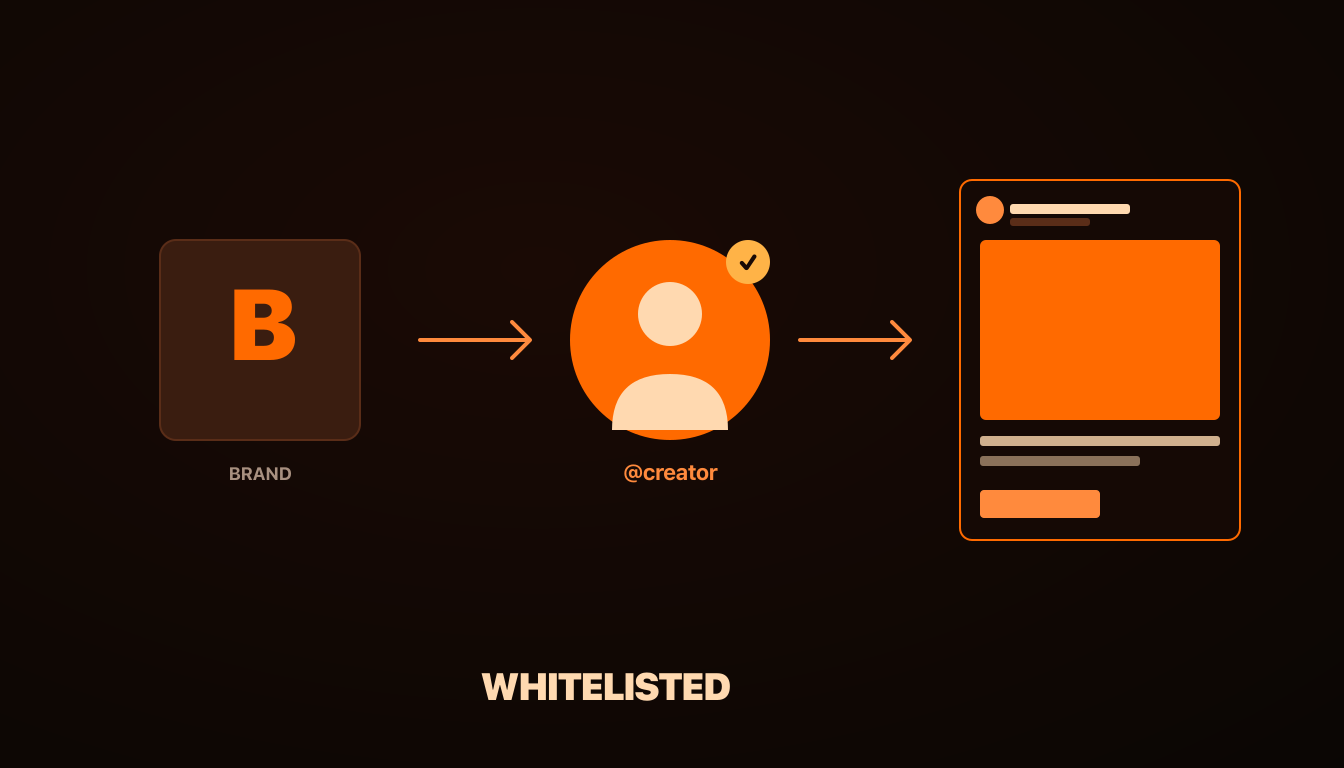
In 2026, the highest-leverage move in DTC paid social isn't a new creative format or a new audience strategy — it's changing whose handle the ad runs under. Whitelisted ads, running under a creator's account instead of your brand's, consistently deliver 20-35% lower CPA in our 90-account benchmark, with the largest gaps in beauty, wellness, and lifestyle DTC.
This guide is the complete operational and performance playbook: what whitelisting is, how to set it up, what to pay creators, how to structure the contracts, and how to think about the performance math that determines whether the overhead is worth it for your account.
What Whitelisting Actually Is
A whitelisted ad (Meta's official term: "Partnership Ad") looks identical to a regular post from the creator's account: their handle, their profile photo, their tone. But the ad is created and run from your brand's ad account, with your targeting and budget, and a "Paid partnership with [Brand]" label that satisfies FTC disclosure.
The mechanics: the creator grants your business account "Branded Content" and "Advertise" permissions on their Instagram/Facebook account via Meta Business Suite. Your team then uploads the creative through Ads Manager and selects the creator's handle as the publisher. The ad runs through Meta's standard auction with the creator's name at the top instead of yours.
Why Whitelisted Ads Outperform
The performance gap comes from three compounding mechanisms.
Trust transfer. Users have built trust signals around the handles they recognize. When a creator they know (or even don't know but recognize as a "real person handle" rather than a brand) appears, the default skepticism is lower. The TSR delta vs the same creative under the brand handle is typically 18-28%.
Pattern-interrupt against ad fatigue. Users have trained themselves to scroll past brand-page ads. A creator handle visually patterns as organic content for the first half-second, which is enough to delay the scroll reflex and give the hook a chance to land.
Algorithmic engagement isolation. Engagement on whitelisted ads (likes, comments, shares) lands on the creator's account post, not your brand page. This matters because Meta's delivery optimization rewards engaged creative — and concentrating engagement on a single creator handle produces stronger signals than spreading the same engagement across hundreds of brand-page ads.
The Setup: 6 Steps
1. Get creator approval. The creator needs to opt in via Meta Business Suite > Branded Content > Approved Brands. They add your business account to their approved list.
2. Request ad permissions. From your Business Manager, send a request to the creator's account for "Advertise" permission. They accept in Business Suite.
3. Verify the Partnership Ad label is enabled. In Ads Manager, when you select the creator's handle as publisher, the "Paid Partnership" label appears automatically. If it doesn't, the setup is incomplete.
4. Upload the creative as a Partnership Ad. Choose "Use existing post" if the creator already published the video to their feed, or "Create new" for an unpublished ad. New is preferred for high-volume testing because it avoids overwhelming the creator's organic feed.
5. Set up reporting. The creator's analytics show only impressions and reach — full conversion data stays in your Ads Manager. Make sure your reporting separates whitelisted vs brand-page performance for accurate attribution.
6. Document the agreement. Written contract with start/end dates of whitelisting window, scope of usage (Meta only vs cross-platform), and termination clause. Most disputes happen because the agreement was verbal.
Contract Structure And Pricing
A standard whitelisting contract in 2026 has five clauses that matter:
Window. The time period during which you can run ads under their handle. Standard is 6 months; 12 months for higher fees. Avoid "perpetual" — you don't need it and creators rarely agree to it.
Platforms. Meta only (cheaper), or Meta + TikTok + YouTube (higher fee, allows cross-platform whitelisting where supported).
Creative scope. Number of ad concepts you can run under their handle. Most agreements allow unlimited creative variations within the window; some cap at 5-10 distinct concepts.
Termination. Either party can terminate with 30-day notice. Important: if the creator terminates, your ads stop serving on their handle — budget should be portable to your brand page as a fallback.
Approval rights. Whether the creator must approve each creative before it runs. Most contracts grant blanket approval at the concept level; per-asset approval kills the operational velocity that makes whitelisting worthwhile.
Typical pricing tiers (in addition to per-video creator fee):
Micro creators (5K-50K followers): $200-500 for 6 months, Meta only.
Mid-tier (50K-250K): $500-1000 for 6 months, Meta + Instagram.
Macro (250K+): $1000-3000+ for 6 months, often platform-bundled.
The Performance Math: When Is Whitelisting Worth It?
Whitelisting is worth the fee when the CPA improvement on the creator-handle ad exceeds the amortized whitelisting fee per conversion.
Example: You pay a $500 whitelisting fee for a 6-month window. The creator-handle ad gets you 1500 conversions across that window vs 1200 you'd have gotten from brand-page ads. The 300 additional conversions cost $1.67 each ($500 / 300). If your gross profit per conversion is above $1.67 — which it almost always is — whitelisting is profitable.
The math gets stronger the higher your spend. At $50K/month per creator, whitelisting fees become trivial fractions of the spend, and a 25% CPA improvement is worth tens of thousands.
Common Whitelisting Mistakes
Skipping the Partnership Ad tag. Some teams run "whitelisted" ads from creator handles without the official Partnership label. This violates FTC and Meta policy. Always use the official setup.
Single-creator over-reliance. If 80% of your spend runs through one creator handle and they terminate the agreement, your performance collapses overnight. Diversify across 3-5+ creator handles.
Treating it as the same creative bucket. Whitelisted and brand-page ads should be tested as separate creative pools. The same hook can perform very differently under a creator handle vs your brand page.
Under-investing in creator selection. A whitelisted ad from a creator users don't trust performs worse than a brand-page ad. The creator handle quality matters more than the asset quality.
Scale Whitelisted Creative With AdRiseLab
AdRiseLab produces and adapts UGC variants for your whitelisting partners — hook variations, length variations, CTA variations — all delivered ready to upload as Partnership Ads. Get started with AdRiseLab.
Related Reading
See the UGC ads playbook for the creator-selection and brief structure that produces ads worth whitelisting in the first place. Read about Meta's AI disclosure rules for the compliance overlay. And explore Andromeda algorithm for why creator-handle engagement signals matter so much in 2026.