Meta & Facebook Ads for SaaS Companies
Facebook ads for SaaS work very differently from e-commerce campaigns. The goal is not an impulse purchase, it's a micro-commitment: a demo request, a free trial signup, or a lead magnet download that starts a buyer down a longer consideration path. This guide covers how SaaS companies actually use Meta ads for SaaS, from SaaS Facebook ads examples and campaign setup to targeting, benchmarks, creative hooks, and the mistakes that quietly drain budget, so you can turn Meta into a reliable source of qualified pipeline instead of cheap-but-useless leads.
What's inside
SaaS Facebook Ads Examples
Useful SaaS Facebook ad examples each address a specific funnel job. Here are six formats to test for demo requests and free trial signups, when to reach for each, an example hook, and the buying question each addresses.
Three visual directions from the AdRiseLab sample library
These are AI-generated concepts, not live customer campaigns. The interface, figures and presenter in the samples are illustrative. For a real SaaS ad, use accurate product screens and substantiated claims.
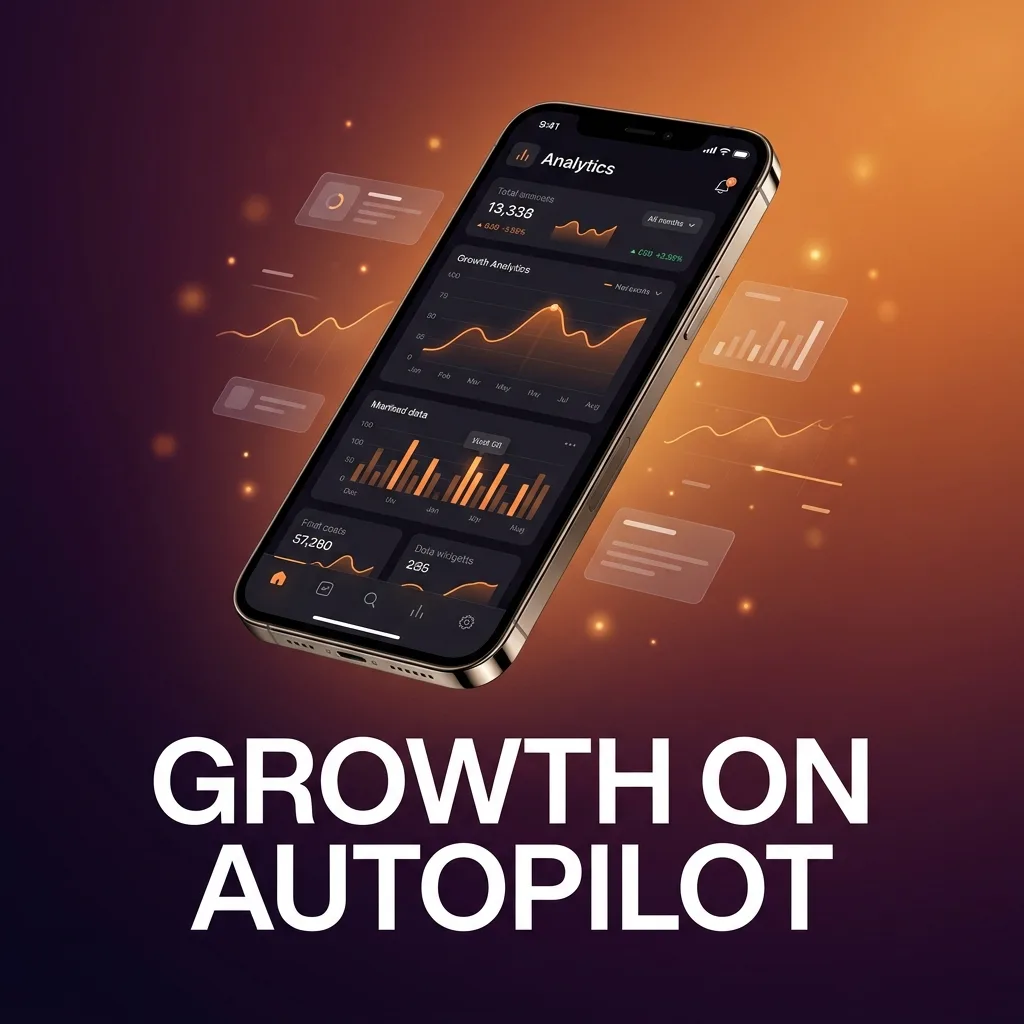
A large headline and product visual establish the category. Replace a broad growth promise with one specific task your software helps a buyer complete.
Introduce one product workflow visually, then take the viewer to a demo of that same task.
Open with a problem the buyer recognizes, explain the workflow, and invite them to see the product.
Build image and copy concepts with the AI Facebook ad generator. The video ad and AI UGC workflows turn the same product into video, including clips where an AI presenter shows your app on a laptop screen.
1. Demo signup ad
When to use: sales-led products where the deal closes on a call.
Example hook: "See how [product] brings your reports into one workspace. Book a product demo."
What it tests: a concrete outcome plus a low time commitment earns the micro-conversion without overselling the product.
2. Free trial ad
When to use: product-led motions where users can self-serve to value.
Example hook: "Try [specific workflow] with [product]. Start your [actual trial duration]-day trial."
What it tests: it lowers perceived effort and risk, the two biggest objections to starting a trial.
3. Freemium ad
When to use: freemium products that monetize after activation.
Example hook: "Build your first [project type] on our free plan. See what is included."
What it tests: a clear free-tier value proposition removes the "what's the catch?" hesitation.
4. Product UI screenshot ad
When to use: any stage, especially when the product is visually distinctive.
Example hook: "This is the dashboard your team has been asking for."
What it tests: B2B buyers want to evaluate the product before committing, and the UI naturally filters for people who recognize the workflow.
5. Pain-point ad
When to use: cold prospecting where you need to stop the scroll.
Example hook: "Still updating 12 spreadsheets every Monday morning?"
What it tests: a specific, visceral pain resonates with people who feel it and repels those who don't, which is exactly the qualification you want.
6. Social proof ad
When to use: mid-funnel and retargeting audiences who already know you.
Example hook: "See how [named customer, with permission] uses [product] for [specific task]."
What it tests: warm audiences need proof, not awareness, and recognizable logos and metrics close the trust gap.
Read the complete Facebook ads for SaaS creative guide for framework-level detail on each of these formats, or see how the URL-to-ad pipeline turns a SaaS landing page into ad variations.
Meta Ads Campaign Structure for SaaS
A reliable SaaS Meta ads account is built from a handful of campaigns that each serve a distinct job. Layering them lets you control where budget goes by funnel stage instead of dumping everything into one campaign and hoping the algorithm sorts it out.
Cold audience campaign. Broad targeting, high creative volume, optimized for a top-of-funnel signal. This is where you introduce the problem and let your creative qualify the buyer. Most of your testing happens here.
Retargeting campaign. Site visitors, video viewers, and lead-form openers who already know you. Serve social proof and product-detail creative here, the job is to move warm interest toward a trial or demo, not to create awareness.
Lead magnet campaign. A benchmark report, template, or teardown captured behind an email. This produces cheaper top-of-funnel volume and feeds a nurture sequence, useful when direct demo or trial volume is too low for the algorithm to learn from.
Demo request campaign. A dedicated conversion campaign optimized for booked demos, for sales-led products. Use outcome-driven creative and recognizable social proof, and only optimize directly for the demo event once you clear roughly 50 conversions per week.
Free trial signup campaign. A conversion campaign optimized for trial starts, for product-led and freemium models. Lead with time-to-value and zero-risk messaging so the perceived effort of trying stays low.
Trial vs. demo, the real difference. A free trial is a self-serve commitment, the buyer evaluates the product alone, so your creative has to make the product look easy and immediately useful. A demo is an assisted commitment, the buyer is agreeing to a conversation, so your creative has to make the outcome look worth a meeting. Optimizing for the wrong one means either a flood of unqualified self-serve signups or a trickle of expensive demo requests. Match the event to how your product is actually bought.
Targeting for SaaS on Meta
The biggest targeting mistake in B2B SaaS Facebook ads is trying to replicate LinkedIn. Meta's job-title and company-size signals are sparse and unreliable, the moment you stack them you end up with a tiny audience and inflated CPMs, and the algorithm never gets enough data to optimize. Job-title targeting on Meta is weak because most people don't broadcast their exact role to Facebook the way they do on LinkedIn.
Broad targeting works better because it gives Meta's Andromeda algorithm room to find your buyers using conversion signals rather than guessing from thin demographic data. With a large audience and enough creative variety, the algorithm consistently outperforms hand-built B2B audiences on cost per qualified lead.
That leads to the creative-as-targeting approach: in the Andromeda era, your creative is the targeting. A creative showing a project-management dashboard naturally attracts project managers. One highlighting enterprise SSO and audit logs filters for IT and security buyers. The visual and the hook decide who leans in, so you steer the audience by changing the creative, not the audience settings.
Product UI creative is especially powerful for B2B qualification. A real screenshot of your interface is meaningless to someone outside your category and instantly recognizable to someone inside it. That self-selection means the people who click already understand the workflow you solve, raising lead quality before a form is ever submitted.
Use retargeting when you have meaningful warm-audience volume, site visitors, trial starts that stalled, video viewers, or lead-magnet downloaders. Retargeting is where you apply pressure (social proof, urgency, comparison) to audiences who already know what you do. It is not where you build a SaaS funnel from scratch, cold prospecting and broad creative come first.
SaaS Facebook Ads Benchmarks
SaaS sits at the expensive end of the Meta spectrum, and that is normal. Use these directional 2026 numbers to sanity-check your account, not as hard targets.
- CTR: SaaS runs lower than most verticals, around 0.6%, because audiences are narrower and the offer is considered rather than impulse.
- CPC: Higher than e-commerce, roughly $3.00, reflecting competitive B2B auctions and lower click rates.
- CPM: The highest of any category at about $18, driven by premium-creative bidding and the audiences SaaS competes for.
- CPL: Cost per raw lead varies widely, often $15-$60 depending on the offer and funnel depth of the form.
- MQL cost: Cost per marketing-qualified lead is the number that matters, typically 3-5x your raw CPL once you filter out junk.
- Raw CPL vs. qualified lead: A cheap CPL is meaningless if the leads never qualify. Always track cost per MQL and, ideally, pipeline, not the headline CPL.
For the full picture across CPC, CPM, CTR, CPA, ROAS, and creative lifespan, see the 2026 Meta ads benchmarks by industry , the SaaS & Software row breaks down exactly where the category lands.
B2B SaaS Facebook Ads Case Study: A Worked Example
Most B2B SaaS Facebook ads case studies you will find online report a single flattering number and omit the denominator. The worked example below does the opposite: it is a modeled scenario built on the benchmark ranges above, not a customer result, and every input is stated so you can substitute your own.
| Input | Value | Where it comes from |
|---|---|---|
| Monthly spend | $8,000 | Chosen, a common mid-market starting budget |
| CPL (trial signup) | $42 | SaaS row of the benchmark model above |
| Trial → paid conversion | 9% | Assumption, the single most account-specific number here |
| Resulting CAC | ~$467 | Derived: CPL divided by trial-to-paid rate |
| Payback at $99/mo | ~4.7 months | Derived, before gross margin |
The instructive part is the sensitivity. Halving CPL from $42 to $21 improves CAC by the same proportion as lifting trial-to-paid from 9% to 18%, but the second is almost always the cheaper win, because it is an onboarding problem rather than an auction problem. Teams that read a case study and copy the targeting are optimising the expensive half.
Two longer worked examples, both labelled as modeled scenarios rather than client results, are in our case studies. For the numbers behind the CPL input, see the SaaS & software benchmark page.
B2B SaaS CAC on Meta: What Acquisition Actually Costs
CPL and CPM tell you what a click or a lead costs. Customer acquisition cost (CAC) tells you whether the channel is actually working, the full paid cost of turning a stranger into a paying account. For SaaS on Meta, working backwards from CAC is the only honest way to set budgets, because the gap between a cheap lead and a closed customer is where most B2B accounts quietly lose money.
Directional 2026 ranges by motion. Self-serve and product-led products with sub-$50/month price points typically land at a paid CAC of $200-$600 from Meta. Mid-market, sales-assisted products ($100-$500/month ACV) usually run $600-$1,500. Enterprise motions rarely close from Meta alone, there the channel's job is pipeline creation, and cost per qualified opportunity ($300-$900) is the more useful number than CAC.
The two ratios that matter. An LTV:CAC ratio of 3:1 or better is the standard health check, if a customer is worth $1,800 over their lifetime, a $600 Meta CAC works. The second check is CAC payback: months of gross-margin revenue needed to recover acquisition cost. Under 12 months is healthy for SMB-focused SaaS; under 18 is tolerable for mid-market. If Meta CAC blows past these, the fix is almost never bidding, it's conversion rate between lead and customer, which is a funnel and creative-qualification problem.
Working the math backwards. Say your trial-to-paid rate is 15% and your target CAC is $450: you can afford $67.50 per trial start. With a landing-page conversion rate of 25%, that's $16.90 per click you can pay, comfortably above the ~$3.00 SaaS CPC average, which is why the constraint in SaaS Meta ads is almost never the click price. It's how many of those clicks your creative pre-qualified before they arrived. Model the same inputs with the SaaS Meta ads ROI calculator before setting a target CAC.
Budget allocation that respects the funnel. A practical starting split for a $10K-$30K/month SaaS account: 60-70% to broad cold prospecting (this is where creative volume and testing live), 20-25% to retargeting and trial-nurture sequences, and 10-15% to a lead-magnet campaign feeding email nurture. Rebalance monthly based on cost per MQL, not CPL. See the full 2026 Facebook ads cost breakdown for how SaaS auction prices compare across 11 industries, and the B2B SaaS CPL benchmark deep-dive for why the headline $63 CPL number misleads more than it informs.
Meta Lead Ads for SaaS: Instant Forms vs. Landing Pages
Meta Lead Ads keep the entire conversion inside Facebook or Instagram, the form opens in-app, pre-filled with the user's profile data, and never touches your website. For SaaS, that trade is double-edged: instant forms reliably deliver 30-50% lower cost per lead than landing-page funnels, but the frictionlessness that makes them cheap is exactly what lets unqualified leads through. Use the Facebook and Instagram budget comparison to check which placements are producing that lead-cost difference.
When instant forms win for SaaS. Lead magnets (benchmark reports, templates, calculators), webinar and event registrations, waitlists, and any offer where an email address is genuinely the goal. They also outperform when your landing page is slow or your mobile conversion path is weak, the in-app form sidesteps both.
When to send traffic to a landing page instead. Demo requests and trial signups almost always belong on your site. The extra friction is a feature: someone who reads your page and fills a form has self-qualified, and your page can sell, handle objections, and set expectations in ways a three-field form cannot. Pipeline-per-dollar, not CPL, decides this comparison.
If you run instant forms, defend lead quality. Use "higher intent" form type (adds a review step), ask 1-2 qualifying questions with dropdown answers (company size, current tooling), and skip pre-filled fields for the answers that matter, typed answers filter drive-by submissions. Most importantly, sync leads to your CRM in real time and follow up within minutes; lead-ad leads decay faster than landing-page leads because the prospect never visited your site and forgets you by the next scroll session.
Read the full Lead Ads vs. landing page forms comparison for 2026 CPL data by form type and the setup checklist.
Trial & Demo Retargeting Sequences That Recover Pipeline
In e-commerce, retargeting recovers abandoned carts. In SaaS, it recovers abandoned evaluations, and because a SaaS evaluation has more stages, a single generic "come back" ad wastes most of the opportunity. Build separate audiences and creative for each break point in the journey:
- Visited pricing, didn't sign up (0-14 days): the highest-intent cold segment you have. Serve social proof and a friction-free trial CTA. A comparison creative ("how we stack up") works here because these buyers are actively shortlisting.
- Started signup, never activated: they wanted the product but the first session didn't deliver value. Retarget with a "first win in 10 minutes" creative or a concierge onboarding offer, not another feature list.
- Active trial, mid-window: nudge toward the activation metric that predicts conversion (first project created, first integration connected). A short product-tip video ad here lifts trial-to-paid measurably.
- Trial expired, didn't convert: the win-back segment. Lead with what changed (new features, new plan) or a time-boxed extension offer. Exclude anyone who converted, obvious, but the most common exclusion mistake.
- Demo booked, no-show or stalled deal: small audience, high value. Case-study and ROI-calculator creatives keep the evaluation alive while sales follows up.
Keep frequency caps sane (2-4 impressions per week per segment), refresh retargeting creative monthly, fatigue hits these small audiences fastest, and maintain strict exclusions between stages so a paying customer never sees a trial ad. The 5-stage retargeting creative stack covers the creative-per-stage playbook in full detail.
Advantage+ for SaaS: What to Automate, What to Keep Manual
Meta's Advantage+ suite was built with e-commerce checkouts in mind, but SaaS teams can borrow most of its leverage if they're deliberate about which pieces to adopt.
Advantage+ audience: adopt it. It formalizes what already works for SaaS, broad targeting with your suggestions as a starting point rather than a hard constraint. Feed it your customer list as a seed and let the system expand. This consistently beats stacked B2B interest targeting on cost per qualified lead.
Advantage+ creative enhancements: adopt selectively. Automatic placements resizing and music are safe. Be careful with AI-generated text variations and image touch-ups on product-UI creatives, an "enhanced" screenshot that no longer matches your real interface undermines the exact trust that UI creative exists to build. Review every enhancement on a product shot before letting it run.
Advantage+ Shopping campaigns (ASC): only for e-commerce-like motions. ASC needs purchase-event volume to work. If you're a low-ACV, self-serve product where "start paid plan" fires like a checkout, and you clear roughly 50 purchase events a week, ASC can outperform manual structures. Sales-led SaaS optimizing for demos should skip ASC entirely and run standard conversion campaigns with Advantage+ audience instead.
Whatever you automate, creative rotation stays your job: Advantage+ redistributes budget across the creatives you give it, it doesn't make fresh ones. Accounts that feed ASC-style campaigns 15-25 active creatives with weekly refreshes are the ones that sustain performance. See the Advantage+ creative rotation guide and the 12 Advantage+ creative best practices for 2026 for the operational detail.
SaaS Facebook Ads Hooks
The hook frames your product's value in the language of a specific pain. The same product can be sold through dozens of hooks, each pulling in a different segment. A few that work well for SaaS:
- "Your team still waits a week for new ad creatives?"
- "Turn one SaaS landing page into 10 Meta ad variations."
- "Demo requests do not come from generic stock-photo ads."
- "Your product UI is your best Facebook ad creative."
- "Stop targeting job titles. Let the creative qualify the buyer."
The pattern across all of them: name a concrete, recognizable situation and promise one specific change. Vague hooks ("save time with automation") get scrolled past, specific ones ("turn one landing page into 10 ad variations") earn the click. Test hooks across categories, pain, outcome, authority, and curiosity, to give the algorithm the signal diversity it needs. See the creative testing framework for how to structure those tests.
Common SaaS Facebook Ads Mistakes
Most underperforming SaaS Meta accounts share the same handful of mistakes. Fixing even two or three usually moves cost per qualified lead more than any bidding tweak:
- Using generic stock photos, people-in-meetings imagery carries no product signal and gets ignored by both buyers and the algorithm.
- Targeting too narrowly, stacked job-title and company filters starve the algorithm of data and inflate CPMs.
- Testing only one creative, without variety the algorithm has nothing to optimize, and you never learn which angle works.
- Sending every user to a demo CTA, cold traffic isn't ready for a sales call; match the CTA to funnel stage.
- Ignoring lead quality, optimizing for cheap leads fills your CRM with people who will never buy.
- Not matching ad promise to landing page, a disconnect between the hook and the page tanks conversion and wastes the click.
- Measuring raw CPL instead of MQL or pipeline, the only cost that matters is the cost of a lead that actually progresses.
The thread connecting these mistakes is treating SaaS like e-commerce. Once you optimize for the right event, keep targeting broad, run real product creative, and measure qualified pipeline, Meta becomes a dependable B2B acquisition channel. Compare your B2B SaaS Facebook ads CPL against 2026 benchmarks to see where you stand.
Teams without in-house media buying depth often bring in a specialist like Flighted to manage account structure, creative testing cadence, and scaling once budgets clear $10K/month.
Producing SaaS Creative Volume Without a Design Team
Everything above points at the same operational requirement: 10-40 active creatives, refreshed weekly, spanning pain hooks, product-UI shots, social proof, and retargeting-stage messages. For most SaaS teams that is the real blocker, not strategy, but production capacity. Designers are busy shipping the product, and agencies quote e-commerce prices for B2B nuance.
This is the exact gap AdRiseLab covers for SaaS: paste your landing page URL and the AI creative engine extracts your value props and generates diversified ad variations, product-focused, pain-focused, and proof-focused, while Claude-powered ad copy writes the headlines and primary text to match. Launch to Meta in one click, then let fatigue detection tell you when each creative needs replacing. The creative-as-targeting strategy this guide describes only works if you can feed it, and feeding it is the part that is now automated.
Deep Dive Articles
Meta Ads Creative Strategy for SaaS: Turning Landing Pages into High-Converting Ads
SaaS Meta ads shouldn't look like DTC campaigns. Learn the creative strategy that drives demo signups and free trials — including visual styles, hook frameworks, and conversion event selection for B2B/B2C SaaS.
Use CasesB2B SaaS Meta Ads: A Funnel-to-Creative Matrix for Trials, Demos, and Lead Magnets
A free trial, a demo booking and a lead magnet are three different creative jobs, and comparing them on cost per conversion hides which one is actually producing pipeline. A funnel-to-creative matrix with modeled unit economics for all three paths.
Use CasesB2B SaaS Facebook Ads CPL Benchmarks 2026: Why $63 Is a Lie and What MQL Actually Costs
Most B2B SaaS Facebook ads CPL benchmarks stop at "$63 per lead." That number hides the MQL math that actually determines whether your campaigns are profitable. Here's the full picture for 2026.
Ad StrategyMeta Lead Ads vs Landing Page Forms: Honest 2026 Benchmarks for B2B & Local
Meta Lead Ads vs landing page forms is one of the most-asked questions in B2B and local lead generation. The honest 2026 answer depends on lead quality requirements, sales cycle length, and CRM integration — with hard benchmarks for each.
Ad StrategyThe Meta Retargeting Creative Stack: What Creative To Run At Each Funnel Stage in 2026
Most retargeting campaigns underperform because they run prospecting creative on warm audiences. This is the stage-by-stage creative stack that lifts retargeting ROAS by 40-70% — what to run for page viewers, ATCs, abandoners, and lapsed customers.
IndustryCreative Rotation for Advantage+ Shopping Campaigns: A Practical Guide for 2026
Advantage+ Shopping gives Meta full control over delivery. But it also burns through creatives faster than any other campaign type. Here's how to manage creative rotation so your ASC campaigns stay profitable.
ProductWhat Is AdRiseLab? Your AI Performance Marketer for Meta Ads
AdRiseLab is an AI performance marketer for Meta ads: it generates Andromeda-optimized creatives from a URL, detects fatigue before ROAS drops, analyzes competitor ads, and publishes to Meta in one click — the whole creative loop, from one platform.
How It WorksURL to 10 Meta Ad Creatives in 30 Seconds, Inside AdRiseLab's AI Creative Engine
Paste a Shopify, Amazon, or any product URL. Get 10 ad creatives with diverse hooks across 3 formats. Here is the 6-step pipeline, a worked example on a real skincare page, and the four cases where it breaks down.
Frequently Asked Questions
Do Facebook ads work for SaaS companies?
What is the best campaign structure for SaaS Meta ads?
Should SaaS companies optimize for demos or free trials?
What are good SaaS Facebook ads examples?
What is a good CAC for SaaS from Meta ads?
Should SaaS companies use Meta Lead Ads or landing pages?
How much creative volume does a SaaS company need?
Get Started
AI audit of your Meta ad account plus creative generation, included in every plan from $39/mo.
Get StartedPlans from $39/mo · Cancel any time