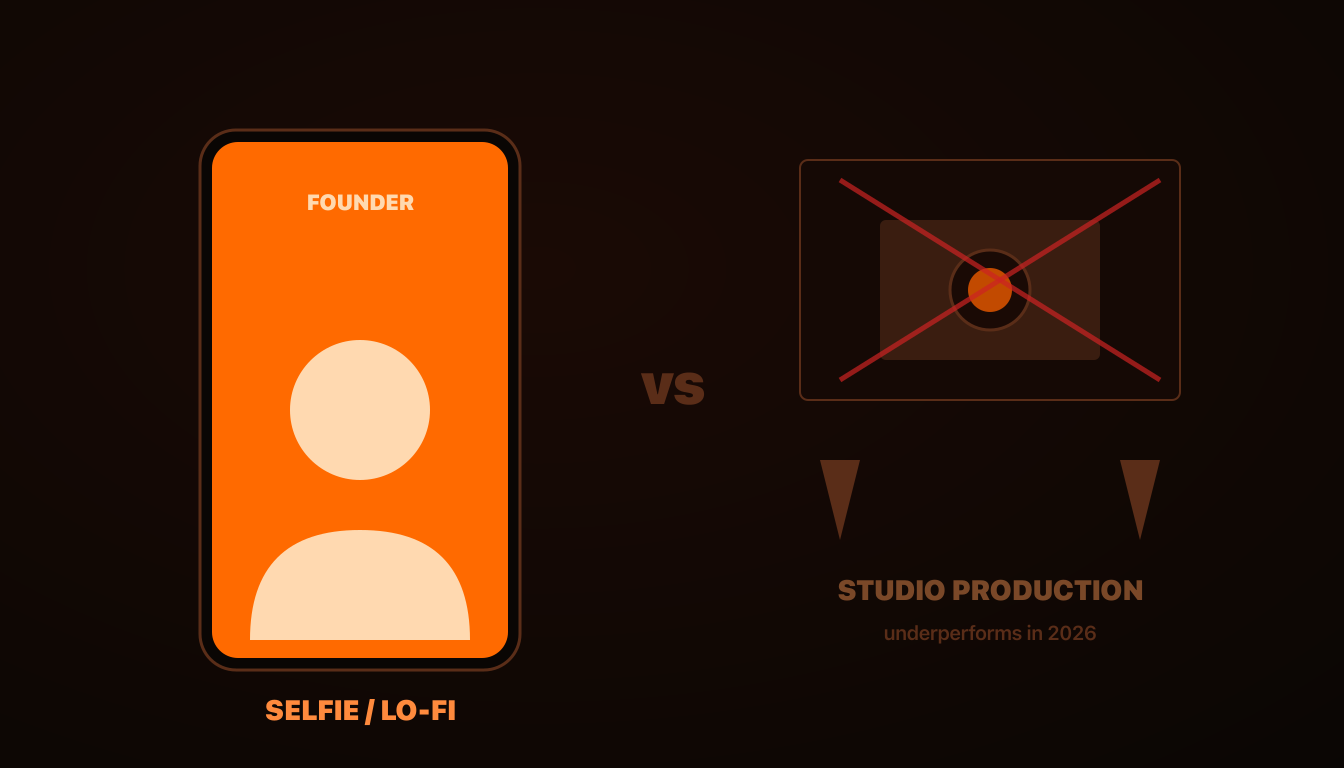
For most of 2024 and 2025, the conventional wisdom in DTC paid social was simple: UGC wins. Pay creators, brief them well, edit fast, scale what works. That playbook is still the right baseline. But in 2026, a new format has consistently outperformed UGC at the top of the funnel: founder-led selfie video.
In our 60-account DTC benchmark across beauty, supplements, food and beverage, and home goods, founder-led ads delivered 28% better prospecting CPA on average than the same accounts' UGC creator ads. The mechanism is straightforward: when the human who built the product is the human pitching it, trust compresses from a multi-touchpoint journey into a single moment of recognition.
Why Founder-Led Works In 2026
Three things changed between 2023 and 2026 that put founder-led ads back at the front of the format mix.
Trust erosion in UGC. As UGC creator ads became 47% of top-performing Meta DTC creative, users became sophisticated about identifying paid creators. The "she's reviewing a product, but she's clearly being paid to review it" recognition arrives faster every quarter. Founder-led video doesn't fight that pattern — it sidesteps it.
High-engagement creative. Founder-led ads tend to draw more comments than polished UGC. Those comments show early whether an ad is landing, and the questions people ask there are material for the next script.
Algorithmic preference for original creative. Meta's 2026 creative-fingerprinting penalizes repurposed and creator-pool stock. Founder ads are by definition unique — there's only one founder of your brand. The ad gets treated as fully original, with the delivery boost that comes with it.
The 5-Beat Founder-Led Script
High-performing founder-led ads follow a 5-beat structure that delivers the trust payload while keeping the runtime tight.
Beat 1 — Hook (0-3s). Open with a specific, contrarian, or curious statement. Not "Hi I'm the founder of X." Try "I started this company because I couldn't fix my own [problem]" or "Most [product category] companies are getting one thing wrong."
Beat 2 — Origin (3-10s). The specific moment or situation that made the founder decide to build the product. Concreteness wins: "Three years ago, I was up at 2am trying to fix my daughter's rash with nothing in the cabinet that worked" outperforms "I started this brand to help families."
Beat 3 — Problem (10-20s). What was broken about existing solutions and what the founder discovered when researching. This is the credibility beat — name the existing brands or category problems explicitly. Specificity is the proof.
Beat 4 — Product (20-35s). What was built, and the one or two ways it's different. Keep this short. The product is the answer to everything the previous three beats set up; if those beats land, the product description doesn't need to oversell.
Beat 5 — Ask (35-45s). "Try it. If it doesn't work, send it back" or "Tap below to see the ingredient list and decide for yourself." The CTA is permission to evaluate, not a sales push.
Production: Intentionally Rough
The biggest mistake brands make with founder-led ads is over-producing them. Lighting kits, professional sound, scripted teleprompter delivery — every layer of polish removes a layer of trust.
The production stack that consistently wins: founder's phone (vertical 9:16), single take with one or two retakes, natural light from a window, no microphone, minimal editing (subtitle burn-in, hook overlay, end card). Total production time: 30-45 minutes from idea to finished ad.
When teams test "high-polish founder ads" against this rough format, the rough format wins 70-80% of the time. The exceptions are categories like luxury beauty or premium home where the brand identity requires high production values throughout.
Founder-Led Versus UGC: When To Use Each
Founder-led and UGC are complements, not substitutes. The right mix depends on funnel stage and category.
Top of funnel, first-time prospecting: Founder-led wins for trust-led categories (beauty, supplements, food, tools). UGC wins for trend-led categories (apparel, accessories, lifestyle).
Middle of funnel, retargeting visitors: UGC wins almost universally. Founder ads at this stage feel repetitive.
Bottom of funnel, cart abandoners: Neither — use product demo / social proof / offer-led creative.
The right starting mix for a DTC brand in a founder-led-friendly category: 30-40% founder-led, 40-50% UGC, 15-25% studio/static.
Common Founder-Led Failure Modes
Scripting the founder. When the founder reads from a script, the conviction drops to zero. Use bullet-point talking points, not full scripts. The founder explanation script in our template set follows that rule: four timed beats with a prompt for each, not a word-for-word script.
Over-rehearsing. The third or fourth take is usually worse than the first. Lock the take when the conviction is highest, even if the delivery has small stumbles.
Hiding the founder's role. Some founders try to appear "just like a customer" in the ad. The format only works when the on-screen identification of "I built this" is explicit.
Polishing the audio. Studio-mic founder ads test worse than phone-mic founder ads in 70% of A/B tests. The audio authenticity is part of the trust signal.
Scale Founder-Led Production With AI Variants
AdRiseLab takes a single founder-led source recording and produces 15-30 hook and length variants for testing — different overlays, different opening seconds, different CTAs. You record once; we adapt for the testing pipeline. Get started with AdRiseLab.
Related Reading
See the first 3 seconds hook formulas for the hook beat that determines whether the founder ad gets watched at all. Read the UGC ads complete playbook for the format that founder-led pairs with. And understand the Andromeda algorithm for what Meta does and does not document about how ads are chosen for delivery.