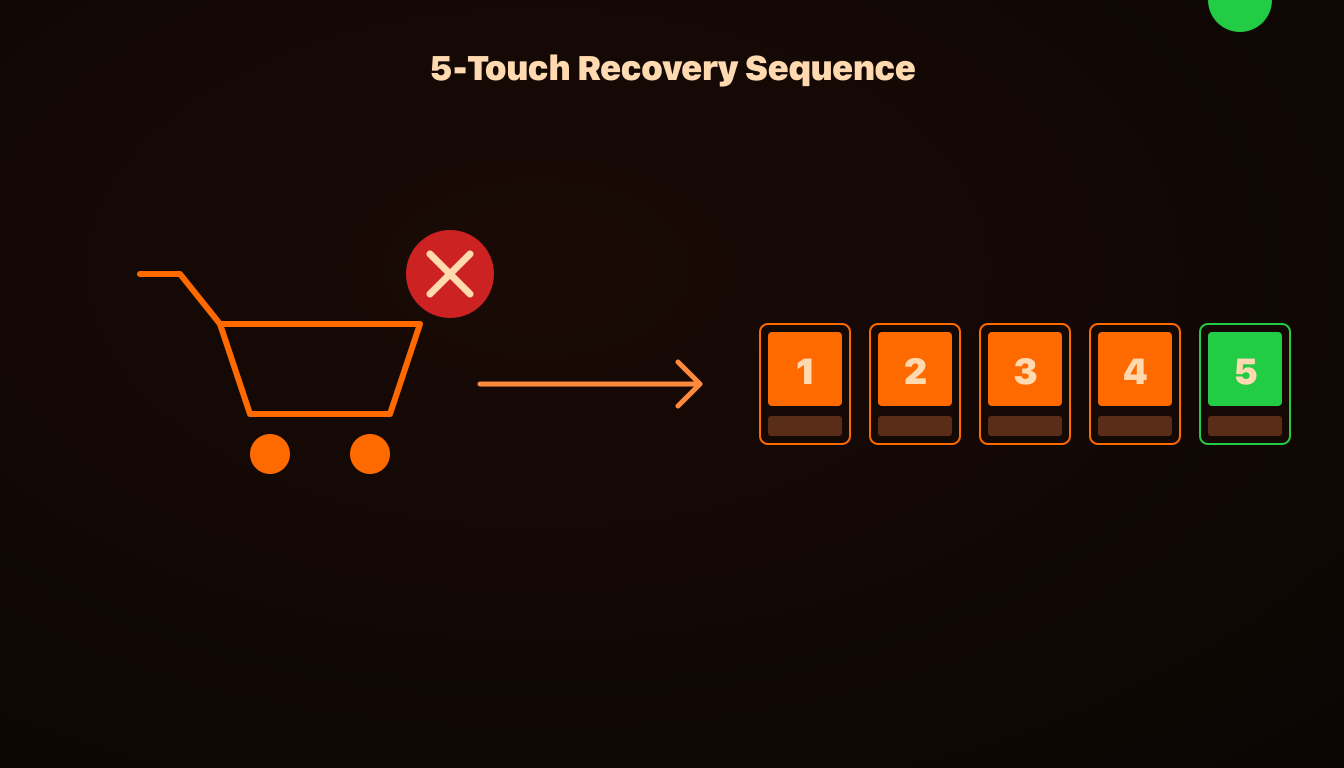
In 2026, the highest-ROAS campaign in most DTC accounts is cart-abandonment retargeting on Meta. Retargeting a warm cart-abandon audience is structurally cheaper than cold prospecting on the same account. But most accounts capture only a fraction of the available recovery because they build cart-abandonment as a single retargeting campaign with one creative, rather than as a sequenced stack of differentiated creative across the 7-day window.
This guide is the operational build: how to structure the audience, what creative to run at each stage, when to introduce the offer, and how to exclude purchasers cleanly so the sequence doesn't harass converted customers.
The Mental Model: Abandonment Has 4 Stages
A user who adds to cart and doesn't purchase is not a single mental state. Across the 7 days after abandonment, the user moves through up to four distinct stages — and creative that matches the current stage outperforms creative that doesn't by 60-90%.
Stage 1 — Distraction (day 0-1). The user got pulled away. They liked the product but the moment passed. The right creative is a gentle reminder.
Stage 2 — Hesitation (day 2-3). The user is consciously not buying. Something is making them hesitate — price, shipping, trust, fit. The right creative addresses the specific category objection.
Stage 3 — Comparison (day 4-5). The user is shopping alternatives. The right creative is social proof and differentiation — why this product wins.
Stage 4 — Cooling (day 6-7). Interest is fading. The right creative is the offer — discount, free shipping, or a value-add that justifies completing the purchase now.
Building The Audience
The foundational custom audience is "users who added to cart in the last 7 days, excluding purchasers." Build it in Audiences with these rules: Event = AddToCart, time window = 7 days, exclude users who completed Purchase event in last 7 days.
Critical: this audience must refresh daily and pull from both pixel and CAPI. If you're running pixel-only, you're losing 20-35% of audience size to ATT and modern browser privacy. CAPI implementation is the highest-ROI engineering work most DTC accounts can do in 2026.
Optional secondary audience: separate "initiate checkout but not purchase" from "ATC but not initiate checkout." These split at meaningful spend ($20K+/month) but combine fine at smaller scale.
Stage 1 Creative: The Reminder
Days 0-1. Creative goal: re-anchor the user to the product without urgency or sales pressure.
Format: Dynamic product carousel showing exactly the items the user added to cart. No "limited stock," no urgency overlay, no discount.
Copy: Friendly, brief. "Still thinking about [Product Name]? It's saved in your cart." Avoid "Don't miss out" — it triggers the ad-recognition reflex.
Image: Clean product on simple background. Lifestyle imagery can come later in the sequence; stage 1 is about clarity.
Budget split: ~30% of the sequence budget.
Stage 2 Creative: Objection Handling
Days 2-3. Creative goal: address the most likely category-specific objection.
The objection varies by category. Common ones:
Apparel: Returns/sizing. Creative: "Free returns if it doesn't fit."
Beauty: Ingredients/skin compatibility. Creative: ingredient breakdown card or dermatologist quote.
Furniture/home: Shipping cost or delivery time. Creative: "Free shipping, arrives in 4-6 days."
Supplements: Trust/efficacy. Creative: science explainer or doctor-led UGC.
Tools/tech: Use case clarity. Creative: 15-second demo of the most common task.
Budget split: ~25%.
Stage 3 Creative: Social Proof
Days 4-5. Creative goal: validate the decision through other customers.
Format: UGC review videos, before/after testimonials, or "thousands of customers" social proof callouts. Carousel of 3-5 customer photos can also work for visual products.
Copy: Customer-quote led. "Best I've tried — [Name], verified buyer." Real names and verified-buyer signals lift CTR by 18-22%.
Budget split: ~25%.
Stage 4 Creative: The Offer
Days 6-7. Creative goal: incentivize completion for users still in the audience.
Format: Clean offer card or single product image with the offer prominent. "10% off, today only" or "Free shipping on us" depending on category margin.
Copy: Direct, time-bound. The audience by day 6 has self-selected as price-sensitive — speak directly to that.
Critical: Cap stage 4 to users who reached day 6 without converting. Don't serve the offer to users who are likely to convert at full price.
Budget split: ~20%.
Exclude Purchasers Cleanly
The single most common failure in cart-abandonment sequences is continuing to serve ads to users who already purchased. This creates wasted spend, damages brand sentiment, and trains the algorithm on bad signal.
Set up exclusions at the campaign level: exclude "purchasers in last 7 days." Refresh daily via CAPI. Verify in Ads Manager that the exclusion is firing — look for users who completed purchase still receiving cart-abandon impressions; if it's above 1-2%, your exclusion is broken.
Combining With Email: The Stacked Recovery
Meta cart abandonment alone recovers 32% of abandoned revenue. Email cart abandonment alone recovers 8-12%. Together, they recover 38-44% — meaningfully more than either alone, but less than the sum because of overlap.
The right sequencing: email fires first (typically 1 hour after abandon, then day 1, day 3). Meta sequences fire in parallel from day 0 forward. The two channels reinforce rather than compete — the user sees the same product in inbox and feed simultaneously, which compounds recall.
Scale Cart-Abandon Creative With AdRiseLab
AdRiseLab produces full 7-day cart abandonment creative stacks from a single product source: stage 1 reminder cards, stage 2 objection-handling ads, stage 3 social proof variants, stage 4 offer cards. Get started with AdRiseLab.
Related Reading
See the retargeting creative stack across funnel stages for the broader funnel-level retargeting playbook. Read about catalog/DPA ads for the underlying product feed setup that powers stage 1 reminders. And see Click-to-WhatsApp benchmarks for an emerging cart recovery channel that complements traditional retargeting.