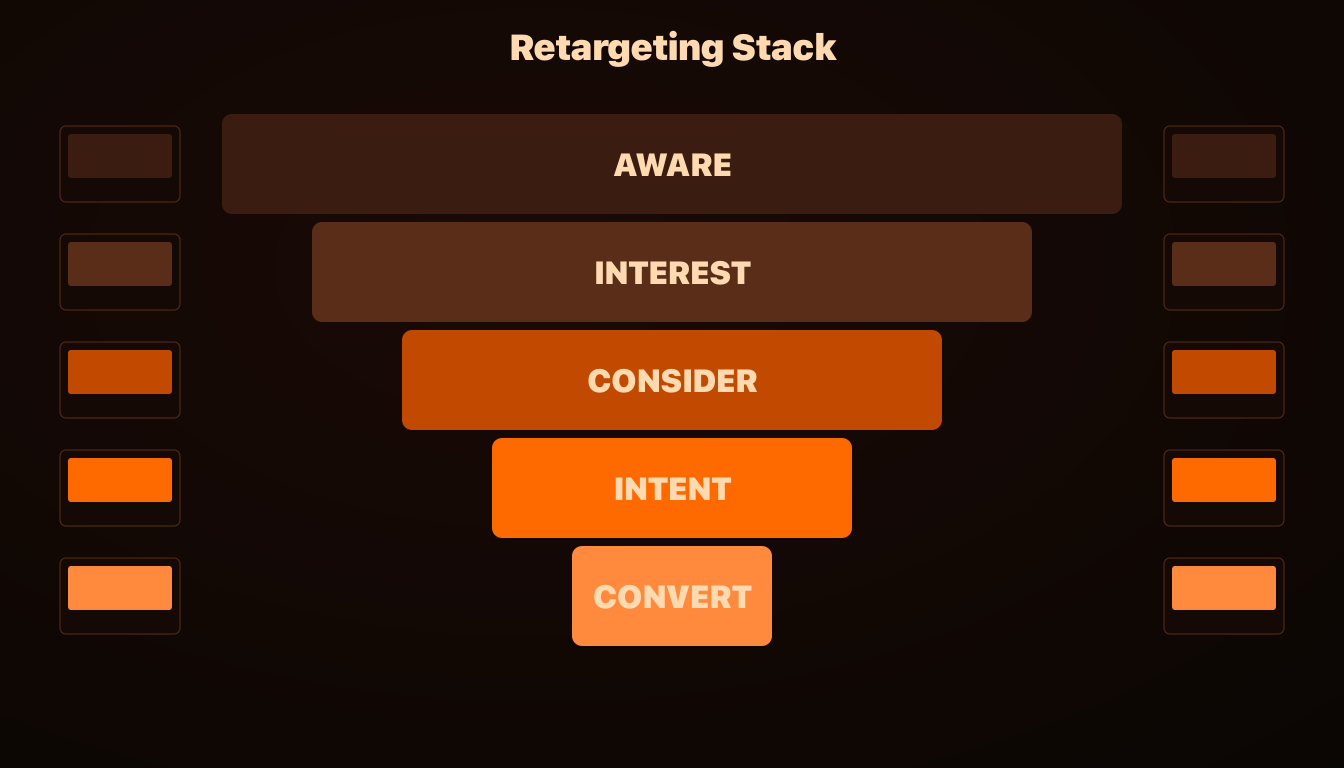
Retargeting is the highest-ROAS spend in almost every Meta account we audit, and almost every account underuses the lever. The mistake is rarely budget allocation — most accounts spend roughly the right share on retargeting. The mistake is creative-audience fit: serving the same creative to a 30-day page viewer that they'd serve to a day-2 cart abandoner.
This guide is the 2026 stage-by-stage retargeting creative stack: who's in each audience, what creative actually moves them, how long the window should be, and what budget share each stage should get.
Why The Standard "One Retargeting Campaign" Loses 40-70% ROAS
A 30-day page viewer is in a completely different mental state from a day-2 cart abandoner. The page viewer needs reasons to care; the cart abandoner needs reasons to act. When you serve both audiences the same creative, the creative is too soft for one and too pushy for the other. The result is 40-70% lower retargeting ROAS than a stage-matched stack delivers.
The fix isn't complicated — it requires running 5 distinct retargeting campaigns (or 3 at lower spend) with differentiated creative. The complexity overhead pays back within 7-14 days for any account spending $5K+/month on Meta.
Stage 1: Page Viewers (Educational)
Audience: 30-day pixel/CAPI page viewers, excluding purchasers and current cart abandoners.
Mental state: Mildly curious. Visited at least one page, didn't engage with a product enough to ATC.
Creative role: Educate on the brand and the category. This is where founder-led content, category-positioning videos, and "why we exist" creative work hardest.
Specific formats: Founder-led selfie video, brand origin story, category education ("Why most [category] products miss the point").
Window: 30 days. Budget share: 25-30% of retargeting spend.
Stage 2: Engagement Audiences (Social Proof)
Audience: 60-90 day engagers on your Instagram/Facebook page who haven't visited the site.
Mental state: Aware of the brand, has consumed organic content, not yet a buyer.
Creative role: Convert latent brand interest into product interest. Social proof is the lever — show that other people like them buy and use the product.
Specific formats: UGC creator reviews, customer testimonial carousels, "1000+ five-star reviews" social-proof callouts.
Window: 60-90 days. Budget share: 15-20%.
Stage 3: ATC Abandoners (Objection + Reminder)
Audience: 7-day ATC, excluding purchasers and 7-day checkout abandoners (those go to stage 4).
Mental state: High intent, blocked by a specific objection.
Creative role: Address the most likely category objection and remind them of the specific product they liked.
Specific formats: Cart abandonment 7-day sequence — reminder day 0-1, objection day 2-3, social proof day 4-5, offer day 6-7. Dynamic Product Ads showing the actual cart contents.
Window: 7 days. Budget share: 20-25%.
Stage 4: Checkout Abandoners (Offer + Reassurance)
Audience: 7-day initiate checkout but not purchase.
Mental state: Very high intent, blocked typically by payment, shipping, or last-second doubt.
Creative role: Reassurance + sometimes a small offer. Free shipping, money-back guarantee, "secure checkout" callouts.
Specific formats: Clean product cards with shipping/guarantee callouts, brief explainer of return policy, occasional small offer (5-10%) capped at users still in audience after day 4.
Window: 7 days. Budget share: 15-20%.
Stage 5: Lapsed Customers (New Launch + Loyalty)
Audience: Past purchasers who haven't bought in 90-180 days.
Mental state: Lapsed but warm — they know the brand and (probably) liked the product.
Creative role: Show new products, share new launches, or activate loyalty/restock messaging.
Specific formats: "New from [Brand]," "Your [product] is probably due for a refill," loyalty tier upgrades, friends-and-family referral asks.
Window: 90-180 days. Budget share: 15-20%.
Audience Exclusions: The Stack Logic
The 5 stages should be mutually exclusive. Each campaign excludes the audiences of the more-intent stages, so a single user only sees one stage of creative at a time.
Stage 5 (lapsed) excludes everyone. Stage 4 (checkout abandon) excludes purchasers in 7 days. Stage 3 (ATC) excludes purchasers and checkout abandoners. Stage 2 (engagement) excludes everyone in stages 3-4-5 and 30-day visitors. Stage 1 (page viewers) excludes everyone deeper. Set up these exclusions at campaign creation; don't rely on Meta's default overlap deduplication.
When To Use 3 Stages Instead Of 5
For accounts spending under $20K/month on Meta, the 5-stage stack creates audiences too small to optimize. Consolidate to 3 stages: visitors (combines stages 1-2), cart funnel (combines stages 3-4), lapsed (stage 5). You give up some performance precision but gain audience size — the right trade-off below $20K spend.
Creative Refresh Cadence
Refresh stage 1-2 creative every 4-6 weeks (founder ads, brand stories — these age slower). Refresh stage 3-4 creative every 2-3 weeks (high-frequency exposure makes them fatigue faster). Refresh stage 5 creative monthly tied to launch cycles.
Scale Multi-Stage Retargeting Creative With AdRiseLab
AdRiseLab produces creative variants for each retargeting stage from a single product source — page viewer education, engagement social proof, cart-abandon reminders, checkout reassurance, lapsed-customer loyalty cards. Get started with AdRiseLab.
Related Reading
See cart abandonment 7-day sequences for the deeper stage 3-4 build. Read about catalog/DPA ads for the product feed setup that powers retargeting at scale. And explore Andromeda algorithm for why creative-audience fit matters even more in 2026 than in prior years.