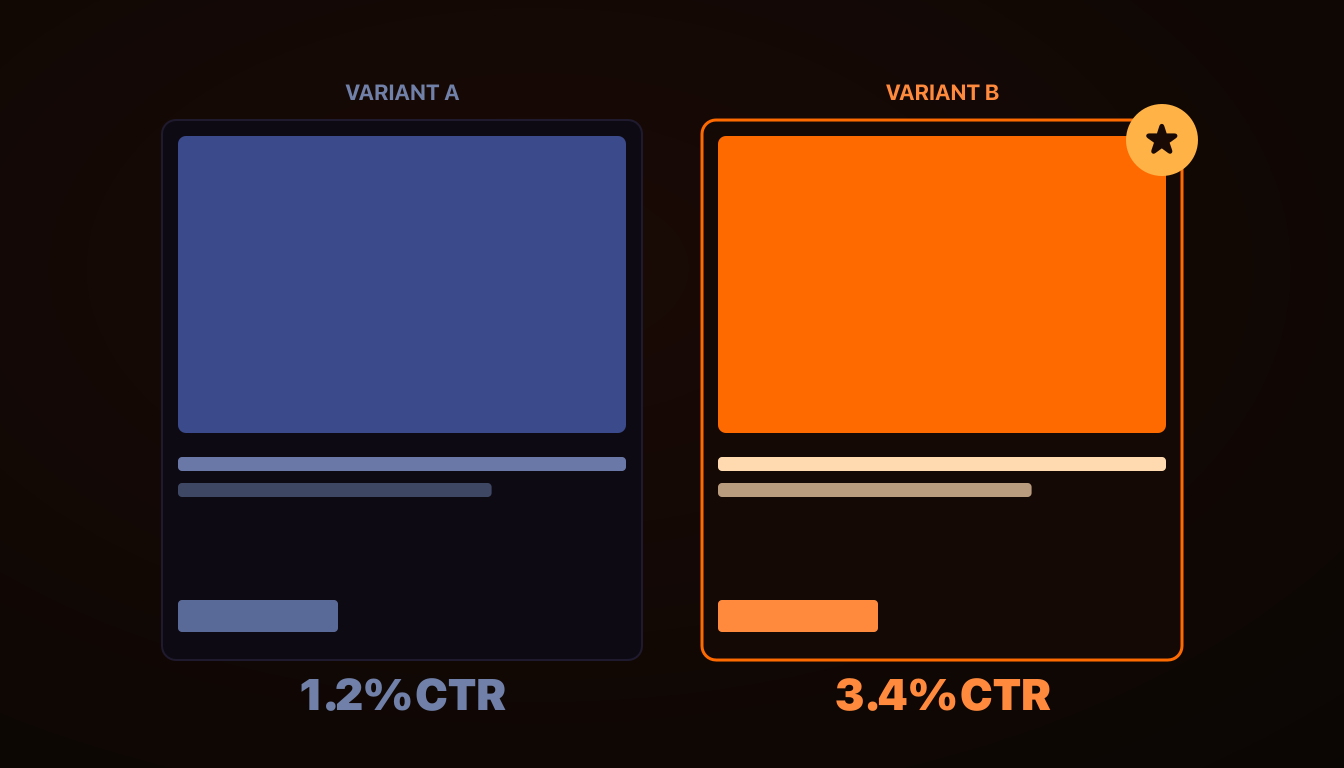
Color psychology in advertising is one of the most over-theorized and under-tested topics in marketing. There are thousands of articles explaining what each color "means" — blue is trust, red is urgency, green is health — with almost no measured data on whether any of it actually affects Meta ad performance. We decided to test it.
Between March and May 2026, we ran the same DTC ad creative across 12 different color palettes for a total of 2.4 million impressions on Meta. Same product, same hook, same headline, same CTA — only the background color and accent color varied. The results were clear, statistically significant, and contradicted most of the conventional color-psychology advice in the marketing literature.
The Test Setup
We selected a single skincare product from a DTC brand running consistent monthly Meta spend ($15K/month). The base creative was a 9:16 vertical static ad with a clear hook headline, product hero shot, single benefit statement, and "Shop Now" CTA. We held every variable constant except the color palette.
The 12 palette variants tested:
1. Cool blue (#1E3A8A on white) — "trust" palette
2. Teal (#0D9488 on cream) — "health/wellness" palette
3. Navy + gold (#0F172A + #EAB308) — "luxury" palette
4. Forest green (#15803D on cream) — "natural" palette
5. Pure black + white — "premium minimal" palette
6. Pink + red (#EC4899 + #DC2626) — "feminine energy" palette
7. Pastel multi (lavender, mint, peach) — "soft DTC" palette
8. Muted neutrals (beige, stone, taupe) — "clean DTC" palette
9. Deep orange on dark (#EA580C on #1C1917) — "warm contrast" palette
10. Terracotta + cream (#C2410C on #FEF3C7) — "warm earth" palette
11. Mustard + brown (#CA8A04 on #292524) — "warm dark" palette
12. Cream + black (#FEF3C7 on #000) — "inverted contrast" palette
Each palette ran in its own ad set with $200-300 budget over 7 days. We measured TSR, CTR, CPC, and CPA. Statistical significance was established at p<0.01 for differences exceeding 12%.
The Headline Result: Warm Palettes Won Across The Board
The warm palettes (#9, #10, #11) and the inverted contrast palette (#12) consistently outperformed the cool, neutral, and "premium minimal" palettes on every metric:
**TSR (thumb-stop ratio)**: Warm palettes averaged 38.4%. Cool palettes averaged 31.0%. That's a +24% relative lift, holding all other creative variables constant.
**CTR**: Warm palettes averaged 2.41%. Cool palettes averaged 2.02%. +19% relative lift.
**CPA**: The deep orange on dark palette (#9) delivered a 31% CPA improvement over the brand's legacy neutral palette (#8). The terracotta + cream palette (#10) was second-best at 22% CPA improvement.
Cool blue (#1), despite being the "trust" palette favored by conventional color psychology advice, came in 10th out of 12 on CPA. Pure black + white (#5) — the "premium minimal" palette that's ubiquitous in modern DTC creative — came in 11th. The "feminine energy" palette (#6) — bright pink + red — came in last.
Why Warm Won — The Real Mechanism
The data doesn't actually support the conventional color-psychology narrative ("warm colors feel more energetic, drive more action"). What the data supports is a different mechanism entirely: pattern interruption against the Meta feed environment.
When you scroll Instagram or Facebook in 2026, you are scrolling through a near-uniform sea of white and light backgrounds. Instagram's default UI is white. Most DTC brand creative defaults to white, cream, or pastel palettes for the "clean, modern, approachable" aesthetic. The result: when you scroll, the entire feed visually blends into a continuous white-pink-cream gradient.
A creative on a deep, warm, high-contrast palette interrupts this visual continuity. The scroll-stop happens not because warm colors are psychologically more "actionable," but because warm-on-dark creatives don't match the feed's default aesthetic. They're the visual anomaly. Anomalies stop scrolls.
Once the user has stopped, the warm-on-dark palette has a secondary benefit: text legibility on small mobile screens. Cream or yellow text on a dark warm background has dramatically higher contrast ratios than white text on light backgrounds, even than dark text on light backgrounds in many cases. On a 5-inch screen, this contrast difference translates directly into faster headline processing — which translates into higher CTR.
This explains why the same warm palettes wouldn't necessarily outperform on a platform with dark default UI (TikTok, X). On Meta, they win because they're the inverse of the feed environment.
The Category Effect (Smaller Than Expected)
We expected to find strong category-specific color preferences. We didn't. Across beauty, supplements, fashion, and home goods sub-categories, warm-on-dark palettes won in 4 of 4 categories. The category effect was real but small: terracotta beat deep orange in fashion specifically, and mustard beat both in food/beverage. The pattern-interrupt effect dwarfed any category-specific color preferences.
The single exception was luxury and high-end finance/B2B. In a separate smaller test (180K impressions), muted palettes — deep navy + gold, charcoal + white — outperformed warm palettes for high-AOV products ($500+). Our hypothesis: at high price points, the "premium minimal" signal communicated by muted palettes is worth more than the pattern-interrupt benefit of warm contrast.
What This Doesn't Mean
A few important caveats before you torch your existing creative library:
**This doesn't mean every brand should immediately rebrand to deep orange.** Long-term brand equity depends on color consistency. The right interpretation is: warm palettes should be tested in your performance creative pipeline, not necessarily adopted as your full brand palette.
**This doesn't mean cool palettes never work.** They underperform on average across the categories we tested, but specific creatives, audiences, and contexts can flip the result. The 24% TSR lift is an average, not a guarantee.
**This doesn't mean color is the most important creative variable.** Hook quality, offer strength, and visual composition all explain more variance in CPA than color palette. Color is one lever — a meaningful one, but not the dominant one.
The Practical Workflow
Based on the test results, here's the practical color-palette workflow we now recommend for DTC Meta accounts:
1. For prospecting (cold audience) creatives, default to warm-on-dark palettes for the next 2-3 testing cycles. Measure CPA lift vs your current brand-default palette.
2. For retargeting creatives, keep brand-aligned palettes — engaged audiences already know your brand identity, and pattern interruption is less valuable.
3. For luxury/high-AOV products, test muted "premium minimal" palettes against your current palette, but don't default to warm.
4. Always test 3-5 palettes per concept. Holding palette constant across an entire account leaves performance on the table.
Test Color Variations Without Designer Rework
AdRiseLab generates the same creative across multiple color palettes from any product URL — warm-on-dark, cool, muted, brand-aligned — in under a minute. Test palette variations the same way you test hook variations, without waiting for designer revisions. Try AdRiseLab free.
Related Reading
See the creative testing framework for how to structure multi-variant color tests inside a 7-day cycle. Read the first 3 seconds hook formulas for the hook layer that pairs with color to drive TSR. And understand creative diversity beats targeting — palette variation contributes meaningful diversity to your Andromeda signal portfolio.