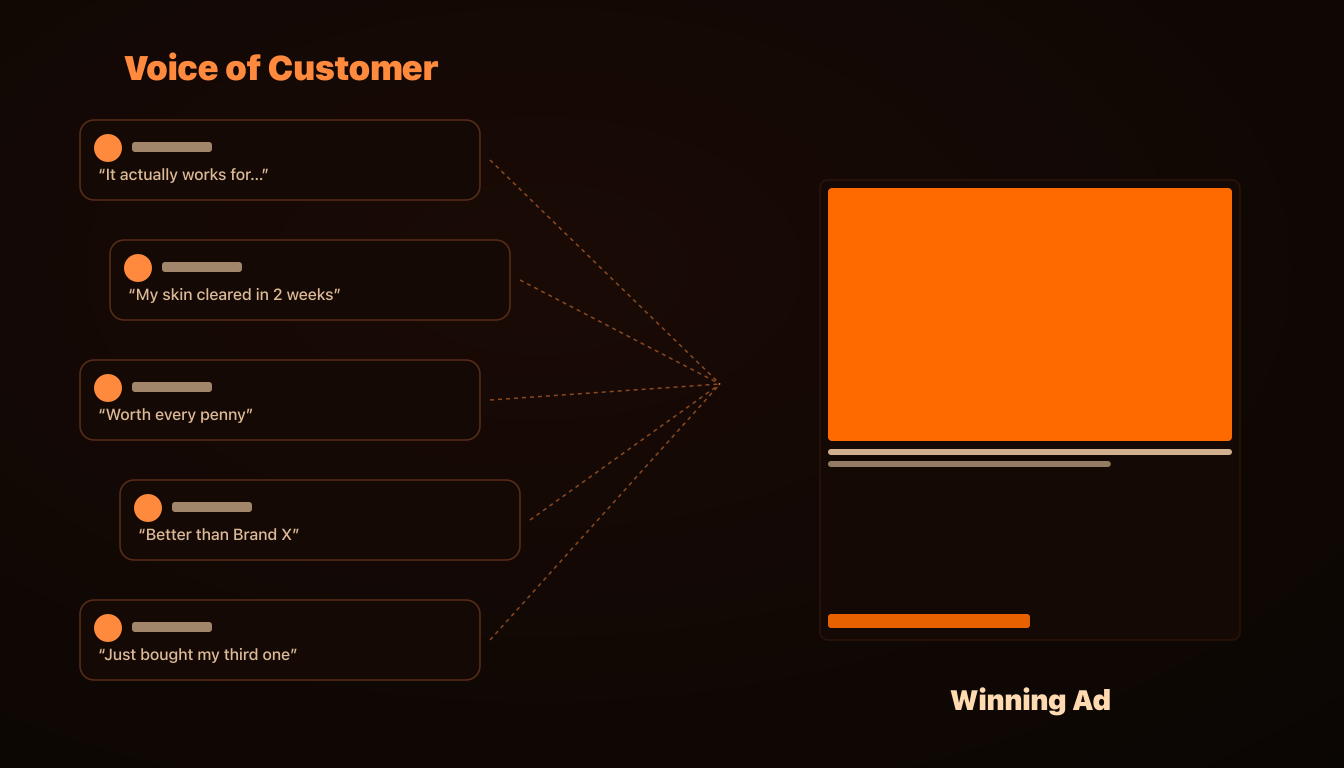
The single biggest gap in most DTC paid social programs in 2026 is that the copy is written by marketers, not customers. Marketers write copy that sounds like marketing. Customers write copy that sounds like the actual experience of using the product — and that's what other prospective customers actually respond to. Copy lifted from what customers actually wrote consistently reads less like an ad than copy a marketer drafts from scratch.
This guide is the operational workflow for mining voice-of-customer language and turning it into Meta ads that convert. Total time investment for a sustained program: about 6 hours per week. The ROI is among the highest of any single creative-process change you can make.
The Four Sources
Voice-of-customer signal is spread across four channels in your business. Each has different qualities.
1. Long-form product reviews. 5-star reviews with text longer than 50 words are the gold standard. They explain *why* the customer loved the product, in their own words. Pull from your DTC site's reviews (Yotpo, Stamped, Okendo), Amazon if you sell there, and any third-party review platforms relevant to your category.
2. Ad comments on top-performing existing creative. Comments on your highest-CTR ads in Meta Ad Manager are extremely valuable — they reveal what the ad triggered in the user (objection, aspiration, surprise) and the exact language that surfaces those reactions.
3. Customer support tickets. The unhappy version of VoC. Equally valuable because it surfaces objections and confusion that you can address pre-purchase in ad copy.
4. DMs and post-purchase survey responses. Often the most candid VoC because users are unfiltered. Post-purchase survey question that consistently delivers gold: "What almost stopped you from buying?"
The Distillation Workflow
Raw VoC is unusable as-is — you can't copy-paste a 200-word review into a 6-word hook. Distillation is the engine that converts raw VoC into ad-ready copy.
Step 1 — Collect. Export 100-300 VoC excerpts from the four sources above. Stick to the top 5-star and top-CTR sources for the first pass.
Step 2 — Tag for emotion and outcome. For each excerpt, identify the dominant emotion (relief, surprise, pride, validation, joy) and the dominant outcome (specific result, specific use case, specific benefit). Tag with short labels: "first-thing-that-worked," "skin-soft-3-days," "saved-pharmacist-trip."
Step 3 — Cluster. Group excerpts by tag. The top 3-5 most-repeated emotion/outcome clusters are your VoC themes. These are the angles your ads should be built around.
Step 4 — Extract hooks. For each cluster, pull the 3-5 most-specific, most-natural-language excerpts. These become hook candidates — either quoted verbatim ("The first thing I've tried that actually worked") or near-quoted with light editing.
What Makes VoC Hooks Win
Three properties distinguish VoC hooks that win on Meta from VoC hooks that don't.
Specificity. "Made my skin feel soft in 3 days" outperforms "Made my skin feel great" by 60-100% in our hook tests. Specific outcomes are more credible than vague ones because they sound like actual reports, not marketing.
Surprise. VoC hooks that capture an *unexpected* outcome (the customer's "I didn't think it would work but...") outperform expected-outcome VoC hooks by 30-50%. The surprise is the trust signal.
Use-case framing. VoC hooks tied to a specific use case ("Use it before I see clients" or "Pack it for travel") outperform generic ones because they implant a use occasion in the prospect's mind.
Common VoC Mistakes
Cherry-picking one quote. A single brilliant review doesn't make a creative angle — patterns across many reviews do. The "I quoted the best review" mistake skips distillation and yields hooks that test no better than marketer-written copy.
Editing too much. When you sand the customer's actual language into "cleaner" marketing language, you destroy the trust signal. Keep the small awkwardness — that's the proof of authenticity.
Skipping comments. Most teams mine reviews and stop there. Ad comments are equally valuable and update much faster — they tell you what's landing in real-time.
One-time mining. VoC themes shift across seasons. Mining once and treating the output as durable for a year leaves the most valuable freshness on the table.
The 6-Hour Weekly VoC Workflow
A sustained VoC pipeline takes about 6 hours per week. Here's how to structure it:
Monday (2h): Pull the week's new reviews and top ad comments into a working doc. Run through them once with quick tagging.
Wednesday (2h): Cluster the new entries with the prior 6-week corpus. Identify any new emergent themes — usually 0-2 per week, but they're where the next winning angles come from.
Friday (2h): Draft 5-10 hook candidates from the dominant clusters, ship 3-5 as A/B tests against current best performers in Meta.
Scale VoC Creative Production With AdRiseLab
AdRiseLab takes your VoC corpus and produces ad-ready variants — quoted-review carousels, VoC-led video hooks, customer-language static ads — at the pace your testing pipeline can consume. Get started with AdRiseLab.
Related Reading
See the 12 hook formulas for the hook structure VoC content plugs into. Read about A/B testing on Meta for the visual layer that pairs with VoC copy. And explore the UGC ads playbook for the creator format that delivers VoC-style content at scale.