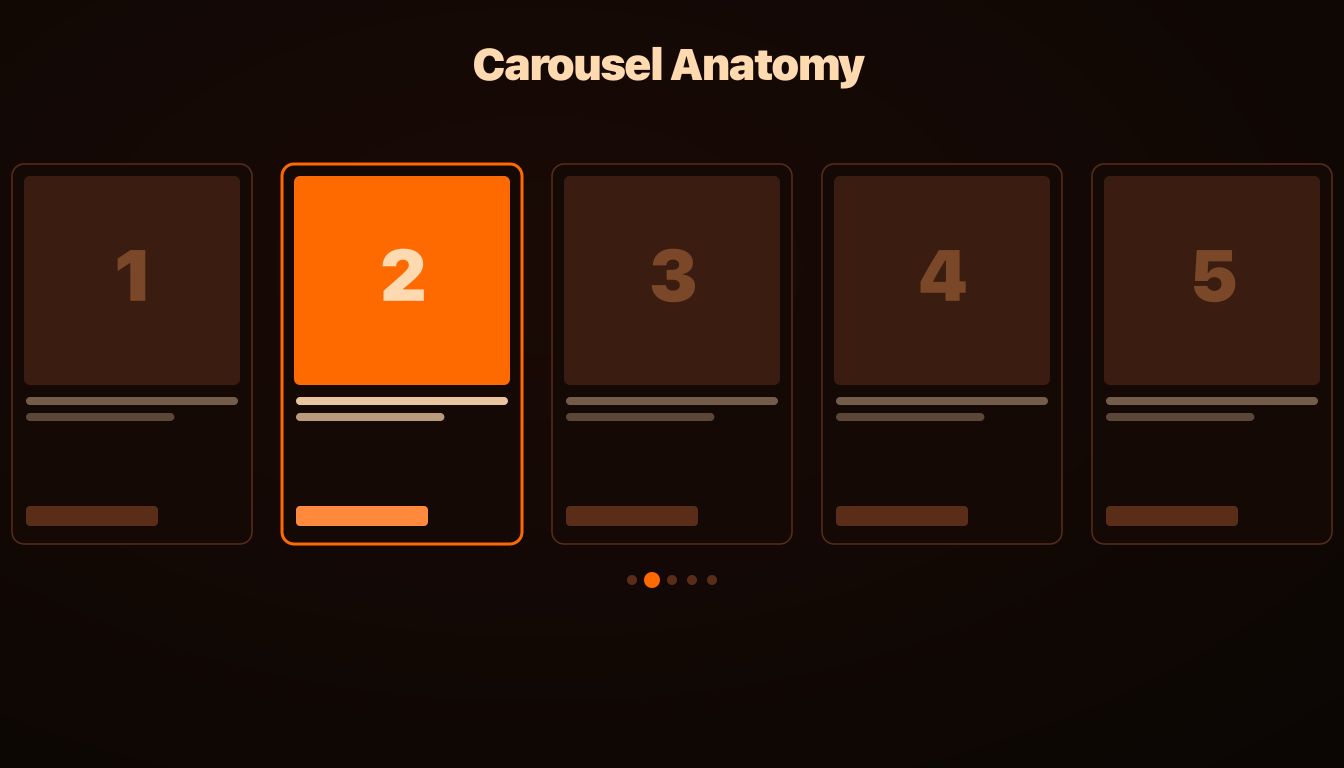
Meta carousel ads were declared dead at least twice in the past three years. They're not. In 2026, well-designed carousels are quietly outperforming single-image ads in DTC categories with multi-feature products — but only when the card sequence follows a specific anatomy. This guide breaks down what that anatomy looks like card-by-card, with benchmarks for swipe rate, completion rate, and CTR contribution at each position.
Why Carousels Still Matter In 2026
The case for carousels comes down to information density per impression. A single-image ad gives you one frame to deliver hook + value + CTA. A 5-card carousel gives you five frames — each engineered for a specific job in the conversion sequence. For products that need to communicate 3+ features or benefits before a viewer is ready to click, the carousel format is structurally better suited than single-image.
Across our 320-ad analysis of DTC accounts running both formats in parallel, 5-card carousels averaged 27% higher CTR than the same brand's single-image ads. The lift was consistent across beauty, supplements, home goods, and apparel categories. For categories with one-feature simplicity (like food snacks or single-use accessories), single-image still wins. Carousel ads are not universally better — they're better for the specific job of multi-feature storytelling.
Carousels also collect interest that never becomes a click: a viewer can swipe through 4 cards and leave without tapping. Design for that viewer too, but judge a carousel on clicks and conversions like any other ad, and use the card-by-card tests below to find which card does the work.
The 5-Card Anatomy
Carousels that work tend to follow the same card-by-card sequence across industries. Here's the anatomy, card by card.
Card 1: The Hook
Design card 1 to stand on its own, because a viewer may not continue through the sequence. Its job is single-purpose: stop the scroll and create enough curiosity to make the swipe-to-card-2 feel worth the micro-effort.
Hook cards that work: a striking visual with bold contrasting text (3-5 words max), a specific surprising statistic, a before/after visual, a contrarian statement that immediately signals a non-default opinion. Hook cards that fail: full product shot with the brand name, a generic lifestyle image, a polite headline like "Introducing X." If card 1 looks like every other ad in the feed, the user never sees cards 2-5.
Card 2: The Problem
Card 2 is where the highest swipe-out rate occurs. About 54% of users who swipe past card 2 will complete the full carousel; the other 46% drop off here. The job of card 2 is to validate the implicit promise made by card 1 — to convince the viewer that the hook wasn't a bait-and-switch and that the next 3 cards will deliver value.
The most effective card 2 design names the specific problem your product solves, in language that mirrors how your customer would describe it. "Hair that's damaged from heat styling" beats "Repair your hair." "Your CPM doubled in 6 weeks and you don't know why" beats "Optimize your ads." Specificity creates recognition; recognition creates commitment to keep swiping.
Card 3: The Solution
Card 3 is where you reveal your product as the answer to the problem named in card 2. This is the card where most teams over-design — they cram in 4-5 features, multiple images, and dense copy. That kills card 3 effectiveness. The cleanest, highest-converting card 3 designs show the product in use with a single, scannable headline naming the core mechanism. "Ceramide complex that rebuilds the hair shaft from inside" works. "Premium hydration system with 12 active ingredients" doesn't.
Placing a single video on card 3 rather than card 1 can work because by that point the user has invested in the swipe and is more willing to wait the extra second for video load.
Card 4: The Proof
Card 4 transitions from claim to evidence. The user has now seen the hook, problem, and solution. Card 4's job is to give them permission to believe the claim by stacking proof: customer reviews, before/after photos, press mentions, certifications, large user counts, clinical results. The format is usually a quote card with a strong attribution, or a multi-image testimonial layout.
Card 4 underperforms most often when it tries to be a second solution card — listing more features instead of providing third-party validation. The viewer has already accepted that your product does something; what they need now is reason to trust the claim. Proof, not more product information.
Card 5: The CTA
Card 5 is the final push. It should contain a low-friction call to action, a sense of urgency or scarcity (real, not manufactured), and a final benefit reminder. The CTA copy should be specific: "Shop The Set" and "Get Free Shipping On First Order" both give the user a concrete next step in a way "Learn More" does not.
Counterintuitively, card 5 often performs better when it doesn't have a strong visual — a clean text-on-background card with a single bold CTA button outperforms heavily-designed final cards. By this point in the sequence, the user has been visually engaged for 4 cards; card 5's job is to convert, not to visually impress.
Swipe-Through Math: Where Users Drop Off
Do not assume every viewer reaches the final card. Put enough context and a useful next step on the opening card, then use later cards to add proof or detail. This guide does not establish a card-completion rate or a conversion advantage over single-image ads.
The largest single drop (47% → 31% between cards 2 and 3) is where most carousel optimization effort should focus. Card 2 quality directly determines how many users get to see your solution, proof, and CTA. Investing 50% of your creative effort into cards 1 and 2 — and 30% into card 3 — produces the highest ROI on your carousel design budget.
When To Use Carousels (And When To Skip Them)
Use carousels when: your product has 3+ features or benefits that require sequenced explanation, your category requires before/after or transformation storytelling, you're running prospecting (cold audience) campaigns where building belief takes more than one image, or you have strong customer testimonials and proof assets that deserve dedicated cards.
Skip carousels when: your offer is simple enough to land in a single image (BOGO discount, single-feature product, time-limited promotion), you're running retargeting where users already know the product and need a fast nudge, or your creative team can't produce 5 distinct cards — a poorly-designed carousel underperforms a well-designed single image every time.
How To Test Carousel Variations
Test carousel variations by holding the structure constant (5-card Hook → Problem → Solution → Proof → CTA) and varying one card at a time. Most teams over-vary, testing 5 entirely different carousels at once and learning nothing about what drove the difference. The cleaner approach: lock cards 2, 3, 4, 5; test 3-5 different hook cards. Then lock the winning hook; test 3-5 different problem cards. And so on.
This isolates the contribution of each card position to overall CTR. Within 3-4 testing cycles you'll have a fully optimized 5-card sequence with statistical confidence in each component, rather than a winning carousel you can't replicate because you don't know which card was responsible.
Generate 5-Card Carousels From Any Product URL
AdRiseLab generates structured 5-card carousel sequences from any product URL in under a minute — each carousel built around the Hook → Problem → Solution → Proof → CTA anatomy with auto-generated copy and visuals for each card. Ship 3-5 carousel variations the same day, test on $50/each over 72 hours, scale the winner. Get started with AdRiseLab.
Related Reading
See the first 3 seconds hook formulas for the engineering behind effective card 1 designs. Read the creative testing framework for the 7-day test cycle that works for carousel variants. And read how creative variety and targeting work together — a carousel can carry several angles in one ad, which a single image can't.