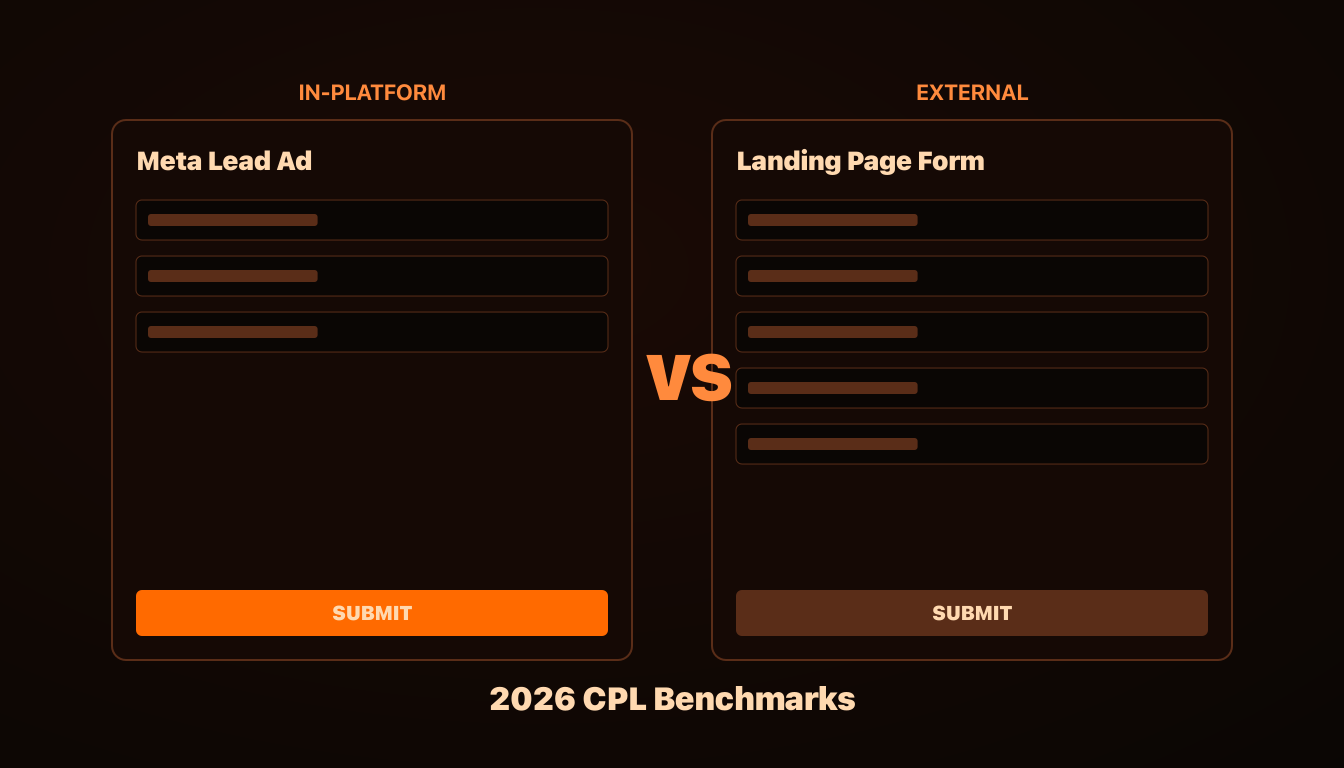
For B2B and local lead generation on Meta, the question of whether to use Meta Lead Ads or drive to landing page forms is one of the most frequent and most contested decisions. The conventional wisdom alternates between "Lead Ads are cheap but trash" and "landing pages convert higher but cost more." The reality in 2026 is more nuanced — and the right answer for your business depends on three specific variables we'll walk through.
What Each Format Actually Is
Meta Lead Ads are an in-platform ad format where the lead capture form opens directly inside Facebook or Instagram. When a user taps the CTA, Meta opens a pre-filled form with their name, email, and phone number sourced from their profile. The user confirms or edits and submits — total interaction time averages 4.2 seconds per Meta's internal data. The lead is then captured by Meta and pushed to your CRM (via native integration or webhook).
Landing page forms are the traditional flow: ad clicks send the user to your website, where they fill out a form with whatever fields you require, then submit. The user typically sees additional content (case studies, testimonials, pricing, FAQ) before or alongside the form. Total interaction time averages 47 seconds for users who complete, with 60-75% of clicked users abandoning before submission.
The structural difference: Lead Ads optimize for completion rate; landing pages optimize for qualification depth.
The 2026 Benchmark Data
From our 80-account benchmark of B2B and local advertisers running both formats in parallel during Q1-Q2 2026:
Cost per lead (CPL): Meta Lead Ads averaged $14.20. Landing page forms averaged $24.60. That's 42% lower CPL for Lead Ads.
Lead-to-MQL conversion: Lead Ads averaged 38%. Landing page forms averaged 64%. That's a 41% lower MQL conversion rate for Lead Ads.
Effective cost per MQL: Lead Ads delivered MQLs at $37.40 each. Landing page forms delivered MQLs at $38.40 each. Within 3% of each other.
That last number is the key insight: when you adjust for lead quality, the cost-per-actually-useful-lead is nearly identical between formats. The CPL advantage of Lead Ads is mostly absorbed by the qualification gap. This means the choice between formats is rarely about cost efficiency — it's about operational fit.
The Three Variables That Decide The Right Format
1. Sales cycle length
For sales cycles under 7 days (local services, e-commerce, simple B2B SaaS), Lead Ads win. The faster decision means lead freshness matters more than qualification depth — a "kind of qualified" lead today beats a "perfectly qualified" lead in 3 days.
For sales cycles over 30 days (enterprise B2B, high-AOV services, complex SaaS), landing page forms win. The longer cycle means deeper qualification at the lead stage pays off in reduced wasted sales effort downstream. The 4× higher MQL conversion rate offsets the higher CPL.
2. Lead handling capacity
If your sales team can handle 100 leads/week, you might prefer 80 high-quality landing page leads over 200 mixed-quality Lead Ad leads. The Lead Ad volume creates operational drag — qualifying calls, disqualification emails, CRM data hygiene.
If your sales team can handle 500 leads/week with automated qualification (drip sequences, lead scoring, BDR triage), Lead Ads win because volume × velocity beats hand-qualified depth.
3. CRM integration speed
Lead Ads only win when leads route to your CRM in real-time and trigger immediate response (ideally within 24 hours, optimally within 1 hour). Lead Ad leads decay faster than landing page leads — by 48 hours, response rates drop 60-70%. If your integration is manual ("we export leads weekly") or delayed, Lead Ads lose most of their advantage.
When Lead Ads Win Clearly
Lead Ads are the right choice when: you're running local services (HVAC, dental, home services, real estate, legal), top-of-funnel lead generation (newsletter signups, ebook downloads, webinar registrations), automotive (test drive bookings, dealer inquiries), or volume-driven inside-sales B2B with automated qualification.
Across these categories Lead Ads tend to win on cost per lead where the operational fit is there; the trade-off is lead quality, which the next section covers.
When Landing Page Forms Win Clearly
Landing page forms are the right choice when: you're running enterprise B2B (10K+ ACV, multi-stakeholder decisions), high-AOV consumer services ($2K+ projects), regulated industries (financial services, healthcare) requiring specific disclosures, or any sales process where the lead's context (company size, role, budget, timeline) materially changes how sales engages.
For these segments, the qualification depth of a custom landing page form is worth the higher CPL. The lead-to-MQL conversion rate gap (64% vs 38%) more than offsets the CPL difference.
The Hybrid That Often Beats Both
Many of our highest-performing accounts use a hybrid structure: Meta Lead Ads for top-of-funnel volume, followed by an automated email qualification sequence that filters leads before they reach sales. The Lead Ad captures the cheap top-of-funnel signal; the email sequence does the qualification work a landing page would have done.
A typical structure: Lead Ad asks for name + email + role + company size (4 fields max). Immediately on lead capture, the lead receives an automated email with a "tell us more about your project" link that drives to a longer qualification form. Leads who complete the qualification form get sales engagement; leads who don't go into a nurture sequence.
This hybrid captures the CPL advantage of Lead Ads while restoring qualification depth via the email layer. Across accounts running this hybrid, effective cost per MQL averages 18-25% lower than either pure format.
Creative Differences Between The Two Formats
Lead Ad creative and landing page creative are not interchangeable. Lead Ads work best with creative that frontloads the offer ("Free quote in 60 seconds") and minimizes complexity. Landing page creative can carry more nuance ("Discover how 47 dental practices doubled new patient bookings") because the landing page itself absorbs the complexity.
A common mistake: using the same creative for both formats. The right pattern is to brief different creative for each — same product, same campaign, different copy framing optimized to format. Lead Ad creative reads more like a direct response prompt; landing page creative reads more like a story that the page extends.
Generate Format-Appropriate Lead Generation Creative
AdRiseLab generates Meta ad creative tailored to your campaign objective — Lead Ads, landing page traffic, conversions — with hook structures and copy optimized for each format's conversion mechanics. Get started with AdRiseLab and ship lead generation creative built for your actual format.
Related Reading
See the creative testing framework for testing Lead Ad vs landing-page creative variations. Read B2B SaaS Facebook ads CPL benchmarks for the deeper benchmark numbers behind B2B Lead Ad performance. And understand Meta's 2026 ad ecosystem for how Lead Ad delivery differs from standard ad delivery under Andromeda.