
The conventional wisdom going into 2026 was simple: video is everything. Reels are the future. Static images are dying. Every agency deck, every Meta-published case study, every "what's working in ads" thread on social pointed in the same direction. And yet, when you actually pull the 2026 performance data across hundreds of accounts and ask which format is driving the most cost-efficient conversions, the answer is surprising. Static image ads are 38% cheaper on CPM, drive 60-70% of total conversions, and produce better blended ROAS than video-only campaigns across most e-commerce categories.
The format war is over and almost no one noticed who actually won. This guide walks through the data, the mechanism behind it, the specific 60/40 image-heavy mix that's consistently outperforming in 2026, and the categories where the math reverses.
The Data: Static vs Video Performance in 2026
Aggregated across 230+ e-commerce and DTC accounts running both formats in Q1-Q2 2026:
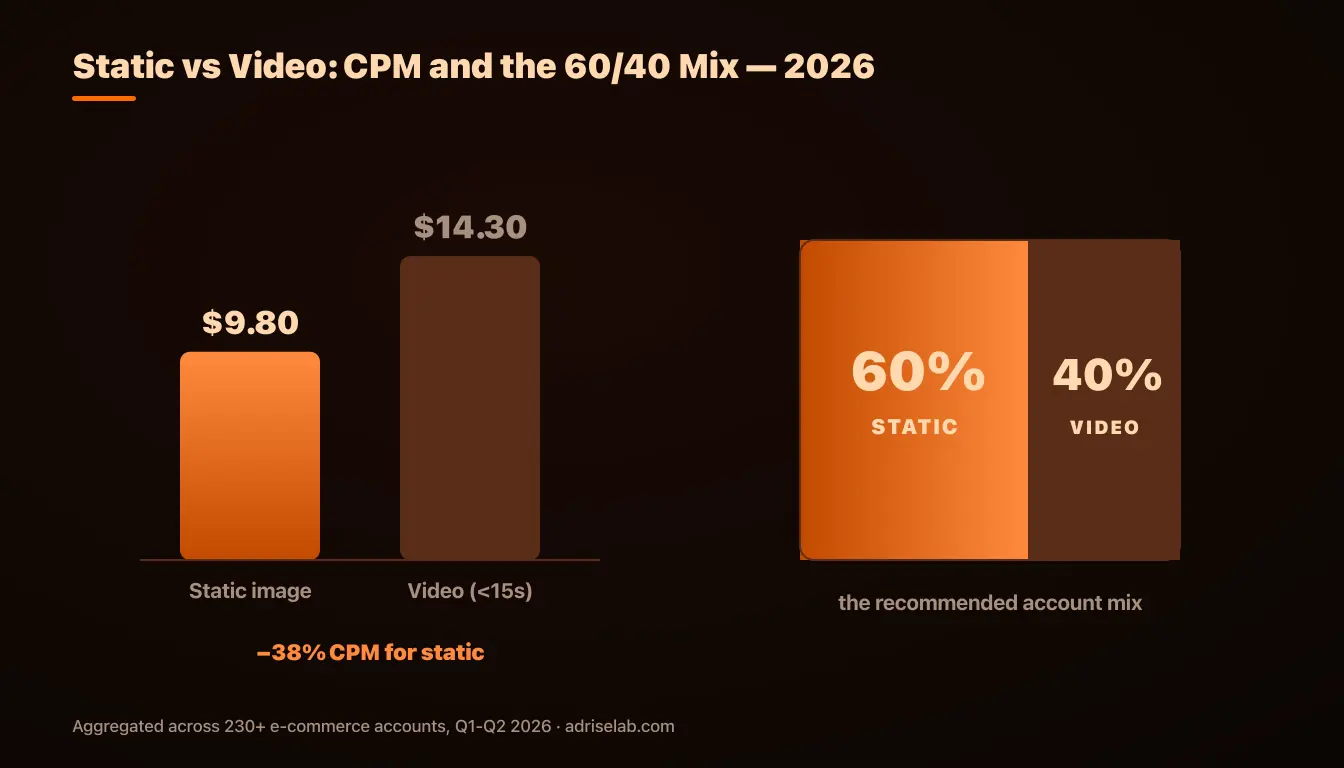
Average CPM by format:
- Static image: $9.80
- Video (under 15s): $14.30
- Video (15-30s): $16.10
- Video (over 30s): $19.40
- Carousel: $11.20
Average CTR by format:
- Static image: 1.6%
- Video (under 15s): 1.9%
- Video (15-30s): 1.4%
- Video (over 30s): 1.1%
- Carousel: 2.1%
Average CPA on conversion-optimized campaigns:
- Static image: $24.10
- Video (under 15s): $29.40
- Video (15-30s): $33.80
- Video (over 30s): $42.10
- Carousel: $26.70
The pattern is consistent: static images are cheaper per impression, have only slightly lower CTR than short video, and drive cheaper conversions than every other format except carousels. The "video is winning" narrative comes from looking at engagement metrics (views, completion rates, video time) that don't translate to conversion economics.
Why Static Image Ads Are Winning the Conversion Game
Three mechanisms explain the static advantage.
1. Static ads are cheaper to produce, so accounts can run more of them. A team producing creative for Meta typically generates 5-8 static variations in the time it takes to produce one video. Meta recommends creative diversification, and an account running 12-20 active distinct creatives has more chances to find a winner than one running 3-5, regardless of format. Static is the natural format for hitting volume, and that volume gives you more ideas to test.
2. Static ads communicate faster than video. On a feed scroll, a user gets 0.6-1.2 seconds to register an ad before scrolling past. A static image with a clear hook headline communicates the offer instantly. A video typically requires 3-5 seconds to deliver its hook, by which time the un-engaged user is gone. The few users who do watch the video are higher-intent, but the total addressable conversion pool per impression is smaller.
3. Static ads survive sound-off environments better. A significant majority of feed and Reels impressions happen with sound off. Video ads designed without sound-off optimization (no captions, no visual emphasis on the offer) lose their hook entirely. Static images don't have this failure mode. Even videos that are sound-off optimized typically perform worse than equivalent static ads because the sound-off treatment makes the video effectively a slow-paced sequence of static frames.
The 60/40 Image-Heavy Mix Framework
The framework that's producing the best ROAS across e-commerce and DTC accounts in 2026:
60% of ad spend allocated to static image creative. Split across product photography, lifestyle photography, social proof formats (review screenshots, before/after, UGC stills), and benefit-focused graphic compositions.
25% of ad spend allocated to short video (6-15 seconds). Hook-focused UGC, product demo clips, and quick before/after transformations. The key constraint: the video must work sound-off and must deliver its hook in the first 2 seconds.
15% of ad spend allocated to carousels. Particularly for product comparison, feature breakdown, and multi-product display use cases.
This mix is treated as a starting point and adjusted by funnel stage:
Cold prospecting (top of funnel): Lean static-heavier, 70/20/10. The job of cold prospecting is broad pattern interrupt and quick communication of the offer. Static images do this best.
Mid-funnel retargeting (visitors who didn't convert): Lean video-heavier, 40/45/15. Mid-funnel users are willing to engage with longer content because they've self-qualified. Video gets to do more storytelling here.
Bottom-funnel retargeting (cart abandoners, high-intent visitors): Lean carousel-heavier, 35/25/40. This audience needs reassurance and reminder, both of which carousels handle well.
The Categories Where the Math Reverses
There are real exceptions where video beats static, and knowing them keeps you from over-applying the 60/40 mix.
Subscription services with complex value props. Streaming, software, financial services, anywhere the offer requires explanation rather than just visual demonstration. Video's ability to walk through a value proposition step-by-step matters. Recommended mix: 35/55/10 (video-heavier). For the video share, the 12 video ad script templates cover the common openings and structures.
High-consideration considered purchases. Mattresses, premium kitchenware, large furniture. The decision requires building confidence, and video does this better than static. Recommended mix: 40/50/10.
Beauty and grooming categories with transformation outcomes. Skincare, hair care, fitness. Before/after video and tutorial content outperforms static. Recommended mix: 35/55/10.
Restaurants and food delivery. Appetite appeal is heavily motion-dependent. Video of food being plated, sauce being poured, steam rising, all of these drive engagement that static can't match. Recommended mix: 30/60/10.
For most other DTC categories, fashion, accessories, electronics, home goods, beauty staples, supplements, the 60/40 image-heavy default is the right starting point.
Specific Static Formats That Are Winning in 2026
Lifestyle product photography with environmental context. Product shown in use, in a real-life setting, with the user's face cropped out or implied. This format consistently outperforms studio product shots by 25-40% on CTR and conversion rate.
Review screenshot composites. Three to five real customer reviews assembled into a single ad creative, with the product image as the backdrop. The social proof density makes this format unusually effective for cold prospecting in categories where buyer trust is the main barrier.
Before/after split images. Side-by-side comparison showing the outcome. Works for fitness, beauty, home cleaning, organization, anywhere the product produces a visible result. Top quartile performance among static formats.
Benefit-headline overlay images. A clean product photo with a single dominant headline overlaying it ("Sleep through the night in 14 days," "Cut workout time in half"). The benefit-led version of a product ad. Highest CTR among pure-static formats.
Carousel-style "process" statics. Even though carousels are technically multi-frame, treating each frame as a static image with a sequential narrative (Step 1, Step 2, Step 3, Result) borrows the static advantage while adding storytelling capacity.
How To Implement the 60/40 Mix This Week
Step 1. Audit your current creative mix by spend. Most accounts running "balanced" creative are actually allocating 70-85% of spend to video without realizing it because video CPMs are higher and absorb budget faster. Calculate actual spend allocation across formats.
Step 2. Identify the static gap. If your current static allocation is under 40%, the 60/40 framework is going to be the biggest single improvement available to your account. Most accounts are leaving 15-25% blended performance on the table by under-allocating static.
Step 3. Build a static-first creative pipeline. As a starting point, plan on 5-10 new static variations per week, then adjust to your budget and what your own results show. AI creative tools, AdRiseLab, AdCreative, Pencil, are particularly strong here because static generation is what they're best at.
Step 4. Run a controlled comparison. For 14 days, run two parallel ad sets in your highest-spend campaign, one with your current mix and one with the 60/40 image-heavy mix. Compare blended CPA, CTR, and total conversion volume. The result will usually favor the static-heavy mix by 15-30% on CPA.
AdRiseLab generates 10-30 static image ad variations from any product URL in under a minute, with the formats listed above (lifestyle, benefit overlay, review composite, before/after) ready to deploy. For an account looking to rebalance toward 60/40 image-heavy without adding designer headcount, this is the fastest path. Get started with AdRiseLab.
Related Reading
See how creative volume above 12 active ads interacts with format mix. Read the creative testing framework for the 7-day cycle that validates new format allocations. And see the Andromeda algorithm guide for what Meta documents about delivery and why creative variety still matters for testing.