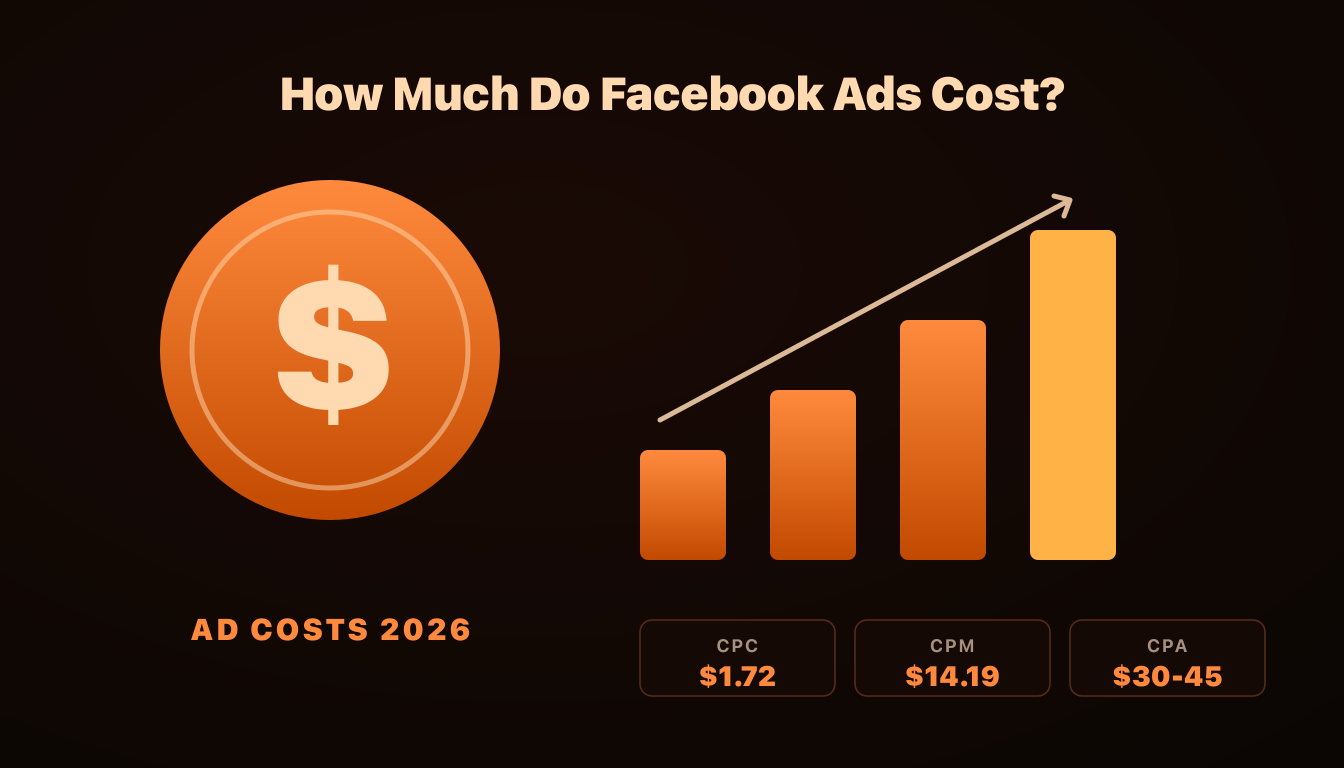
Facebook ads cost an average of $1.72 per click (CPC) and $14.19 per 1,000 impressions (CPM) in 2026. Cost per acquisition (CPA) on conversion campaigns typically lands between $30 and $45, and cost per lead (CPL) ranges from $8 in low-friction B2C niches to $60+ in B2B. Those are the headline averages — but averages hide a 6x spread across industries, objectives, and account quality. This guide breaks down what Facebook ads actually cost in 2026, by industry and by objective, and exactly which levers move your costs down.
How Facebook Ad Pricing Actually Works
Facebook doesn't have a price list. Every impression is sold in a real-time auction, and what you pay is determined by three factors: your bid (or budget, if you use automatic bidding), your estimated action rate (how likely the algorithm thinks a user is to take your desired action), and your ad quality ranking (how users respond to your creative relative to competitors targeting the same people).
The practical implication: two advertisers targeting the same audience at the same time can pay wildly different prices. An advertiser with fresh, diverse, high-engagement creatives effectively gets a discount in the auction, because Meta makes more money showing ads users actually engage with. An advertiser running the same three fatigued ads for six weeks pays a premium for the same impressions. Under the Andromeda algorithm, creative quality is the single largest controllable cost factor.
Average Facebook CPC by Industry in 2026
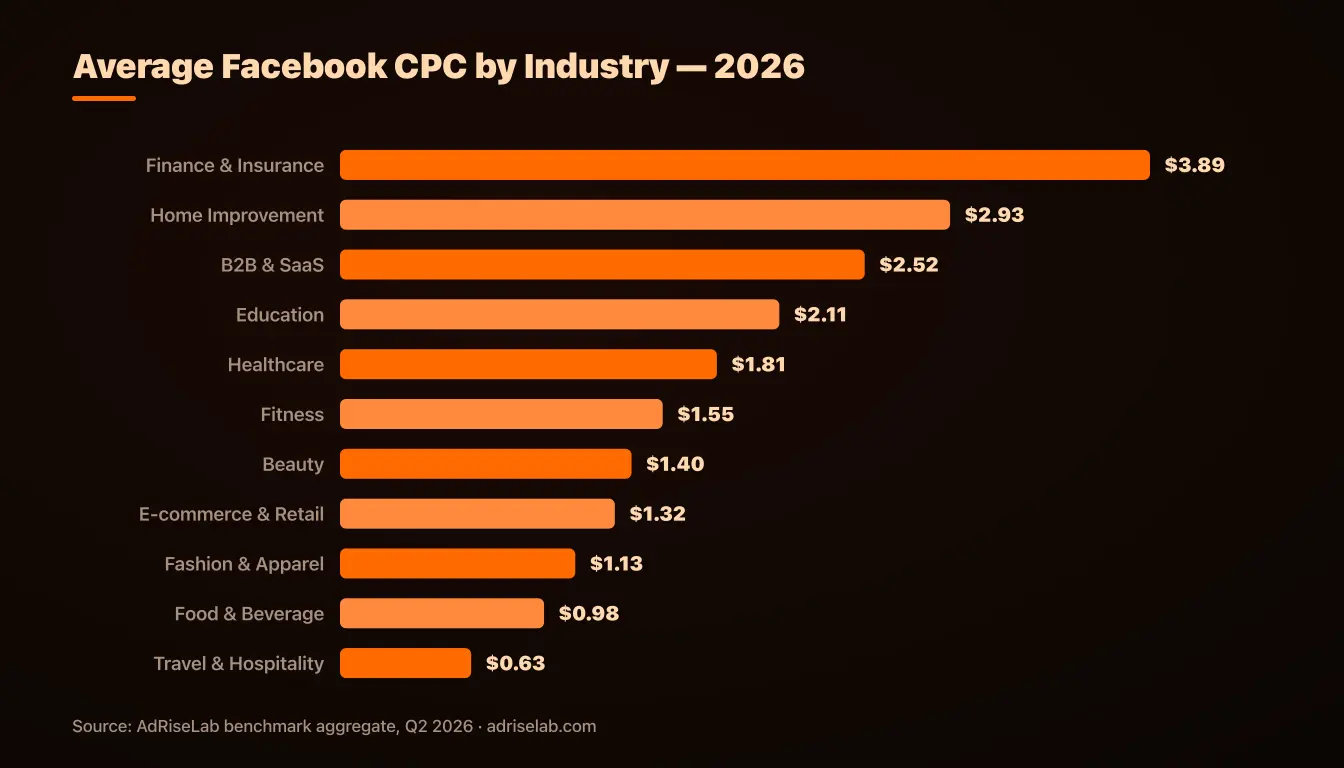
Here are 2026 average CPCs across the 11 industries we track, aggregated from ad accounts connected to AdRiseLab plus published industry benchmarks:
Industry CPC benchmarks for 2026:
- Finance & Insurance: $3.89. Highest-value conversions, deepest-pocketed competition, and heavy compliance constraints on creative variety.
- Home Improvement: $2.93. High ticket values and seasonal demand spikes keep auctions expensive.
- B2B & SaaS: $2.52. Narrow professional audiences cost more to reach — see our B2B SaaS CPL benchmarks for the full lead-cost picture.
- Education: $2.11. Long consideration cycles and credential-heavy targeting.
- Healthcare & Wellness: $1.81. Policy restrictions limit creative options, raising effective costs.
- Fitness: $1.55. Competitive but broad-audience friendly.
- Beauty & Cosmetics: $1.40. Visual-first vertical where strong creative substantially beats the benchmark.
- E-commerce & Retail: $1.32. The broadest category — strong creatives in e-commerce routinely achieve sub-$1 CPCs.
- Fashion & Apparel: $1.13. High CTRs from visual products pull CPCs down.
- Food & Beverage: $0.98. Broad appeal, high engagement rates.
- Travel & Hospitality: $0.63. Cheapest clicks on the platform — aspirational content earns high engagement.
Average Meta CPM in 2026: $14.19 and Climbing
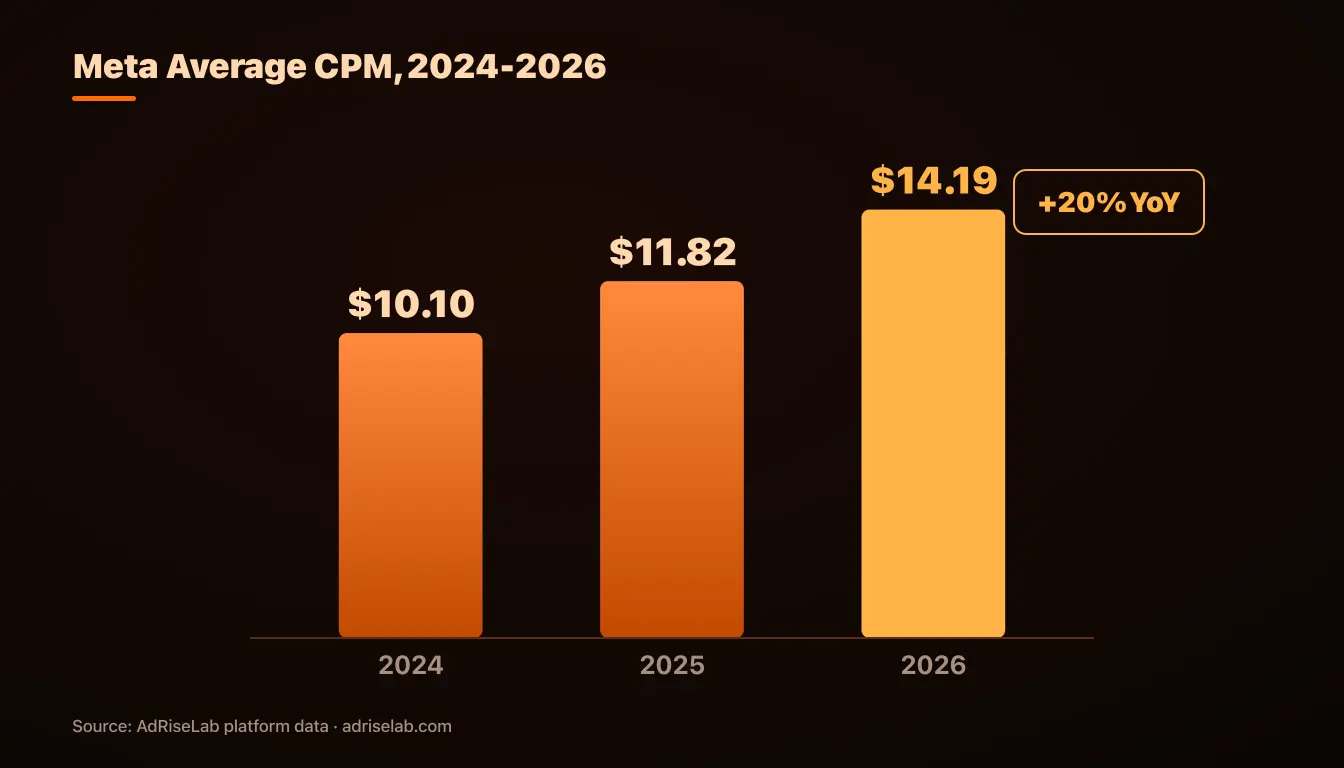
Meta's average CPM climbed from $11.82 in 2025 to $14.19 in 2026 — a 20% year-over-year jump driven by advertiser demand growth outpacing inventory, AI-driven competition entering auctions, and Reels inventory monetizing below Feed rates but saturating. We covered the mechanics and the four counter-levers in detail in why Meta CPMs jumped 20% in 2026. Prices also move within the year; see how CPMs rise from October to January before setting a Q4 budget.
CPM also varies sharply by placement: Instagram Feed and Instagram Reels run the most expensive ($15-17 average), Facebook Feed sits near the blended average, Facebook Reels and Stories deliver 10-20% below average, and Threads placements run 30-40% cheaper than Instagram for advertisers willing to be early.
CPA and CPL Benchmarks by Objective
Cost per result is where industry differences compound with funnel quality, so ranges are wider:
Typical 2026 cost-per-result ranges:
- E-commerce purchase CPA: $18-42. Sub-$25 is achievable for AOVs under $50 with strong creative volume; $35+ usually signals creative fatigue or landing page friction.
- Lead generation CPL (B2C): $8-25. Local services, fitness, education lead magnets. Meta Lead Ads typically come in 30-50% cheaper than landing-page forms, at some lead-quality cost.
- Lead generation CPL (B2B): $35-90. The widely-quoted $63 average hides massive variance — our B2B SaaS CPL deep dive explains what a marketing-qualified lead actually costs.
- App install: $2.50-6.00. Gaming at the low end, fintech at the high end.
- Traffic (link click): $0.40-1.20. Cheap, but clicks without conversion intent are the most overrated metric on the platform.
What Budget Do You Actually Need?
Work backwards from the learning phase. Meta's delivery system needs roughly 50 conversion events per ad set per week to exit the learning phase and stabilize performance. If your expected CPA is $30, that's $1,500/week — about $215/day — to give a single ad set optimal conditions. Most advertisers can't start there, and that's fine: the practical tiers look like this.
Budget tiers and what to expect:
- $20-50/day (testing tier). One campaign, one ad set, broad targeting, 5-10 creatives. Expect slower learning and noisier data. Goal: find one winning creative angle.
- $50-200/day (growth tier). One to two campaigns, 10-15 active creatives, weekly refresh cadence. Learning phase exits become consistent.
- $200-1,000/day (scaling tier). Structured account with separated prospecting and retargeting, 15-25 active creatives, scaling framework applies.
- $1,000+/day (performance tier). 25-40+ active creatives, daily monitoring, dedicated creative pipeline — at this level creative production is the bottleneck, not budget.
The 4 Levers That Actually Lower Your Costs
Most cost-reduction advice focuses on bidding tricks that move numbers 2-3%. These four levers move them 15-40%.
1. Creative refresh velocity. Fatigued creatives pay an auction penalty that compounds daily. Accounts that add 3-5 genuinely distinct creatives weekly and pause decaying ones consistently run 15-30% cheaper CPAs than accounts refreshing monthly. The detection playbook is in our creative fatigue guide.
2. Creative signal diversity. Under Andromeda, more distinct creatives mean more audience discovery — and cheaper delivery as the algorithm finds pockets of cheap, receptive users your competitors' narrow creative sets can't reach. Creative diversification is the lever that most directly affects delivery cost.
3. Broad targeting. Narrow audiences create artificial scarcity that you pay for. Advantage+ and broad targeting give the algorithm room to find cheap conversions — provided you feed it enough creative diversity to work with.
4. Placement liberalization. Advertisers who restrict delivery to Instagram Feed pay peak CPMs. Letting Advantage+ Placements arbitrage cheaper inventory (Facebook Reels, Stories, Audience Network, Threads) reliably pulls blended CPM down 10-20% with minimal CPA impact.
The Bottom Line
Facebook ads in 2026 cost more than they ever have — $14.19 CPMs are the new baseline, and they're not going back down. But cost-per-result is more controllable than ever, because the auction now explicitly rewards the thing you can manufacture: fresh, diverse, high-quality creative. The advertisers complaining loudest about costs are almost always the ones running five stale ads; the ones quietly scaling are paying less per purchase than they did in 2024.
AdRiseLab generates Andromeda-optimized ad creatives from any product URL in under 30 seconds, making the weekly refresh cadence that keeps costs down operationally trivial. Get started with AdRiseLab — plans from $39/mo, cancel any time.
Related Reading
Read why Meta CPMs jumped 20% in 2026 for the macro picture behind rising costs. See the B2B SaaS CPL benchmarks if you're in lead generation. Learn how to cut CPA 35% with budget optimization and how many creatives your account needs to earn the auction discount. To turn a CPM into a budget or an impression count for your own plan, use the CPM calculator.