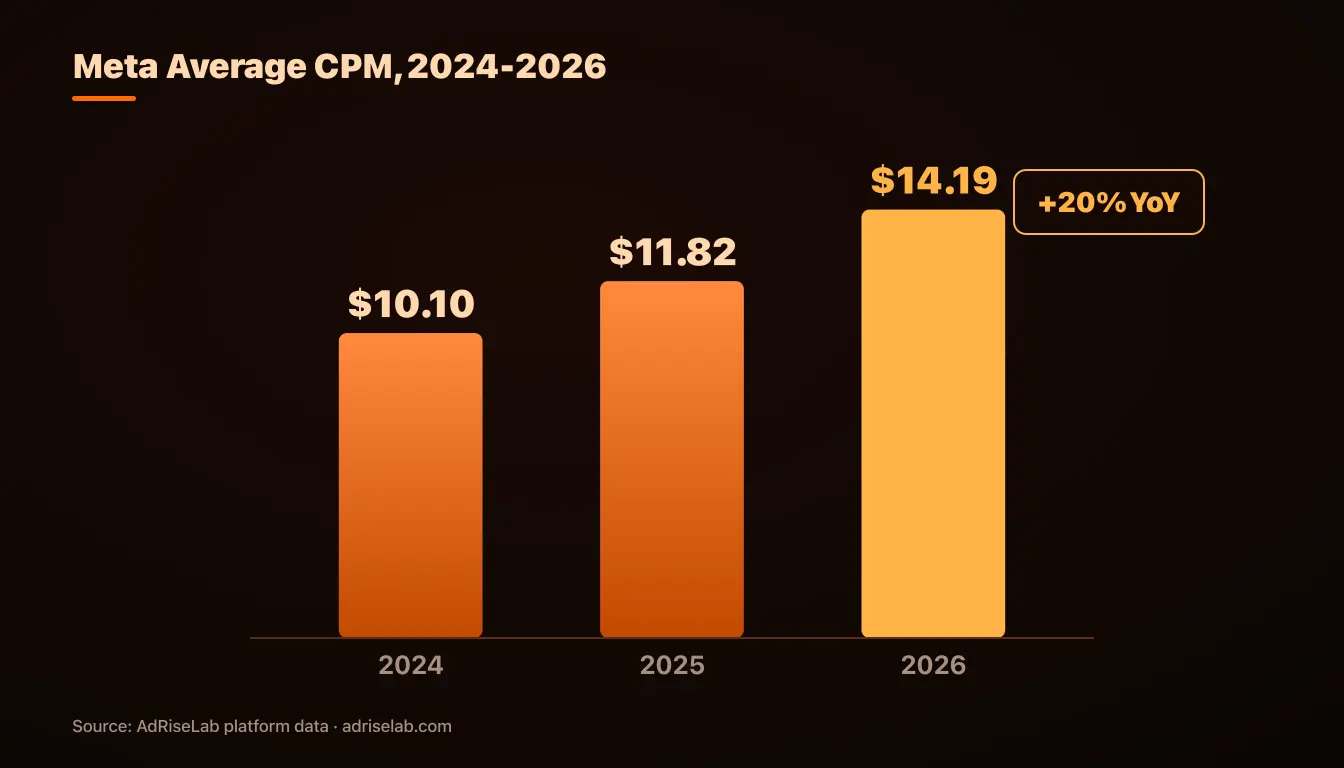
Q2 2026 Meta CPM data is in and the trend that everyone suspected is now confirmed: the platform-wide average CPM rose from $11.82 in 2025 to $14.19 in 2026, a 20% year-over-year increase. CPC climbed from $1.55 to $1.72. Average CPA on conversion campaigns went from $30 to $38.19. For most advertisers, this isn't showing up as a dramatic line in the charts, it's showing up as a slow, steady margin squeeze that has people asking the same question across Reddit, Slack groups, and agency calls: why are my Meta ads so expensive in 2026?
The honest answer involves three structural reasons CPMs are going up and four specific operational levers that actually bring them back down. This guide walks through both.
Why Meta CPMs Jumped 20% (The Real Causes)
There are three intersecting forces driving the 2026 CPM increase, and understanding the cause matters because it determines which levers will and won't work for your account.
1. Auction density is rising faster than ad inventory. Meta's monthly active users grew about 3% YoY across Facebook and Instagram. Total advertiser count, particularly in DTC e-commerce, grew an estimated 12-18% as small brands shifted budget out of TikTok and back to Meta following the platform stability concerns of 2025. More advertisers competing for roughly the same inventory mechanically raises auction prices.
2. Reels inventory absorption changed the placement mix. Meta has been aggressively pushing Reels delivery for two years, and the average user now sees a significantly higher Reels-to-Feed ratio than in 2024. Reels has a different supply curve, lower auction density historically but higher CPMs on conversion-optimized campaigns because the conversion rate per impression is lower. The net mix shift contributes maybe 3-5 points to the platform-wide CPM increase.
3. Signal loss from continued privacy changes. Apple's ATT, Safari's ITP, and ongoing browser-level signal restrictions mean Meta's conversion data quality has degraded incrementally each year. The algorithm responds by raising auction floor prices on conversion campaigns to compensate for the modeling uncertainty. Roughly 4-7 points of the CPM increase trace to this.
Note what's NOT on this list: "Meta is just being greedy" isn't really driving the increase. Meta's blended advertising margins have been roughly flat. The cost is real, and it comes from structural shifts you can partially counteract.
The 4 Levers That Actually Pull CPM Back Down
Lever 1: Expand placements to Threads, Reels, and full Advantage+ Placements.
The single highest-leverage CPM lever in 2026 is placement expansion. Facebook Feed and Instagram Feed CPMs are the most expensive surfaces on the platform, in part because they're where the highest-quality conversion signals come from and where advertisers have the most demand. Other placements run significantly cheaper:
- Threads CPM: 30-40% below Instagram Feed
- Instagram Reels CPM: 15-25% below Instagram Feed
- Facebook Reels CPM: 35-45% below Facebook Feed
- Audience Network: 50-70% below Facebook Feed (but lower quality)
Most accounts running manual placement selection are still on Feed-only or Feed + Stories. Moving to full Advantage+ Placements typically drops blended CPM by 18-25% within 14 days, with the algorithm dynamically reweighting to wherever conversion economics are best for your account.
The blocker most advertisers cite is "but the Reels placement performs worse." This is usually true at the placement-isolated CPA level but misleading at the campaign-blended level. Reels delivers cheaper top-of-funnel impressions that pull down blended CPM and feed the algorithm signals it then uses to optimize Feed conversions more efficiently. The total math almost always wins when you let Meta distribute.
Lever 2: Push creative diversity above 12 distinct active ads per account.
Andromeda's creative-as-targeting mechanism means CPM is partly a function of creative diversity. Accounts with rich creative signal pull cheaper impressions because the algorithm has more pricing options. Accounts running 3-4 active creatives effectively force the algorithm into a narrow auction lane that prices higher.
The before/after data from accounts that pushed creative diversity from 4-6 to 12-20 active ads in early 2026:
- Blended CPM: -12 to -19%
- CTR: +25 to +40%
- Effective CPC: -28 to -42%
- CPA: -15 to -25%
The creatives need to be genuinely distinct (different hooks, layouts, formats), not surface variations of the same template. Cosmetic diversity doesn't earn the Andromeda discount.
Lever 3: Implement Conversions API with strong Event Match Quality.
Roughly 4-7 points of the 2026 CPM increase came from signal loss. The CAPI implementation directly counteracts this. Accounts running pixel-only see auction floor prices roughly 12-18% higher than equivalent accounts running pixel + CAPI with EMQ scores of 7+ for their key events.
The mechanism is clean: Meta's algorithm needs to know your real conversion rate to bid intelligently. When signal is degraded, it bids defensively, paying higher CPMs to ensure it captures the impressions it's confident will convert. Better signal lowers the defensive premium.
Specifically, CAPI implementation typically reduces blended CPM by 8-12% for conversion-optimized campaigns within 14 days of EMQ stabilizing above 7. For accounts where CAPI is the missing piece, this is often the single highest-ROI infrastructure project of the year.
Lever 4: Switch from cost cap or bid cap to lowest cost.
Many advertisers reflexively turn to cost caps when CPA rises, hoping to "force" the algorithm into cheaper auctions. This almost always backfires. Cost caps and bid caps narrow the auction options the algorithm can pursue, forcing it to compete only in lanes where it can hit the cap, which are typically the most price-competitive lanes (the ones where everyone else is also capped). The math is paradoxical but consistent: caps generally raise blended CPM.
Switching from cost cap to lowest-cost bidding typically drops blended CPM 6-10% within a few days while widening the audience pool the algorithm can access. The trade-off is variance: lowest-cost campaigns have wider day-to-day CPA spread but lower average CPA over a 14-day window.
If margin requires a hard CPA ceiling, the better approach is to run lowest-cost campaigns with strict pause thresholds rather than imposing the ceiling via bid configuration. The algorithm operates more efficiently when it has full latitude.
A Concrete Before/After: The Account-Level Math
Below is a representative account that implemented all four levers across a 6-week period in Q1 2026. Starting point: $40K/month e-commerce account, manual placements (Feed + Stories), 5 active creatives, pixel-only, cost-cap bidding.
Week 0 baseline:
- Blended CPM: $16.40
- CTR: 1.1%
- CPC: $1.49
- CPA: $42.30
Week 2 (after enabling Advantage+ Placements):
- Blended CPM: $13.20 (-20%)
- CTR: 1.3% (+18%)
- CPC: $1.02 (-32%)
- CPA: $39.10 (-8%)
Week 4 (after pushing to 14 active creatives via AdRiseLab):
- Blended CPM: $11.40 (-13% additional)
- CTR: 1.7% (+31% additional)
- CPC: $0.67 (-34% additional)
- CPA: $31.80 (-19% additional)
Week 6 (after CAPI implementation reaching EMQ 7.4):
- Blended CPM: $10.30 (-10% additional)
- CTR: 1.7% (flat)
- CPC: $0.61 (-9% additional)
- CPA: $28.60 (-10% additional)
Total cumulative result: blended CPM dropped from $16.40 to $10.30, a 37% reduction. CPA dropped from $42.30 to $28.60, a 32% reduction. Same audience, same budget, dramatically better economics, achieved through structural changes rather than creative breakthroughs.
What Probably Won't Help Lower Your CPM
A few common moves that get recommended but rarely move CPM meaningfully:
Lowering daily budget. Reducing budget doesn't reduce CPM, it just delivers fewer impressions. The auction clears at the same price; you just buy less of it.
Switching to manual bidding with a low manual bid. This typically gets your ads outbid entirely and your delivery drops to near-zero. Manual bidding works for specific use cases (cost caps for hard-margin businesses) but doesn't reduce CPM in any general sense.
Targeting cheaper geographic regions. Yes, US CPMs are higher than most other regions, but if your business sells primarily to US customers, expanding geo just inflates spend on impressions that won't convert. Use geo expansion for genuine market expansion, not for CPM optics.
AdRiseLab's value in this specific context: generating the 12-20 active creatives needed to unlock the Andromeda diversity discount, without adding designer headcount. For an account paying inflated 2026 CPMs, the creative diversity lever is often the fastest, highest-ROI intervention available. Get started with AdRiseLab.
Related Reading
See how Threads ads provide a 30-40% CPM arbitrage right now. Learn how the Andromeda algorithm rewards creative diversity with cheaper impressions. And read the creative volume framework for hitting the 12-20 active ad threshold. For the seasonal layer on top of that structural increase, the Q4 Meta CPM curve covers what October through January reportedly costs and how to decide whether to scale into it. To see what a higher CPM does to your own budget and impression count, run it through the CPM calculator.