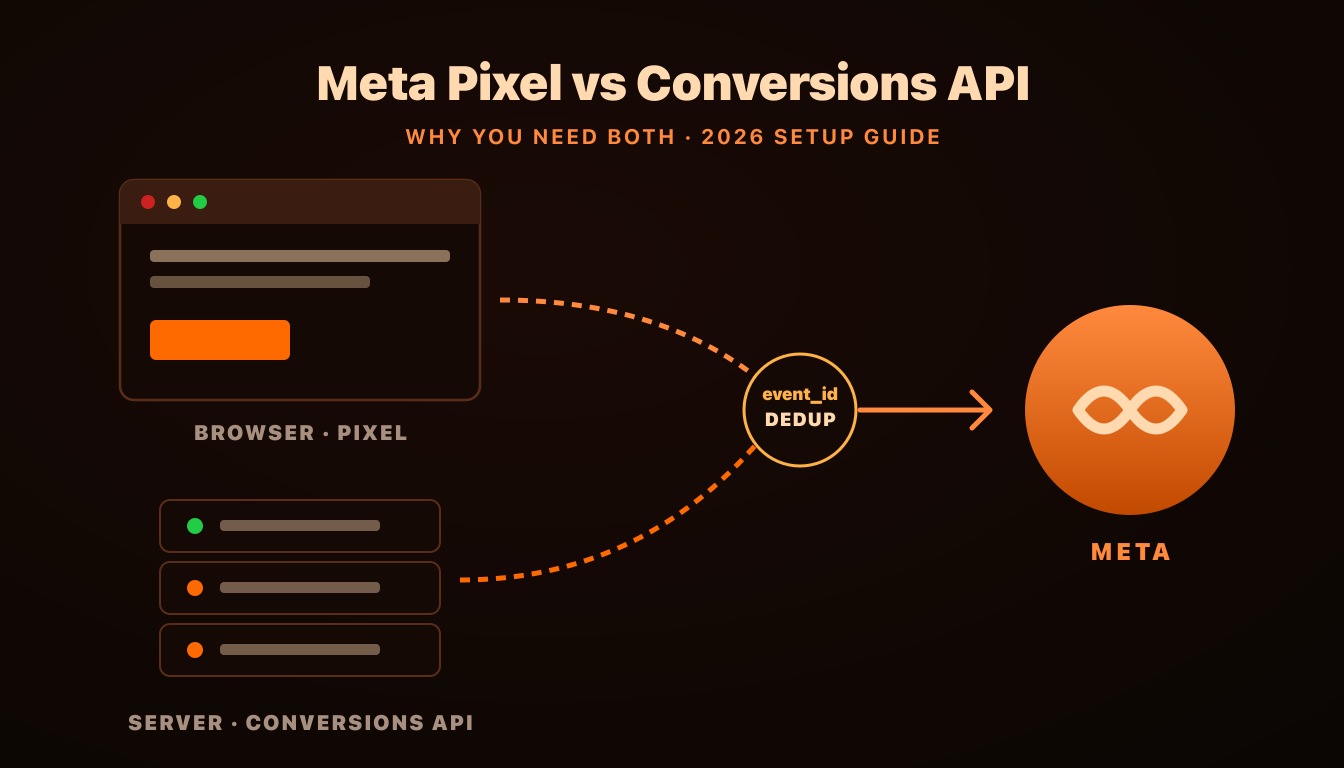
The Meta Pixel and the Conversions API do the same job — telling Meta when someone converts — from two different places. The Pixel fires from the user's browser; the Conversions API (CAPI) fires from your server. In 2026, the browser path alone loses 20-30% of conversions to Safari's tracking prevention, ad blockers, iOS privacy prompts, and short-lived cookies. Every lost event under-reports your real ROAS and — worse — starves the algorithm of the optimization signal it learns from. This guide explains the practical differences, why "Pixel vs CAPI" is the wrong question, and the exact setup with deduplication.
What Each One Actually Does
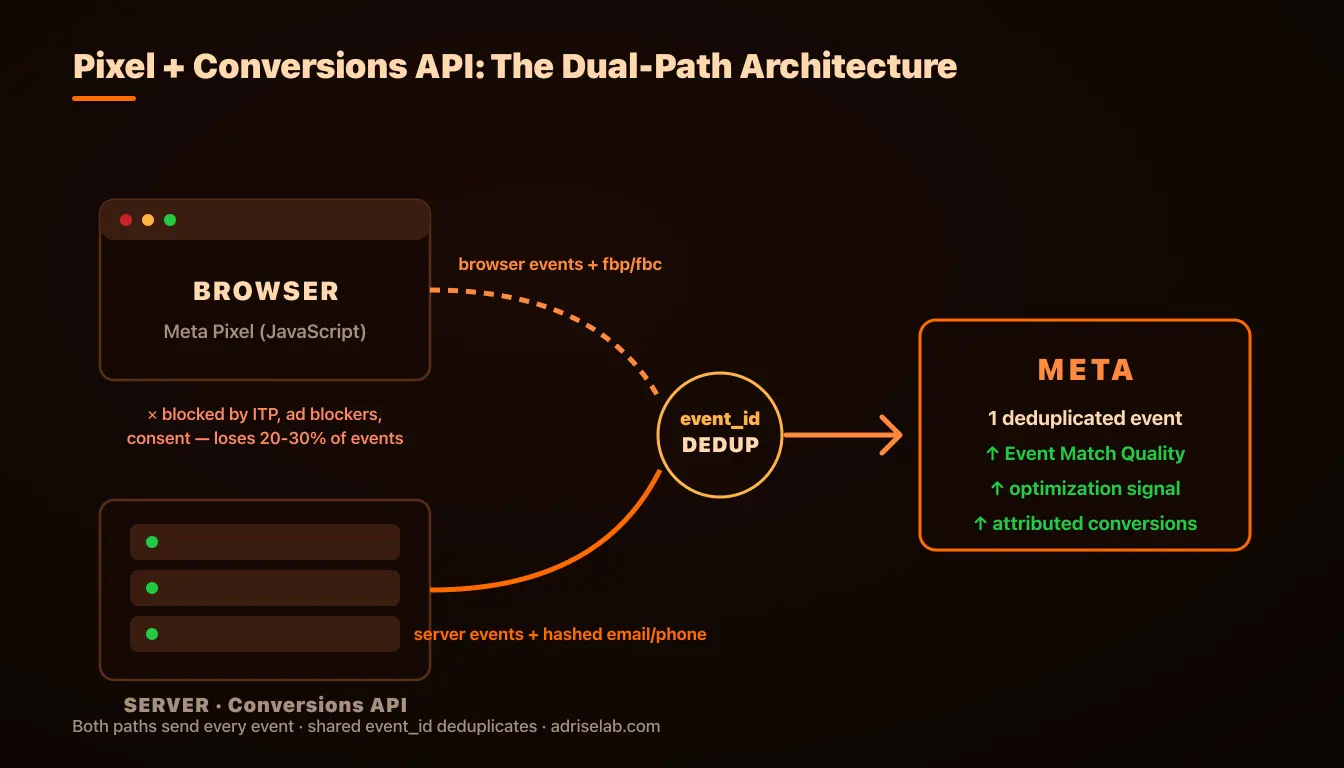
The Meta Pixel is a JavaScript snippet that runs in the visitor's browser. It captures page views, engagement, and conversion events the moment they happen, along with browser identifiers (fbp cookie, fbc click ID) that make user-matching accurate. Its weakness is its location: anything that interferes with browser scripts — ITP in Safari, ad blockers (used by 30%+ of some demographics), consent rejections, cross-site cookie limits — silently kills its events.
The Conversions API sends the same events from your server (or your platform's servers) directly to Meta over HTTPS. Nothing in the browser can block it, it survives cookie death, and it can carry richer customer data — hashed emails, phone numbers, order values from your actual backend. Its weakness is the inverse: alone, it lacks the browser context (click IDs, on-page behavior) that makes matching precise, and it only knows about events your server sees.
Why You Need Both: The Redundancy Model
Meta's delivery system is a learning machine, and conversions are its training data. Feed it 70% of reality and it optimizes toward a distorted picture — overweighting the users and placements whose conversions happen to survive browser tracking. The dual-channel model fixes this: browser and server send every event independently with a shared event ID, Meta deduplicates to a single copy, and each channel covers the other's blind spots. The browser contributes match-rate-boosting identifiers; the server contributes the 20-30% of events the browser loses.
The measurable effects in accounts we audit when CAPI is added correctly: reported (real) conversions recover much of the 20-30% that browser-only tracking was missing, Event Match Quality climbs, CPAs appear to drop (they were always lower — now you can see it), and learning phases complete faster because the ~50-events-per-week threshold is reached with previously-invisible conversions counted.
Setup, Step by Step
The how-to steps above cover the sequence; three implementation notes deserve expansion.
Platform integrations do the heavy lifting. Shopify's Meta sales channel set to "Maximum" data sharing, WooCommerce's official plugin, and equivalents on BigCommerce, Squarespace, and Webflow all implement browser + server + dedup automatically. If you're on one of these, your job is verification, not engineering: 15 minutes in the Test Events tool confirming both paths arrive and collapse to one event.
Custom stacks have a no-code middle path. The CAPI Gateway is Meta's self-hosted relay (deployable on AWS and other clouds in about half an hour) that converts your existing Pixel traffic into server events without writing integration code. Full custom implementation — calling the API from your backend with hashed customer parameters — buys maximum data quality and is worth it once ad spend justifies engineering time.
Deduplication is non-negotiable. Both channels must send a shared event_id per event. Without it, Meta counts conversions twice — inflating your reported ROAS, corrupting the optimization signal, and eventually producing the unpleasant discovery that your "3.5x" account is a 2.2x account. Platform integrations handle this; custom implementations must.
Event Match Quality: The Score That Quietly Runs Your Account
Events Manager scores each server event from 0 to 10 on Event Match Quality (EMQ): how reliably the customer information you send can be matched to a Meta account. Meta calculates it from which parameters arrive, their quality, and the share of events matched. The usual levers, in order: send the event through CAPI at all, pass hashed email on every event where you hold it, then forward clean fbc and fbp values.
A higher score means more of your real conversions are matched and used for optimization. It does not prove your revenue figures are right, and published before-and-after CPA gains come from uncontrolled single-account cases. The full guide to Event Match Quality covers the score bands, the Dataset Quality API fields and a 7-step fix order.
How This Connects to Everything Else
Tracking quality is upstream of every benchmark and tactic on this blog: the CPA benchmarks assume measured conversions, ROAS targets are only as real as attribution, and creative performance signals sharpen when the conversion data feeding them is complete. If you're going to fix one infrastructure thing this quarter, fix this one.
With tracking solid, the bottleneck moves back to creative volume — where AdRiseLab generates ad creatives from a product URL and publishes them to your account after you confirm the launch. Get started with AdRiseLab.
Related Reading
New to the platform? Start with the complete beginner's guide to running Facebook ads — tracking is step 2 for a reason. Then see how the learning phase consumes your conversion signal and what your true costs look like once attribution is honest. If reported conversions fell in 2026 without a tracking change, check engage-through attribution first: Meta narrowed what counts as a click and removed the long view windows. If you are weighing a dedicated tracker on top of this setup, AdRiseLab vs WeTracked.io covers what each layer is actually for. Once the events are trustworthy, the 12-point measurement-first audit is the framework that turns them into decisions.