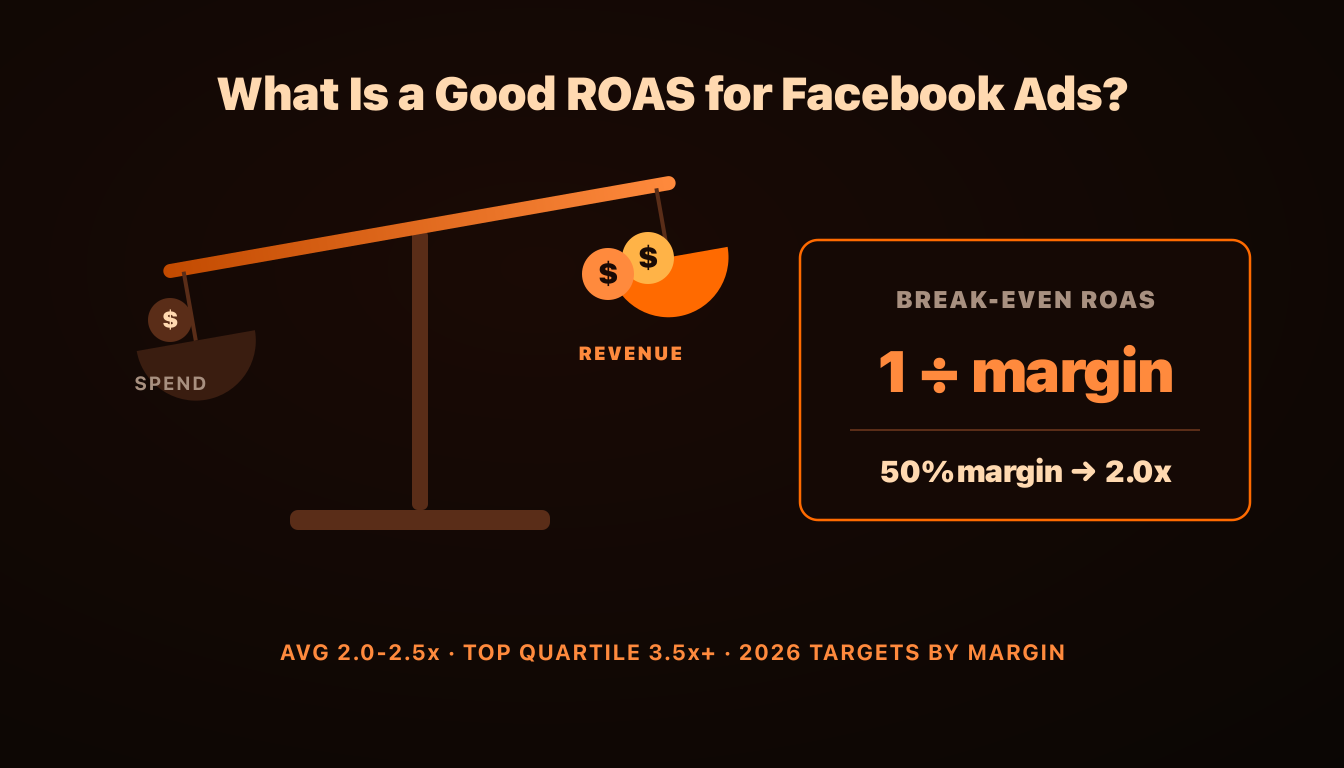
A good ROAS (return on ad spend) for Facebook ads in 2026 is anything meaningfully above your break-even point — and your break-even is 1 divided by your gross margin, not a number from someone else's case study. The platform-wide e-commerce average runs 2.0-2.5x, top-quartile accounts sustain 3.5x+, and businesses with subscription LTV profitably run campaigns at 1.5x. This guide gives you the formula, the 2026 benchmarks by industry, and the situations where ROAS actively misleads you.
The Break-Even ROAS Formula
ROAS = revenue attributed to ads ÷ ad spend. A $10,000 spend producing $25,000 in tracked revenue is a 2.5x ROAS. Whether 2.5x is good depends entirely on what a dollar of revenue is worth to you, which is your gross margin.
Break-even ROAS = 1 ÷ gross margin. Compute gross margin per order honestly: price minus COGS, shipping, payment processing, packaging, and any per-order variable cost, divided by price. A $100 AOV store with $45 of true variable costs has a 55% margin and breaks even at 1.82x. Everything above that line is contribution profit; everything below it is paying Meta for the privilege of shipping boxes.
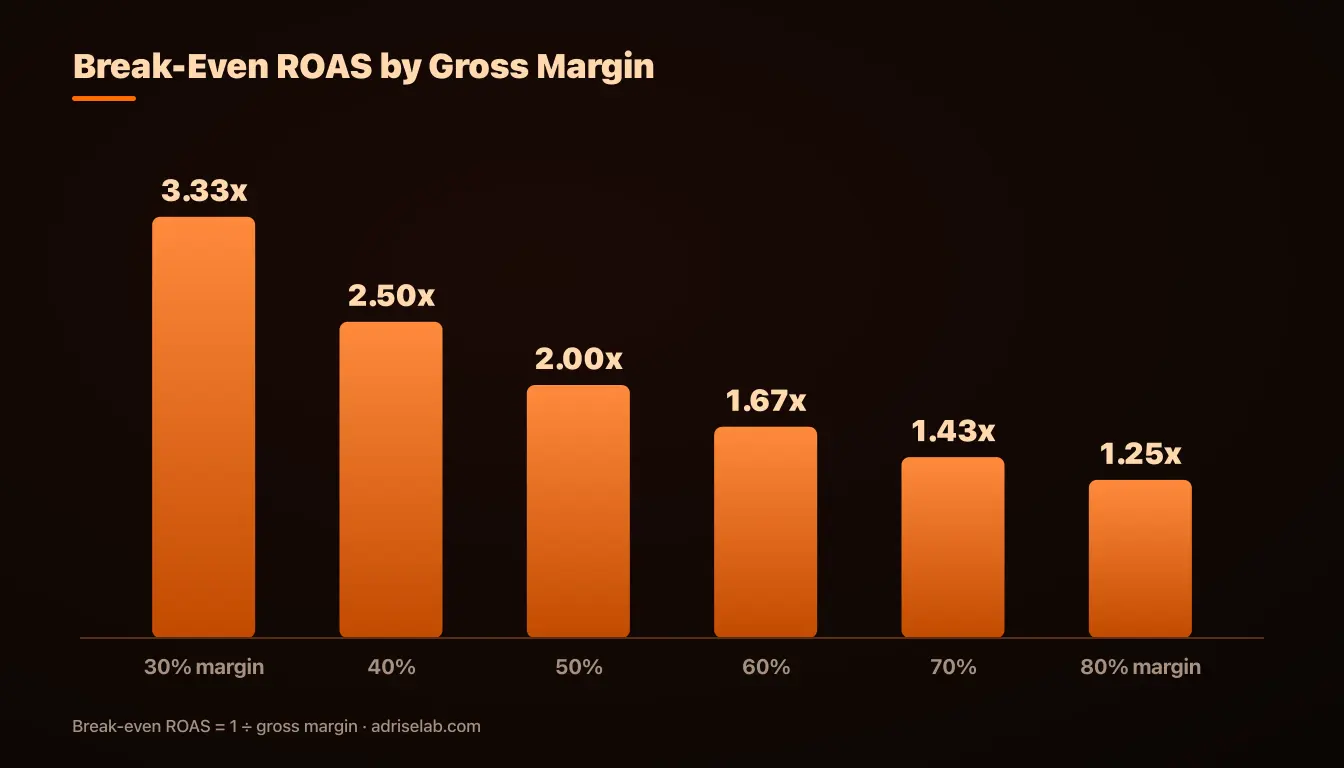
Break-even ROAS at common margin levels:
- 30% margin → 3.33x break-even. Thin-margin resale and electronics — Facebook ads are hard here without LTV.
- 40% margin → 2.50x break-even. Typical for fashion with moderate production costs.
- 50% margin → 2.00x break-even. The classic DTC midpoint.
- 60% margin → 1.67x break-even. Strong DTC economics — supplements, beauty, accessories.
- 70% margin → 1.43x break-even. High-margin digital-adjacent products.
- 80% margin → 1.25x break-even. Digital products and software — almost any competent campaign is profitable.
Facebook ROAS Benchmarks by Industry, 2026
With the formula established, here's where 2026 accounts actually land — blended ROAS (prospecting + retargeting), 7-day click attribution:
Blended ROAS averages by vertical:
- Beauty & Cosmetics: 2.8x. Strong visual creative fit and healthy margins.
- Fashion & Apparel: 2.5x. High return rates eat into realized (vs tracked) ROAS — track both.
- Supplements & Wellness: 2.4x. Subscription LTV lets leaders run first-order break-even.
- Home & Living: 2.2x. Higher AOV, longer consideration, solid retargeting economics.
- Food & Beverage DTC: 2.1x. Repeat-purchase models carry it.
- Electronics & Gadgets: 1.9x. Thin margins make this the hardest profitable vertical.
- B2B & SaaS: not ROAS-measured. Judge on cost per qualified lead and pipeline, not 7-day revenue.
Full creative-level CTR and CPA context for these verticals is in our industry benchmark report.
Why Your ROAS Target Should Differ From Your Neighbor's
Three businesses with identical 2.5x ROAS can be thriving, treading water, and dying. The variables that change the target: gross margin (the formula above), LTV and repeat rate (a 40% repeat-purchase rate lets you target first-order break-even and bank the second order), AOV (higher AOVs tolerate higher CPAs at the same ROAS), and returns (apparel's tracked 2.5x can be a realized 2.1x after 15-20% return rates). The honest version of "what's a good ROAS" is: model your contribution margin per order, decide how much of LTV you're willing to spend to acquire, and derive the target — then benchmarks become context instead of goals.
When ROAS Lies to You
Four systematic distortions worth knowing before you reallocate budget on a ROAS report:
Attribution inflation on retargeting. Retargeting ads claim credit for buyers already en route to purchase, which is why retargeting "ROAS" of 8-15x is normal and mostly fictional. Judge retargeting on incrementality and your account blend, not the line item.
Recency under-reporting. With 7-day click attribution, the last few days always look worse than they'll end up — conversions are still arriving. Never judge yesterday's ROAS; evaluate trailing windows that have matured. Also check which attribution setting a report uses: since March 2026, click-through now requires a link click.
Blended ROAS hiding creative decay. Account-level ROAS can hold steady while your top creative quietly fatigues, because retargeting compensates — until it doesn't. Watch creative-level leading indicators, not just the account number.
Survivor math on small spend. A $300 total spend with one $250 order shows a "ROAS" that means nothing. Demand statistical volume — roughly 50+ conversions — before treating any ROAS figure as signal.
How to Actually Improve ROAS in 2026
ROAS improves from three directions, and advertisers chronically over-invest in the third:
1. Raise revenue per conversion. AOV levers — bundles, post-purchase upsells, free-shipping thresholds — improve ROAS with zero ad changes. 2. Lower cost per conversion. In 2026 this is overwhelmingly a creative game: accounts that diversify creative across all five dimensions see a median 40% CPA reduction, and fresh creatives earn cheaper auction prices. Budget structure helps too — see the budget optimization framework. 3. Re-slice targeting and bids. Often worth single-digit percentages, and no setup wins in every account — test manual segmentation against a broad control before you trust it.
The accounts that sustain a high blended ROAS tend to have the same thing in common: a steady supply of genuinely distinct creatives with a weekly refresh, rather than a single winner run to exhaustion. The creative pipeline is the ROAS strategy. When the number moves the wrong way, decompose the drop across CPM, CTR, conversion rate and AOV before deciding it was the creative.
AdRiseLab makes that pipeline operational for any team size: paste a product URL, get creatives with different hooks, angles and formats in 30 seconds, review them, then publish directly to your account. Get started with AdRiseLab.
Related Reading
Pair this with what Facebook ads cost in 2026 to model CPA targets from your break-even. See how to scale from $10K to $100K/month without ROAS collapse, and the creative diversification playbook behind most top-quartile ROAS numbers.