UGC is the format Meta advertisers can't ignore and can't scale. Creator-style ads — the handheld, first-person, 'let me show you this thing I found' format — consistently earn the highest thumb-stop rates on Reels and Stories, because they read as content before they read as advertising. Every performance team knows this. And every performance team also knows the production reality: finding creators, briefing them, chasing drafts, negotiating usage rights, and paying $150-$500 per finished video that may or may not hook. AdFlow UGC removes that pipeline entirely. Paste a product URL, get authentic creator-style ads. Generated, not commissioned.
The UGC Paradox: Best Format, Worst Production Model
The numbers behind UGC's dominance are well documented — the complete UGC playbook walks through them — but the short version is that authenticity wins the first three seconds. Polished brand creative signals 'ad' instantly; creator-style content earns a beat of attention before the viewer categorizes it, and that beat is where hooks do their work. Under Andromeda, UGC also emits a genuinely different creative signal than studio content, which means it reaches audience segments your polished creatives never touch.
The problem has never been whether UGC works. It's what producing it costs. A single creator video runs $150-$500 once you count the fee, the brief-writing time, and the revision rounds. Turnaround is one to three weeks per batch. Usage rights need negotiating — and renegotiating when a video wins and you want to keep scaling it. And the format burns fast: because UGC thrives on freshness, creative fatigue hits it harder than any other format, so the pipeline that took three weeks to fill needs refilling by week five. Most teams try UGC, see the performance, do the production math, and quietly retreat to static ads.
What AdFlow UGC Does
Product URL in, creator-style ads out. The flow starts the same way everything in AdRiseLab starts: paste your product URL. The AI extracts your product, benefits, price point, and audience context, then writes and produces UGC ads from it. No brief, because the product page is the brief.
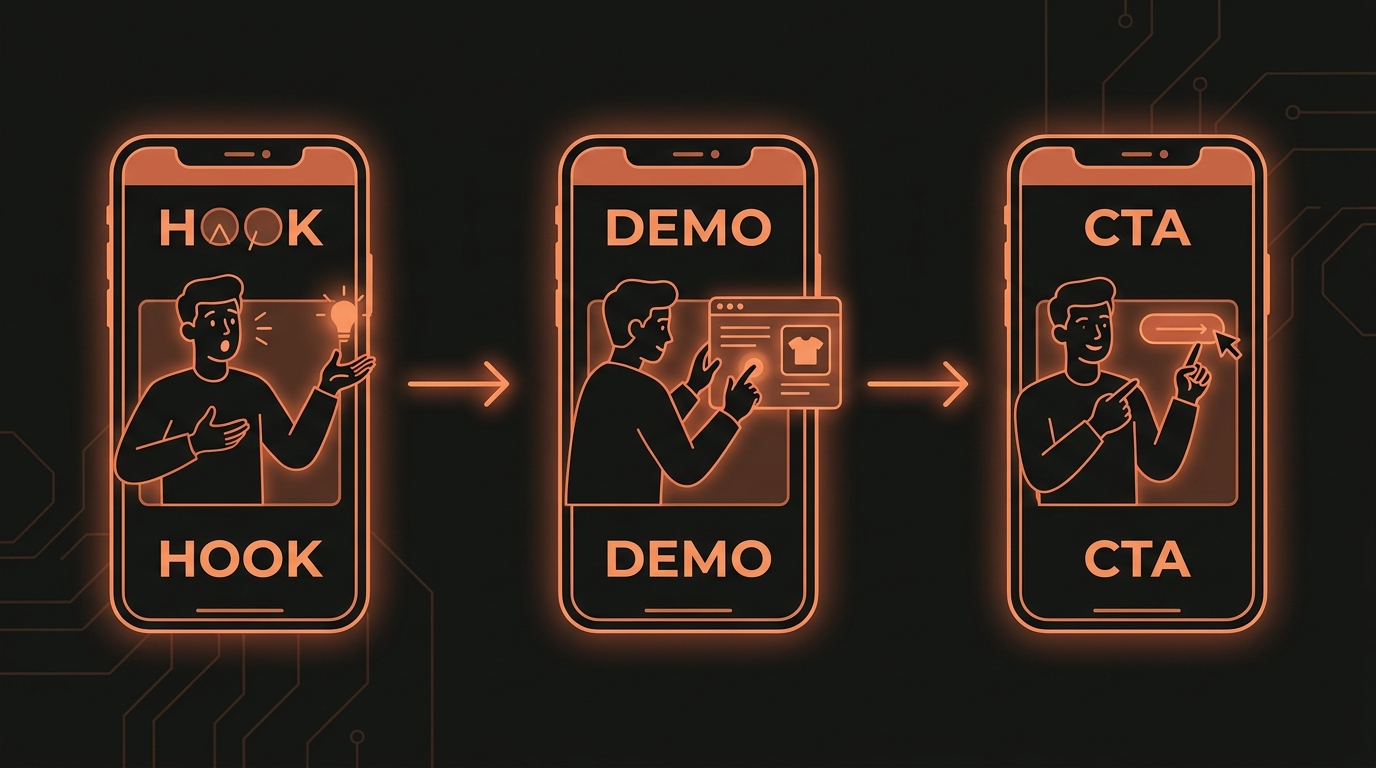
The hook-demo-CTA structure, always. Every AdFlow UGC ad is built on the three-act structure that converts: a scroll-stopping hook in the first three seconds, a demo section showing the product in real use, and a call to action delivered in creator voice rather than announcer voice. This isn't a template you have to remember to apply — it's how the module thinks. The hook formulas that lift thumb-stop ratio by 40% are built into the hook generation.
Authentic creator voice, on purpose. UGC that sounds like an ad performs like an ad. AdFlow UGC scripts are written the way real creators talk: first-person, specific, conversational, a little imperfect. 'I've been using this for two weeks and my Monday mornings are different' — not 'introducing the revolutionary solution.' The authenticity is the mechanism, so the script engine protects it.
Hook variations at volume. The same product, five different angles: pain ('still hiding your skin in photos?'), outcome ('glass skin in 14 days'), social proof ('my feed would not shut up about this'), curiosity, before-after. In the creator pipeline, each variation is another brief and another fee. Here, variations are the default — which is exactly what Andromeda's appetite for signal diversity demands from cold-traffic campaigns.
Meta-ready output. Ads render in 9:16 for Reels and Stories, land in your creative library next to your image ads, and publish through the same one-click Meta pipeline — campaigns are created with ACTIVE status after you review the settings and confirm launch.
The Economics, Before and After
Take a realistic testing program: five UGC concepts a month, each tested across three hooks. In the creator pipeline, that's 15 videos — $2,250 to $7,500 in creator fees, plus the coordination overhead, plus three weeks of calendar time. Most teams respond by testing less: two videos, one hook each, and a prayer. Underpowered tests produce ambiguous results, ambiguous results erode confidence in the format, and the UGC program dies not because UGC failed but because the sample size did.
AdFlow UGC collapses the cost of a variation to roughly the cost of a thought. Fifteen videos is a working session, not a quarter's budget line. That changes what's testable: you can run a real hook matrix, kill losers without flinching at sunk costs, and refresh winners the moment fatigue signals appear instead of three weeks after. The format that fatigues fastest finally has a production model that refreshes fastest.
Where It Sits Next to AI Video Ads
AdRiseLab now has two video modules, and the division of labor is deliberate. AI Video Ads is the broad studio: avatar presenters, template packs from 'Product Presenter' to 'Green Screen Effect,' cinematic product scenes, and rendering in every placement ratio. AdFlow UGC is the specialist: it does one thing — authentic creator-style ads — and optimizes everything around that one thing, from script voice to pacing to the hook-demo-CTA skeleton.
In practice, the two cover different funnel jobs. UGC dominates cold-traffic hooks, where the ad has to survive the 'is this an ad?' reflex. Cinematic and presenter-led video earns its keep in consideration and retargeting, where the buyer already knows you and wants to see the product properly. The 60/40 mix guidance still applies across formats — but inside your video allocation, UGC-for-cold and cinematic-for-warm is the starting split we see work.
A First Week That Actually Tests Something
Day one: generate one product's UGC set — five hooks, one demo body. Launch the five as a cold-traffic test with equal budgets. Day three: read early hook rates (hook rate, not CPA — nothing converts before it stops the scroll). Kill the bottom two. Day five: take your top hook and generate three voice variations of it — same angle, different creator energy. Week two: the winner earns real budget; the learnings ('outcome hooks beat pain hooks for this product, calm voice beats hype') feed the next product's set. That loop — which used to take a quarter and a five-figure creator budget — now fits inside a fortnight and a subscription.
What About AI Disclosure?
The obvious question with AI-generated creator content: what does Meta require you to disclose? The rules are workable but real — photorealistic AI-generated people in ads fall under Meta's AI disclosure requirements, and the platform's detection has gotten materially better through 2026. AdRiseLab handles the mechanical side (the disclosure flag is set where required at publish time), but you should understand the policy landscape you're operating in; the Meta AI disclosure compliance guide covers what triggers disclosure, what doesn't, and the gray areas. The practical takeaway from accounts already running disclosed AI UGC: disclosure has shown no measurable performance penalty when the creative is good — viewers punish bad ads, not disclosed ones.
Availability
Update, October 2026: AdFlow UGC is now included in every plan; the early-access rollout described at launch is complete. A 4-15 second clip uses credits by length, shown before you render. If you're new to AdRiseLab, get started — plans from $39/mo. Full details live on the AdFlow UGC product page.
Related Reading
Get the strategic foundation in the UGC ads complete playbook, steal the 12 hook formulas the hook engine is built on, and see why creative fatigue hits UGC hardest. Then meet the sibling module: AI Video Ads for avatar presenters and cinematic product scenes.