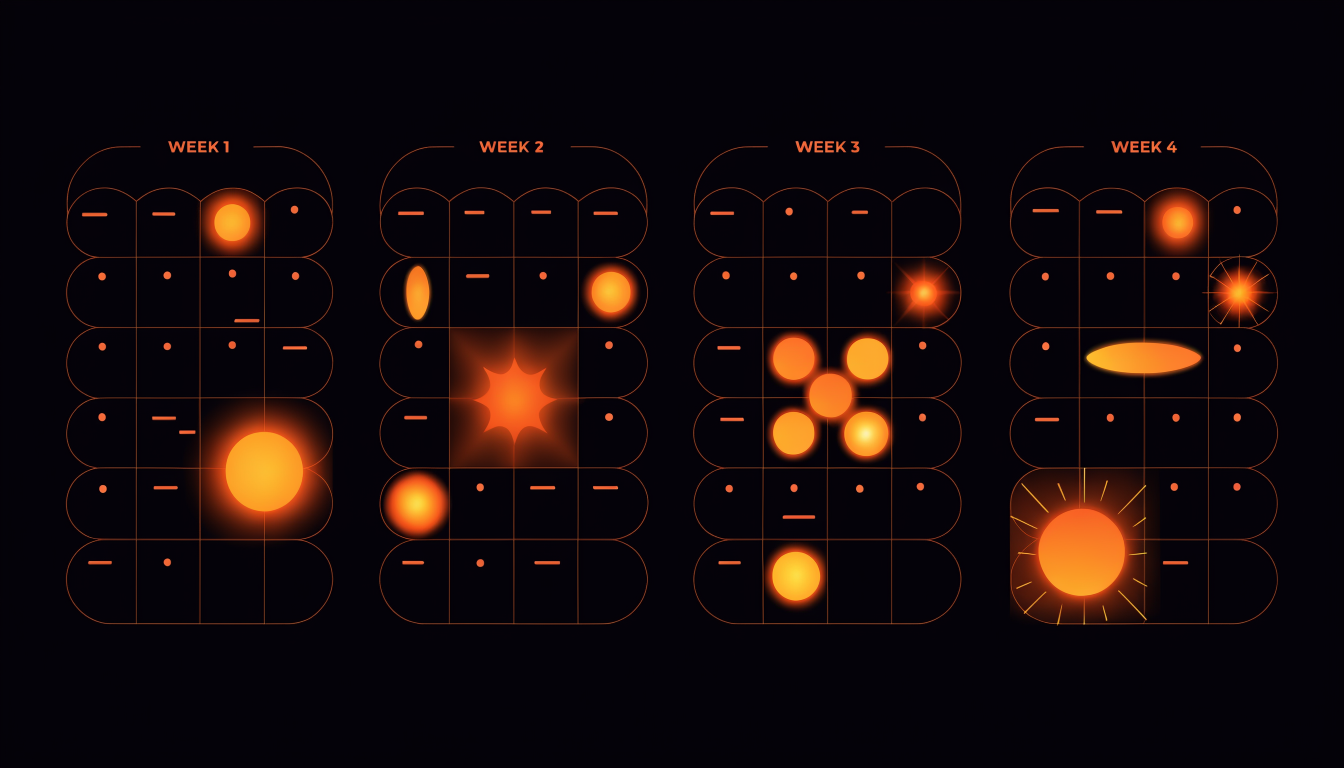
Black Friday/Cyber Monday is the highest-stakes week of the year for most e-commerce brands on Meta. It's also the week where Q3 prep decisions show up most starkly. Brands that stockpile creative, build their account structure, and lock their Q4 budget plan starting in late August consistently outperform brands that "ramp up in October." The reason is mechanical: third-party sources report Black Friday week CPMs 50-80% above baseline, a new ad set needs roughly 50 optimization events in a 7-day window to exit the learning phase, and creative fatigue accelerates dramatically under high-frequency Q4 delivery. By the time Halloween hits, late starters are running stale creative through learning-phase campaigns at premium CPMs. They lose, even if they have a great offer.
This guide is the 28-day BFCM launch calendar, working backward from Black Friday week. It covers what to build, when to build it, how many creatives to stockpile, and the budget pacing that keeps you in the auction without burning unnecessary spend.
Reading this in October? You are on time. Day one of the calendar is October 30. Use the weeks before it to test new hooks and offers while CPMs are still close to baseline; costs start drifting up in late October and step up again the week before Thanksgiving, as the Q4 Meta CPM curve shows. Anything you learn now is learned at the cheapest prices of the quarter.
Download the calendar (CSV + calendar file)
The whole plan below is in one free download: adriselab-bfcm-2026-calendar.zip (7 KB). No sign-up.
- bfcm-2026-meta-ads-checklist.csv: one row per day from October 30 to December 12, with the phase, the task, what to do, the budget step against normal daily spend, and empty Owner and Done columns. Opens in Google Sheets, Excel and Numbers.
- bfcm-2026-meta-ads-calendar.ics: the same 28 tasks as all-day events. Import into Google Calendar (Settings, Import and export), Apple Calendar (File, Import) or Outlook. Events are marked free, so they do not block meetings.
Every date and number in the files comes from this article, so if you change a date in your copy, the reasoning for it is in the matching section below.
The High-Level Calendar
For BFCM 2026 (Black Friday: November 27, Cyber Monday: November 30), the calendar anchors are:
T-28 days (October 30, 2026): Account audit and structural lock. All major structural changes complete by this date. After this, no new ad sets, no audience changes, no major Pixel/CAPI changes.
T-21 days (November 6): Creative production sprint starts. By T-15 (November 12), your stockpile of brand-approved, ready-to-launch creative is at least 30 distinct ads, organized by funnel stage.
T-14 days (November 13): Warm-up campaigns live. Pre-BFCM teaser and warm-up campaigns launch this date to get the algorithm into a learned state before the high-CPM window opens.
T-7 days (November 20): Full BFCM creative stack in rotation. All BFCM-specific offer creative is live and beginning rotation.
T-0 (November 27): Black Friday launch. Peak-spend mode begins.
T+3 days (November 30): Cyber Monday continuation. Sustained peak-spend mode with Cyber Monday-specific creative rotated in.
T+7 days (December 4): Post-BFCM scale-down begins. Gradual budget reduction begins, fatigue analysis kicks in.
Each phase has specific tasks. Below is the breakdown.
T-28 to T-22: Structural Foundation Week
This is the foundation phase. The structural decisions you lock in here govern everything that happens for the next month.
Day -28: Account-level audit. Pull Opportunity Score for every campaign. Anything under 65 needs structural intervention this week. Target: every campaign at 70+ before BFCM creative drops.
Day -27: Pixel and CAPI verification. Confirm Event Match Quality scores are at 7+ for purchase events in Events Manager. If CAPI isn't implemented, this is the last reasonable window. Implementing CAPI for the first time after T-21 is risky because the system needs time to stabilize signal quality.
Day -26: Campaign consolidation. If you have more than 3-5 active campaigns, consolidate. BFCM is the wrong time to run a fragmented account structure. Each campaign should have a clear job: cold prospecting, mid-funnel retargeting, bottom-funnel retargeting, possibly a separate Advantage+ sales campaign (formerly Advantage+ Shopping).
Day -25: Budget pacing plan locked. Calculate your peak-week budget: 1.5x normal daily spend during warm-up (T-14), 2x when the full offer goes live (T-7), 2.5x two days before Black Friday, and 3-4x from Black Friday through Cyber Monday. Get the spend plan approved internally now to avoid mid-November debates.
How to raise budget without wrecking delivery. Each step above is bigger than the 20% budget edit that the learning-phase guide flags as a reset risk. That is the trade-off of peak week, and it is why the steps are planned the way they are: made at campaign level rather than by restructuring ad sets, applied to ad sets that already exited learning during warm-up, and put in place before the Thanksgiving-week cost step-up. An increase made on Black Friday morning arrives after prices have already moved. Set the Black Friday and Cyber Monday steps in advance with budget scheduling in Ads Manager so nobody is editing budgets at 6am on the day.
Day -24: Audience consolidation. Move toward Advantage+ audience targeting. BFCM is the worst time for narrow targeting because high-CPM weeks reward audience breadth.
Day -23: Promotional landing pages built. All BFCM-specific landing pages live, mobile-optimized, and tracked. CTAs and form events firing into the Pixel/CAPI.
Day -22: Internal team alignment. Customer service, fulfillment, and inventory teams synced on the campaign plan. This sounds obvious but is the #1 cause of post-BFCM regret when operational capacity doesn't match ad demand.
T-21 to T-15: Creative Stockpile Week
The creative phase. By the end of this week, you should have 30-50 distinct ad creatives ready to deploy, organized by funnel stage and offer angle.
Target creative inventory by funnel stage:
- Cold prospecting: 15-20 distinct creatives across formats (60% static, 25% short video, 15% carousel)
- Mid-funnel retargeting: 10-12 distinct creatives focused on objection handling and social proof
- Bottom-funnel retargeting: 8-12 distinct creatives focused on offer reinforcement and urgency
Build every concept in more than one crop. Advertisers began reporting on August 25, 2026 that manual placement selection was disappearing from ad sets. The replacement, value rules, can lower your bid for a placement by at most 90 percent, so a placement can be made expensive to win but not switched off. For BFCM that means the old fix of excluding Reels or Audience Network when a creative looks wrong there is no longer reliable. Produce each concept as a vertical 9:16 version and a 4:5 or 1:1 feed version, so whatever placement Meta chooses gets a creative made for it. The details are in what replaced placement controls.
Creative themes to cover:
- Discount-led creative (the headline offer)
- Value-bundle creative (gift sets, bundles, BOGO framings)
- Social proof creative (review composites, UGC stills)
- Urgency creative (countdown frames, "ends soon" messaging)
- Gift-recipient creative (for gift-giving categories: "Perfect gift for [recipient]")
- Free shipping / value-add creative (for categories with low base discounts)
Why 30-50 is the right number. The math is straightforward: BFCM delivery happens at 4-8x your normal daily volume. Creative fatigue accelerates proportionally. A creative that lasts about two weeks at normal delivery can fatigue in 3-5 days under BFCM delivery pressure. To run a 10-day BFCM campaign cleanly, you need a refresh of 3-5 creatives per day, which works out to 30-50 distinct creatives in rotation.
Day -21: Creative production sprint begins. Block calendars. If you're using AI creative tools, this is when you generate the bulk inventory.
Day -20 to -18: Creative production sprint. Producing 30+ distinct creatives across formats in 3 days requires AI tools, an agency partner, or a dedicated in-house creative team operating at full capacity.
Day -17: Internal creative review and brand QA. Filter the production batch for brand consistency, legal/compliance check, and offer accuracy.
Day -16: Pre-BFCM creative testing on small budget. Launch a $200-500 test campaign with the top 10 creatives to validate they're landing. This is small-spend, signal-only testing, not a real launch.
Day -15: Creative organization and ad set assignment. All 30-50 creatives organized by funnel stage and ready for assignment to specific ad sets.
T-14 to T-8: Warm-Up Week
The warm-up phase. Pre-BFCM campaigns go live to get the algorithm learning before peak-CPM week opens. The goal is not to drive massive sales this week, the goal is to get out of learning phase before the expensive auction hits.
Day -14: Warm-up campaigns launch. These are full Advantage+ campaigns running your top 8-10 creatives with the regular offer (not the BFCM-specific offer). Budget: 1.5x normal daily spend. This generates real conversion signals at near-normal CPMs and warms the algorithm.
Day -13 to -10: Algorithm stabilization period. Let warm-up campaigns run. Resist the urge to optimize aggressively. Daily pause/scale decisions are fine, but no structural changes.
Day -9: First BFCM-specific creative drops into rotation. Soft BFCM messaging starts mixing into warm-up campaigns ("Black Friday is coming," teaser content). Not the full offer yet.
Day -8: Audience exclusion verification. Confirm that warm-up campaign audiences will properly exclude/include from BFCM campaigns. Audience overlap during peak week wastes spend.
T-7 to T-1: Pre-Launch Week
The pre-launch phase. Full BFCM creative drops in. Spend ramps up. This is the final preparation before peak week.
Day -7: Full BFCM creative goes live. The actual offer creative replaces teaser content. All 30+ creatives are now in rotation across cold, mid, and bottom funnel campaigns. Budget: 2x normal daily spend.
Day -6 to -4: Active monitoring and creative culling. Identify which creatives are early-performing winners and which are early losers. Pause clear losers (CPA 50%+ above target after 3+ days). Increase delivery weight on early winners.
Day -3: Final creative refresh prep. Identify which creatives need to be refreshed during peak week (typically the ones already showing early fatigue signals). Stage replacements ready to deploy.
Day -2: Pre-peak budget increase. Bump daily spend to 2.5x. The auction is already heating up; you want to capture pre-Black-Friday intent. Confirm the scheduled 3-4x step for Black Friday is in place now, not on the morning itself.
Day -1 (Thanksgiving): Hold spend, light monitoring. Most US e-commerce performance dips on Thanksgiving Day itself. Don't panic and over-correct. The next day reverses sharply.
T-0 to T+3: Peak Week (Black Friday + Cyber Monday)
The execution phase. This is what everything else built up to.
Day 0 (Black Friday): Full peak budget. 3-4x normal daily spend, already scheduled from Day -2. All BFCM creative in rotation. Monitor in 4-hour intervals, not daily.
Day +1: Weekend continuation. Maintain peak budget through the weekend. Many advertisers reduce spend on Saturday/Sunday, which is a mistake, Cyber Monday demand builds across the weekend.
Day +2: Pre-Cyber Monday creative refresh. Drop in the Cyber Monday-specific creative variations (different offer framing, urgency messaging, "extended for one more day" hooks).
Day +3 (Cyber Monday): Peak sustained. Full peak budget. Monitor creative fatigue aggressively. Anything showing 30%+ CPA degradation gets paused immediately and replaced with held-back stockpile creative.
T+4 onward: Post-Peak Scale-Down
The wind-down phase. Gradual budget reduction with fatigue analysis.
Day +4 to +7: Gradual scale-down to 1.5x normal spend. Don't hard-stop. Many late shoppers and gift purchasers convert in early December.
Day +8 to +14: Return to normal spend. Phase out BFCM-specific creative. Phase in holiday gift-giving creative for the December gifting cycle.
Day +15: Full post-mortem. What worked, what didn't, what creative angles generated the cheapest conversions, what to repeat next year. Document everything while it's fresh.
Don't compare 2026 to 2025 on Meta-reported conversions alone. Meta removed the 7-day and 28-day view windows from the Ads Insights API on January 12, 2026, and on March 3 narrowed click-through attribution to link clicks, moving likes, saves and 5-second video views into engage-through attribution. Last year's BFCM and this year's are counted under different rules, so a lower reported number can be a definition change rather than a worse result. Compare store orders and revenue first, then read Meta columns on the same attribution setting. The full breakdown is in engage-through attribution.
How AI Creative Tools Change the BFCM Equation
The single biggest operational change in BFCM prep over the past two years is creative production capacity. Producing 30-50 distinct ad creatives used to require a 2-3 week creative sprint with a full design team. With AI creative tools, the same volume is producible in 1-2 days at fraction of the cost.
AdRiseLab specifically generates 15-30 distinct ad creatives from a single product URL or landing page in under a minute, across formats and hook angles, in feed, square and vertical crops. The short-video share of the mix is covered too: video ads and AdFlow UGC render 4-15 second creator-style clips on every paid plan, with the credit cost shown before rendering. For BFCM prep, this means the creative stockpile phase compresses from 7 days to 1-2 days, freeing 5+ days for testing, refinement, and warm-up campaign optimization. Campaigns, ad sets and ads are created in your connected Meta account only after you confirm the launch, and budget and structure decisions stay with you. Get started with AdRiseLab.
Related Reading
See how many creatives your account actually needs to back into the right BFCM stockpile size. Read the creative testing framework for the 5-7 day testing cycle that validates BFCM creative before peak week. And understand the Andromeda algorithm drivers that determine whether your BFCM campaigns will scale cleanly. And before committing peak-week budget, run the headroom arithmetic in the Q4 Meta CPM curve: the decision turns on whether your conversion rate rises faster than your CPM, not on the CPM headline.