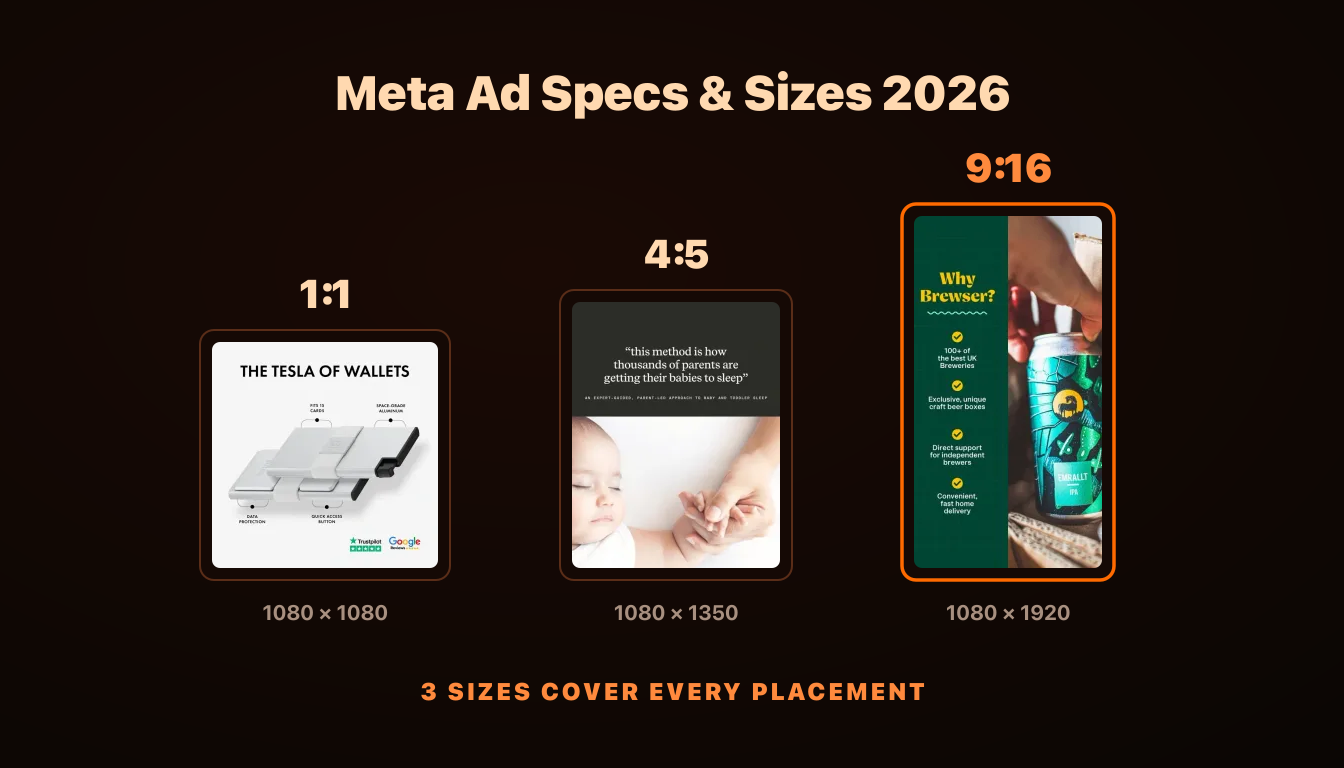
Every Meta ad spec that matters in 2026, in one reference. The short version: produce every creative in three sizes — 1080×1080 (1:1), 1080×1350 (4:5), and 1080×1920 (9:16) — keep videos in MP4/H.264 under 30 seconds, and write primary text so the first 125 characters carry the message. The rest of this cheat sheet covers each placement's exact requirements, the text limits, and the safe zones that keep your CTA from being buried under UI elements.
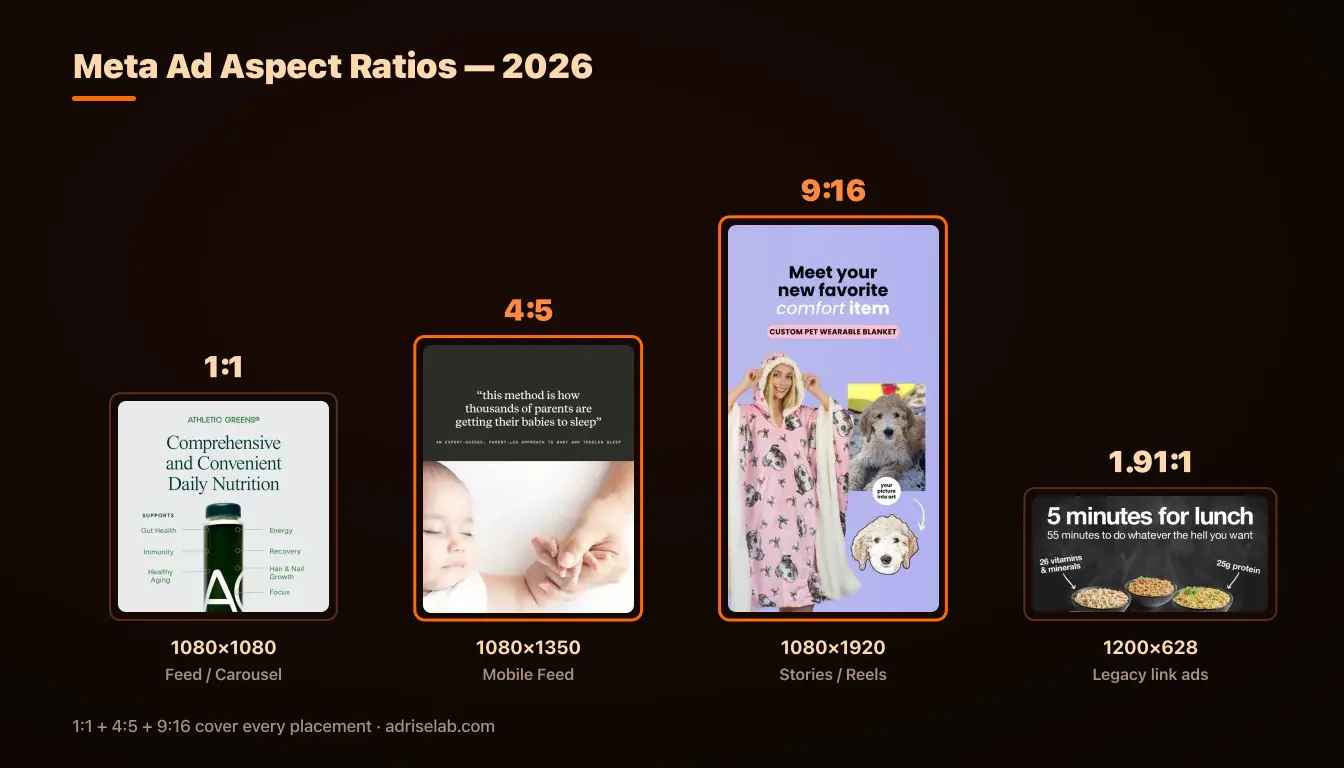
Image Ad Specs by Placement
Facebook & Instagram Feed:
- Recommended size: 1080×1350 (4:5) — the tallest ratio Feed supports, maximizing mobile screen share.
- Also supported: 1080×1080 (1:1) — required for some catalog and carousel contexts.
- Landscape 1200×628 (1.91:1) — legacy format; only use for link ads where the image is secondary.
- File types: JPG or PNG, max 30MB.
- Minimum width: 600px — but always export 1080px+; Meta's compression punishes small sources.
Stories & Reels (Facebook and Instagram):
- Size: 1080×1920 (9:16) full-screen vertical, no exceptions worth making.
- Safe zones: keep text and CTAs out of the top 14% (269px), the bottom 35% (672px) and 6% (65px) on each side, where profile chrome and CTA overlays render. Check your own file with the safe zone checker or use its free overlay templates; full safe-zone maps are in our vertical video production guide.
- Letterboxed 1:1 assets in these placements consistently underperform native 9:16 — this is the most common spec mistake in 2026 accounts.
Right column, search, and Audience Network accept 1:1 and 1.91:1 assets automatically; they're low-volume placements that don't justify dedicated production.
Video Ad Specs
Video requirements for 2026:
- Container: MP4 or MOV, H.264 codec, AAC audio.
- Max file size: 4GB. Max duration 241 minutes — irrelevant in practice; 15-30 seconds is the performance window for cold traffic, with the first 3 seconds doing most of the work.
- Resolution: 1080px minimum width. 4K sources are downscaled; they don't hurt but don't help.
- Frame rate: 24-30fps. 60fps is supported but adds file size without measurable lift.
- Captions: always. Burned-in or uploaded SRT — feeds are watched in silence more often than not.
- Thumbnail: set it manually. Auto-selected frames are a quiet CTR killer.
On the strategic question of whether to produce video at all: our static vs video analysis found a 60/40 image-heavy mix beats video-only strategies in most verticals — video is mandatory for Reels placements, not for the account as a whole.
Carousel Ad Specs
Carousel requirements:
- Cards: 2-10 per carousel, each 1080×1080 (1:1). Square is the only ratio carousels render consistently across placements.
- Per-card text: headline ~40 characters, description ~20 characters before truncation.
- Mixed media allowed — image and video cards can share one carousel; keep video cards under 15 seconds.
- First card carries the campaign. Card 1 gets 60-70% of total carousel impressions-weighted attention; sequence accordingly. The full card-sequencing playbook is in carousel ad anatomy.
Text Field Limits That Actually Matter
Meta's technical limits are generous; the visible limits are what determine performance:
Visible text limits in 2026:
- Primary text: first ~125 characters show on mobile Feed before "See more." Front-load the hook and the offer.
- Headline: ~40 characters in Feed, as few as 27 in some placements. One idea, no subordinate clauses.
- Description: ~30 characters, renders inconsistently. Treat it as optional garnish, never load-bearing.
- Text on image: no formal penalty since the 20% rule retired, but text-heavy images still underperform — the algorithm's quality signals correlate with native-feeling visuals.
Aspect Ratio Strategy Under Advantage+ Placements
The spec sheet above is table stakes; the strategic layer is ratio coverage. Advantage+ Placements (the 2026 default) distributes your ads across every surface — but it can only serve placements you've supplied ratios for. An ad set with only 1:1 assets effectively forfeits optimal delivery on Stories and Reels, placements that now carry more than half of available impressions and meaningfully cheaper CPMs.
The operational standard in 2026: every creative concept ships in all three ratios at launch. Manually, that triples production time — which is why ratio coverage is one of the strongest arguments for automating creative production. AdRiseLab generates every creative in all three formats automatically: one URL in, 10 concepts × 3 ratios = 30 ad-ready assets out.
Common Spec Mistakes That Cost Performance
The five we see most in account audits:
- 1.One 1:1 asset running everywhere. Letterboxed Reels delivery, wasted impressions.
- 2.Critical text in Stories safe-zone margins. CTAs hidden behind the swipe-up chrome.
- 3.Sub-1080px source images. Meta's compression turns them visibly soft.
- 4.125+ character openers. The offer dies behind "See more."
- 5.Auto-selected video thumbnails. A mid-blink frame as your ad's first impression.
AdRiseLab handles specs automatically — every generated creative exports in 1:1, 4:5, and 9:16 with safe-zone-aware text placement, ready to publish directly to your ad account. Get started with AdRiseLab.
Related Reading
Producing every ratio matters more than it used to: Meta is removing placement controls from ad sets, so the crop is now the only reliable control over how an asset renders. Go deeper on 9:16 production specs and safe zones for Stories and Reels. See carousel card sequencing for the highest-converting card orders. And read the Reels-first strategy guide on why 9:16 should lead your production pipeline, not trail it.