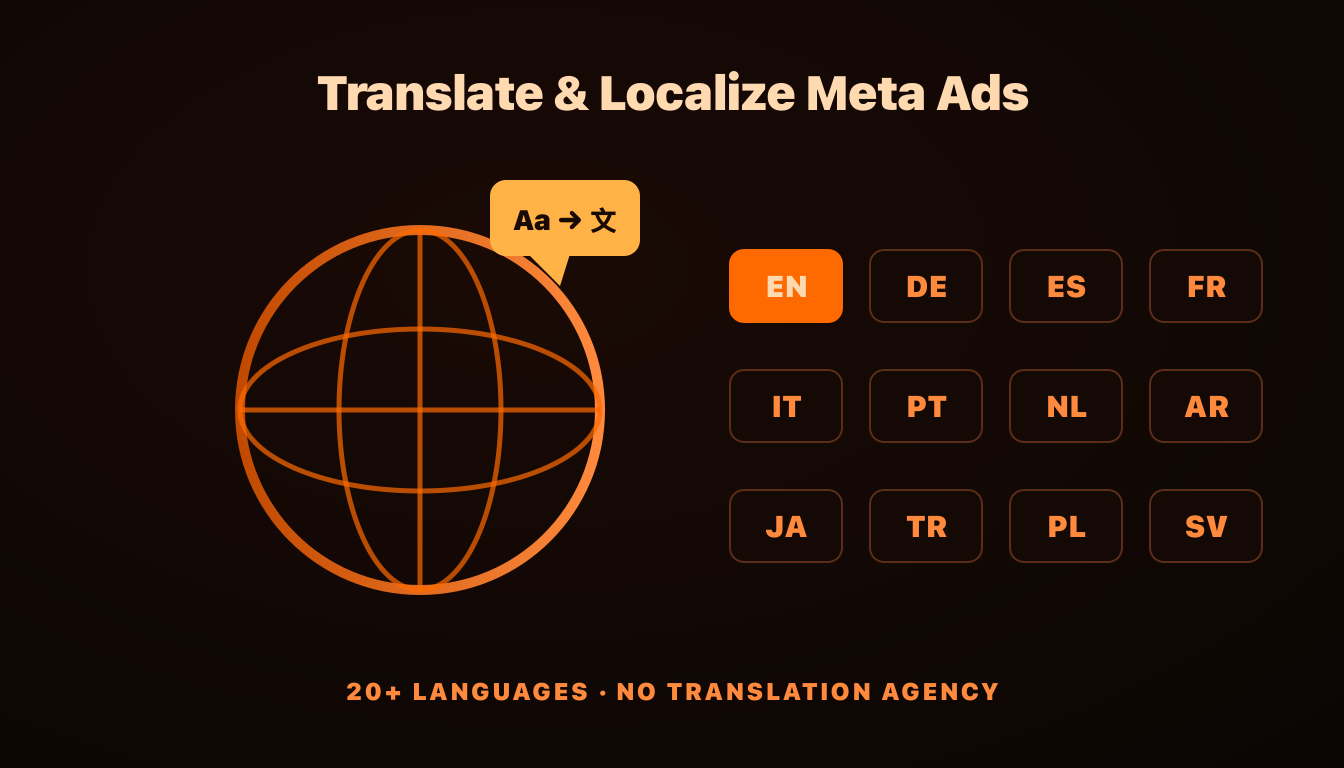
English ads in non-English markets quietly underperform by 30-40% on CTR — even in markets where everyone speaks English. Users scroll-stop reflexively on their own language; a foreign-language ad gets processed a beat slower, and in feed advertising that beat is the impression. This guide is the complete 2026 workflow for localizing Meta ads without a translation agency: what actually needs localizing, the AI generation pipeline that replaced per-market production, the QA traps that make localized ads look foreign anyway, and the campaign structure that makes multi-market results readable.
Why Localization Pays More in 2026 Than Ever
Two structural shifts raised the stakes. First, Meta CPMs jumped 20% in mature English-speaking markets — while CPMs in many European, Latin American, and Gulf markets remain 30-60% lower, making expansion the cheapest growth lever many DTC brands have. Second, the Andromeda algorithm reads creative signals — and language is the loudest signal in the set. A native-language creative gets matched to its market's users with precision that an English creative with country targeting never achieves.
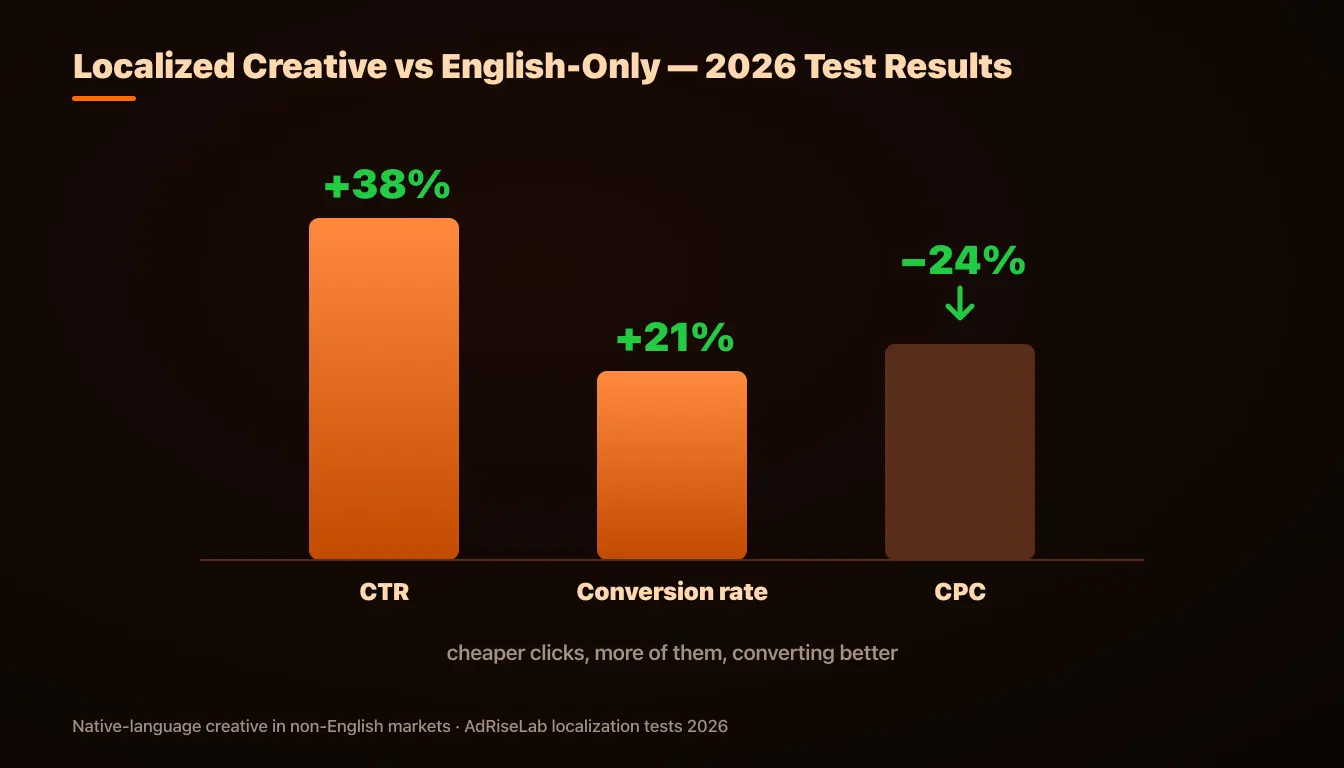
The arbitrage is real: brands that localize properly access cheaper auctions with stronger creative-market fit, and the effect compounds across CTR, CPC and conversion rate versus running the English originals in the same markets.
What "Localized" Actually Means (It's Not the Caption)
The most common failure mode is translating the primary text while the creative itself stays English. Users see the image first — and an English headline baked into the visual with a German caption underneath reads as a foreign ad with subtitles. Full localization covers:
The complete localization inventory:
- Overlay text in images and video — the highest-visibility language in the ad.
- Primary text, headline, description — written natively, not translated word-for-word.
- CTA framing — "Jetzt entdecken" beats a literal rendering of "Discover now."
- Currency, prices, and sizing conventions — €, local VAT-inclusive pricing, EU sizing.
- Captions and voiceover for video — AI voiceover now handles native-accent generation in most major languages.
- Cultural references and imagery — seasons, holidays, aesthetics, and social proof that match the market.
- The landing page — a perfect German ad clicking through to an English checkout wastes everything upstream.
The AI Pipeline That Replaced Agency Localization
The traditional workflow — brief an agency, wait two weeks, pay per language, iterate by email — is why most brands never localized properly. The 2026 workflow inverts it: generate natively in each language from the start. AdRiseLab generates ad creatives in 20+ languages directly from a product URL — the overlay text, copy, and CTA are produced in the target language at generation time, not retrofitted onto an English design. One URL becomes native creative sets for every market you operate in, in the same generation flow as your home-market ads.
This matters beyond speed: per-market creative volume. Localized markets need the same 10-15+ creative diversity and weekly refresh cadence your home market does — a single translated hero ad fatigues just like a single English one. AI generation is what makes maintaining five markets' creative pipelines operationally possible for a small team.
The QA Traps That Make Localized Ads Look Foreign Anyway
Four traps catch nearly everyone:
Text expansion. German runs ~35% longer than English, French ~20%, Finnish compounds unpredictably. Overlay text that fills the layout in English overflows it in German — design with expansion headroom or regenerate layouts per language rather than squeezing fonts.
Right-to-left languages. Arabic and Hebrew require mirrored layouts — reading flow, image-text relationships, even directional arrows flip. Translated text dropped into an LTR layout is instantly recognizable as foreign and visually broken to native readers.
Idiom and register. "Game-changer," "no-brainer," and most hook formulas don't translate — they need native equivalents with the same psychological function. This is where one native-speaker review pass per market earns its cost many times over; reviewers catch in minutes what A/B tests would take weeks to reveal.
False-friend pricing. Unconverted dollar prices, missing VAT (EU prices are tax-inclusive by expectation), and US-only offers ("free shipping" that isn't) erode trust at the moment of click.
Campaign Structure for Multi-Language Accounts
One language-market per ad set, no exceptions. Mixed-language ad sets let delivery pool toward the cheapest market, make per-language results unreadable, and break creative-market matching. The clean structure: a campaign per region (or per market at scale), ad sets per language-market, each funded to clear its own learning phase, each benchmarked against local CPM/CPC baselines rather than your home market's. From there, multi-market operation runs like an agency managing multiple accounts: standardized weekly refresh, per-market fatigue monitoring, and budget flowing to the best margin-adjusted CPA.
AdRiseLab's 20+ language generation, three-format export, and direct publishing make a five-market creative operation feel like running one account. Get started with AdRiseLab — plans from $39/mo, cancel any time.
Related Reading
Pair market expansion with the CPM arbitrage picture and placement-level costs. For the creative volume side, see how e-commerce brands scale to 50+ creatives a week and the URL-to-creative workflow that powers it.