
Meta is removing manual placement selection from ad sets. Advertisers began reporting its disappearance on August 25, 2026. What replaces it is a value rule, which adjusts your bid for a placement rather than turning the placement off.
The distinction is not academic. A value rule permits bid adjustments from plus 1,000 percent down to minus 90 percent. A minus 90 percent adjustment makes a placement expensive to win. It does not make it impossible to win. Exclusion has become suppression.
If your brand-safety policy, your creative specification, or your client contract assumed a placement could be switched off, that assumption no longer holds.
What was removed
Reporting describes the removal of placement-level controls in ad sets, including exclusions by placement, by platform, by device, and by operating system.
This did not arrive without warning. It is the last step in a sequence that has been running for eighteen months.
| Date | Change |
|---|---|
| January 21, 2025 | Detailed targeting exclusions removed |
| October 16, 2025 | A default 5 percent budget allocation to excluded placements introduced |
| February 18, 2026 | Advantage+ structure stopped permitting campaign-level exclusions |
| July 29, 2026 | Instagram Explore Feed and Messenger Stories removed from placement selection |
| August 25, 2026 | Advertisers begin reporting placement selection gone, value rules in its place |
Read as a sequence, the October 2025 change is the tell. Once excluded placements still received 5 percent of budget, exclusion had already stopped meaning exclusion. The August 2026 change removed the remaining fiction.
The official status, stated plainly
At the time of writing, Meta has published no announcement, and Help Centre documentation still describes manual placement selection as an available setting. The rollout appears to be gradual and account by account, which is why two media buyers can compare screens and disagree about whether it has happened.
This matters more than it sounds. If you are reading a page that presents this as finalised, platform-wide and officially documented, that page is ahead of the evidence. Check your own ad set. The control is either there or it is not, and that is the only reliable test available today. Source: PPC Land on the placement control removal.
What a value rule can and cannot do
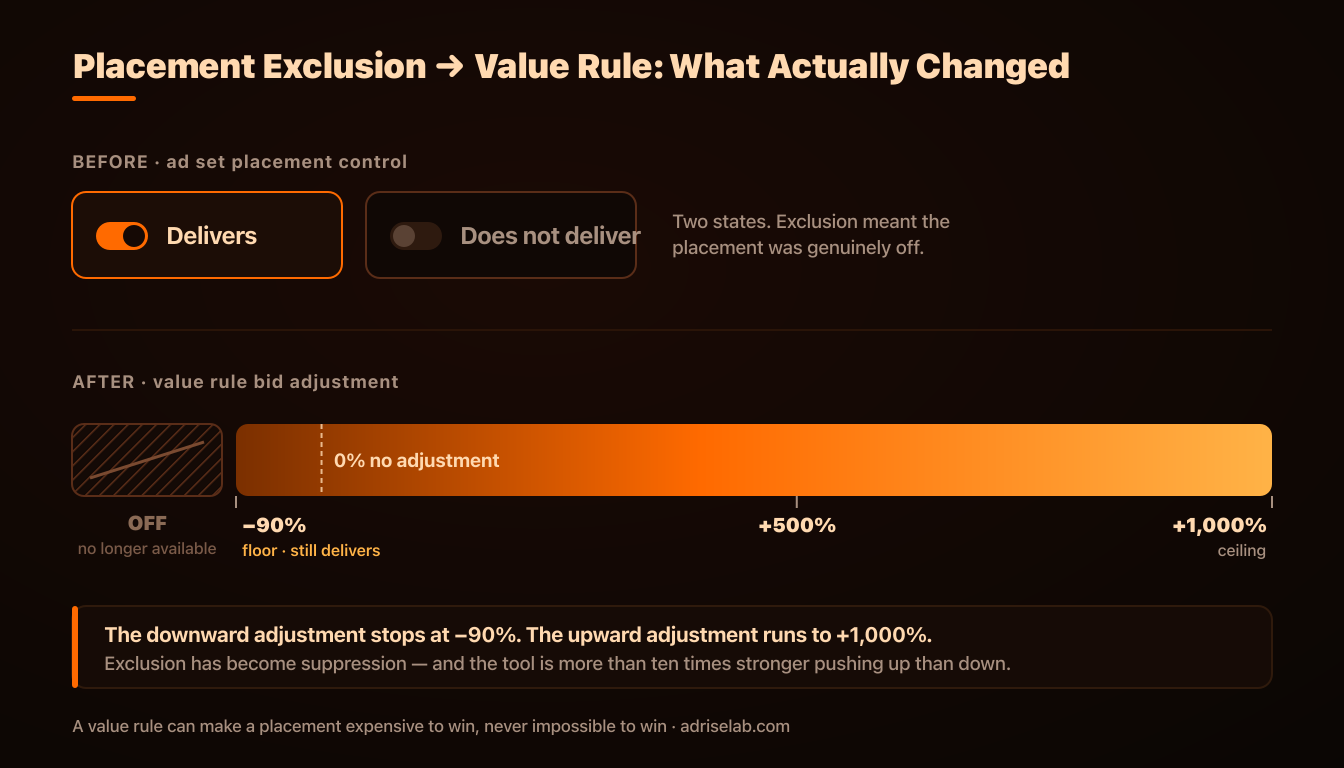
A value rule adjusts how much you are willing to bid for an impression carrying a given attribute. Value rules currently allow adjustments across seven eligible placements, plus devices and mobile operating systems.
| Capability | Old placement control | Value rule |
|---|---|---|
| Prevent delivery on a placement | Yes, nominally | No |
| Reduce delivery on a placement | Yes | Yes, to a floor of −90% |
| Increase delivery on a placement | Only indirectly, by excluding others | Yes, to +1,000% |
| Guarantee a creative never appears somewhere | Yes, nominally | No |
The asymmetry is the story. The upward adjustment is more than ten times larger than the downward one. This is a tool built to redistribute spend toward what the delivery system already favours, not a tool built to let you fence part of it off.
The performance justification, and how to read it
Meta reportedly justifies the change with performance data: ad sets using Advantage+ placements delivered an 11.7 percent lower cost per action on average than ad sets using manual placement settings.
That figure deserves the standard caution. Advertisers who choose manual placements are not a random sample. They are disproportionately advertisers with a reason to restrict placements - a creative that only works in feed, a regulated vertical, a brand-safety requirement, or an asset library that never got the vertical crop. A comparison between two self-selected groups measures the selection at least as much as it measures the setting.
The honest reading is narrower and still worth accepting: broad placements usually do outperform hand-picked ones, which has been true for several years and is consistent with how the Meta ads auction allocates impressions. What the change removes is the option to be wrong about it.
What this actually breaks
Four things break, in descending order of urgency:
- 1.Brand-safety commitments. If you have told a client, a legal team or a compliance reviewer that your ads will not run in a given surface, you can no longer deliver that promise through ad set settings. Say so, in writing, before it surfaces in a report.
- 2.Aspect-ratio assumptions. Placement exclusion was how many teams avoided shipping a 1:1 static into a full-screen vertical surface where it renders with heavy padding or crops the headline. The fix now moves upstream into the asset.
- 3.Reporting comparability. Any performance comparison spanning the rollout date mixes two different delivery regimes. Annotate it, or the next person reads a settings change as a performance change.
- 4.Test design. A creative test that assumed a fixed placement mix no longer has one. If placement mix drifts between cells, the difference you measure includes that drift.
What to do instead
Ranked by how much they actually help:
- 1.Produce every crop. Ship 9:16, 4:5 and 1:1 for every concept rather than relying on a setting to protect a single ratio. This is the only response that fully removes the exposure. The [ad specs cheat sheet](/blog/meta-ad-specs-sizes-2026-cheat-sheet) and the [9:16 production specs](/blog/vertical-video-meta-ads-9-16-production-specs) cover the requirements.
- 2.Apply a minus 90 percent value rule where you previously excluded. It is the strongest available suppression. Treat it as a strong preference, not a guarantee.
- 3.Move genuine hard exclusions up a level. Where a placement must never be used, the remaining levers are campaign objective and format choice, not ad set configuration.
- 4.Read the placement breakdown weekly. If you cannot prevent a placement, you at least need to see it early. That breakdown is now a monitoring surface rather than a confirmation that your settings held - see [account analytics](/product/account-analytics).
- 5.Rewrite the client-facing language. Replace we exclude with we bid down, because the second one is true.
How to check your own account
Because the rollout is gradual, the only answer that applies to you is the one in your own Ads Manager:
- Open any ad set and look for the placements section. If manual selection is gone, you are on the new behaviour.
- Look for a value rules entry point. Where it has replaced placement selection, the bid adjustment range is the control you now have.
- Export a placement breakdown for the last 30 days and compare it with the 30 days before August 25. A visible shift in placement mix with no settings change on your side is the signature.
- Record the date you observed the change. When you later explain a performance shift, that annotation is the difference between a diagnosis and a guess.
The part that outlasts this change
Every narrowing step in the timeline above points the same way: the controls that live in campaign settings keep shrinking, and the controls that live in the creative keep mattering more. Placement exclusion is simply the latest setting to stop being a setting.
The practical consequence is that creative production is now the brand-safety layer, the formatting layer and the targeting layer at once. An asset library with every crop, built to be legible in a surface you did not choose, is the version of control that Meta cannot remove from an ad set. AdRiseLab generates image and video creative for Facebook and Instagram from a connected Meta ad account, and campaign structure, budget and final publishing stay with the advertiser.
Related Reading
For the asset side of this, 12 Meta video ad script templates covers the shot structure and every required ratio, and static ad anatomy does the same for images. Meta Advantage+ creative best practices explains what the automated layer does with your assets once placement selection is gone, and the Andromeda algorithm covers the retrieval system deciding which of them gets shown.