
A Meta video ad script is four decisions, not a paragraph of copy: what is on screen at second zero, what claim carries seconds one to three, what evidence occupies the middle, and what the last two seconds ask for.
The twelve templates below fix three of those four and leave one open. That is what makes them testable. Swapping a template's open variable produces a comparison you can interpret. Swapping the background colour does not.
Every template targets a 15-second runtime, sound-off legibility, and a 9:16 or 4:5 frame. Production requirements are in the 9:16 production specs and the ad specs cheat sheet.
The structure every template follows
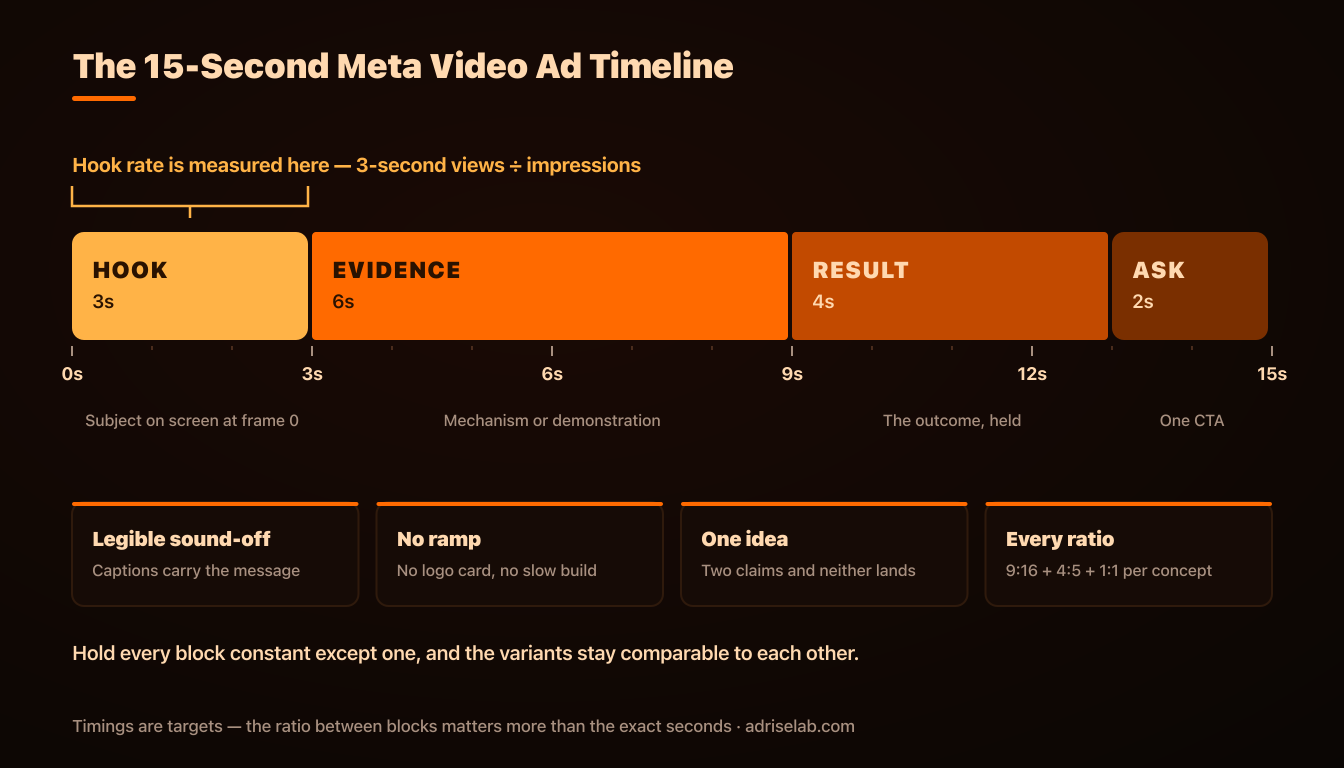
Timings are targets rather than rules. The ratio between the blocks matters more than the absolute seconds, and a 30-second cut simply stretches the middle two.
Each template below lists timing, shot, on-screen text and audio. The open variable line names the one element to change when you build variants. Hold everything else. Five variants of one template with five values of its open variable is a readable test. Five different templates at once is a shotgun.
The twelve templates
1. Problem-first
| Time | Shot | On-screen text | Audio |
|---|---|---|---|
| 0.0-0.5s | The failure state, mid-action | The problem in four words | Ambient, no music intro |
| 0.5-3.0s | Same shot, closer | The consequence line | Direct address |
| 3.0-9.0s | Product resolving the failure | The mechanism, one line | Explanation |
| 9.0-13.0s | The result state | Outcome claim | Calm |
| 13.0-15.0s | Product plus offer | CTA | CTA spoken |
Open variable: which problem. Test three genuinely different pains, not three phrasings of one.
2. Direct offer
| Time | Shot | On-screen text | Audio |
|---|---|---|---|
| 0.0-1.0s | Product, full frame, moving | The offer, stated | Offer spoken immediately |
| 1.0-5.0s | Product in use | What you get | Specifics |
| 5.0-11.0s | Two or three feature beats | One line each | Fast |
| 11.0-15.0s | Offer card | Deadline or condition | CTA |
Open variable: the offer framing. Percentage off, currency off, bundle, or free add-on.
3. Confession
| Time | Shot | On-screen text | Audio |
|---|---|---|---|
| 0.0-2.0s | Face, handheld, close | I was wrong about... | First person |
| 2.0-6.0s | Same | The prior belief | Unscripted cadence |
| 6.0-12.0s | Cut to product | What changed | One specific detail |
| 12.0-15.0s | Face again | Recommendation | CTA |
Open variable: the admission. It has to be an objection your buyers actually hold, not a manufactured one.
4. Demonstration, no talking
| Time | Shot | On-screen text | Audio |
|---|---|---|---|
| 0.0-1.0s | Hands, product entering frame | None | Product sound only |
| 1.0-10.0s | One unbroken use sequence | Two captions maximum | Natural sound |
| 10.0-14.0s | Result, held | Result stated | Natural sound |
| 14.0-15.0s | Product, CTA | CTA | Brief sting |
Open variable: which single use case. One per ad, never two.
5. Objection handler
| Time | Shot | On-screen text | Audio |
|---|---|---|---|
| 0.0-2.5s | Face | The objection, verbatim | Quoted |
| 2.5-5.0s | Face | Fair. | Acknowledgement |
| 5.0-12.0s | Product evidence | The specific counter | Evidence |
| 12.0-15.0s | Product | CTA | CTA |
Open variable: which objection. Source them from your own ad comments and support tickets - see comments to creative.
6. Comparison
| Time | Shot | On-screen text | Audio |
|---|---|---|---|
| 0.0-1.5s | Split frame, both options visible | Before / After | Hook line |
| 1.5-8.0s | Alternating, three beats | One differentiator per beat | Fast cuts |
| 8.0-13.0s | Your option alone | The summary difference | Calm |
| 13.0-15.0s | Product | CTA | CTA |
Open variable: the axis of comparison. Time, cost, effort, or result.
7. Unboxing
| Time | Shot | On-screen text | Audio |
|---|---|---|---|
| 0.0-1.0s | Package already opening | Finally arrived | Natural sound |
| 1.0-7.0s | Contents revealed one at a time | Name each item | Reaction |
| 7.0-12.0s | First use | First impression | Unscripted |
| 12.0-15.0s | Product assembled | CTA | CTA |
Open variable: the reveal order. Lead with the item that best differentiates, not the largest one.
8. Founder explanation
| Time | Shot | On-screen text | Audio |
|---|---|---|---|
| 0.0-2.0s | Founder, workspace visible | We built this because... | Direct |
| 2.0-7.0s | Founder | The gap in the market | Specific |
| 7.0-12.0s | Product, handled by founder | The design decision | Detail |
| 12.0-15.0s | Founder | CTA | Personal CTA |
Open variable: which design decision. More in founder-led selfie video.
9. Listicle
| Time | Shot | On-screen text | Audio |
|---|---|---|---|
| 0.0-1.5s | Product, count on screen | 3 things nobody tells you about X | Hook |
| 1.5-5.0s | Beat one | 1. plus the point | Fast |
| 5.0-9.0s | Beat two | 2. plus the point | Fast |
| 9.0-13.0s | Beat three | 3. plus the point | Fast |
| 13.0-15.0s | Product | CTA | CTA |
Open variable: the count and the category. Three is completable in 15 seconds; five is not.
10. Testimonial stitch
| Time | Shot | On-screen text | Audio |
|---|---|---|---|
| 0.0-2.0s | Customer face, mid-sentence | The strongest quote fragment | Customer voice |
| 2.0-8.0s | Two more customers, cut together | Each quote as caption | Customer voices |
| 8.0-12.0s | Product | The common thread | Narrator |
| 12.0-15.0s | Product | CTA | CTA |
Open variable: which benefit the quotes share. All three have to support one claim, or the ad makes none.
11. Process reveal
| Time | Shot | On-screen text | Audio |
|---|---|---|---|
| 0.0-1.5s | Raw material or first step | How it is actually made | Ambient |
| 1.5-10.0s | Four process beats | Name each step | Ambient, light narration |
| 10.0-13.0s | Finished product | The quality claim the process earns | Narration |
| 13.0-15.0s | Product | CTA | CTA |
Open variable: which step to dwell on. Choose the one a competitor cannot replicate.
12. Category education
| Time | Shot | On-screen text | Audio |
|---|---|---|---|
| 0.0-2.0s | Text card over product motion | The question the buyer asks | Question spoken |
| 2.0-9.0s | Explanatory visuals | The answer in three parts | Teaching tone |
| 9.0-13.0s | Product as the applied answer | Where the product fits | Calm |
| 13.0-15.0s | Product | CTA | Soft CTA |
Open variable: the question. Pull it from search queries and support volume, not from imagination.
Production rules that apply to all twelve
These are not style preferences. Each one is a constraint imposed by how the ad is actually viewed:
- 1.Legible with sound off. Assume no audio. Captions are load-bearing, not decorative.
- 2.Respect the safe margins. Keep text clear of the top and bottom of a 9:16 frame where interface elements sit.
- 3.Produce every ratio. Ship 9:16, 4:5 and 1:1 per concept. Placement selection is being removed from ad sets, so the crop is now the only reliable control over how an asset renders - see [the placement controls change](/blog/meta-placement-controls-removed-value-rules-2026).
- 4.No ramp. Second zero must already contain the subject. A logo card is a second of paid silence.
- 5.One idea per ad. Two claims in 15 seconds means neither lands.
- 6.Rights before delivery. Music, voice and likeness need licences that cover paid social specifically, which is a narrower grant than general commercial use.
On that last point, voiceover and music licensing covers the clearance question, creator whitelisting covers running a creator's footage from their handle, and Meta disclosure rules covers what has to be declared.
How to test these without wasting budget
Pick one template. Build five variants changing only its open variable. Hold the offer, the audience, the landing page and the runtime constant.
Judge on hook rate first. Attention metrics reach a readable sample far sooner than conversion metrics, because the denominator is impressions rather than clicks - at a $15 CPM, tens of thousands of impressions are inexpensive, while tens of thousands of clicks are not. Only promote to a conversion judgment what clears the attention gate. The sample-size arithmetic is in the creative testing budget calculator, and what counts as a good hook rate sets the gate.
Then apply the guardrail that catches the most common self-inflicted failure: a high hook rate with a low hold rate means the opening over-promises relative to what follows. That is bait, not a hook, and scaling it buys attention you cannot convert.
What these templates do not claim
No hit rate is attached to any template here, and none should be inferred from the order they appear in. Attaching one would require a controlled comparison of all twelve against a shared offer and audience, which this article does not have.
Published creative benchmarks report hit rates by hook category, and those are useful as hypothesis generators rather than as rankings: ads are not randomly assigned to hook types, business models or offers, so the comparison measures the advertisers as much as the format. Use the twelve structures to generate genuinely distinct variants, and let your own account decide which one earns budget.
Related Reading
For images rather than video, static ad anatomy covers nine layout templates in the same format. First three seconds hook formulas goes deeper on the opening block, the UGC playbook covers casting and sourcing, and static versus video and the 60/40 mix covers how much of the budget should be video in the first place.