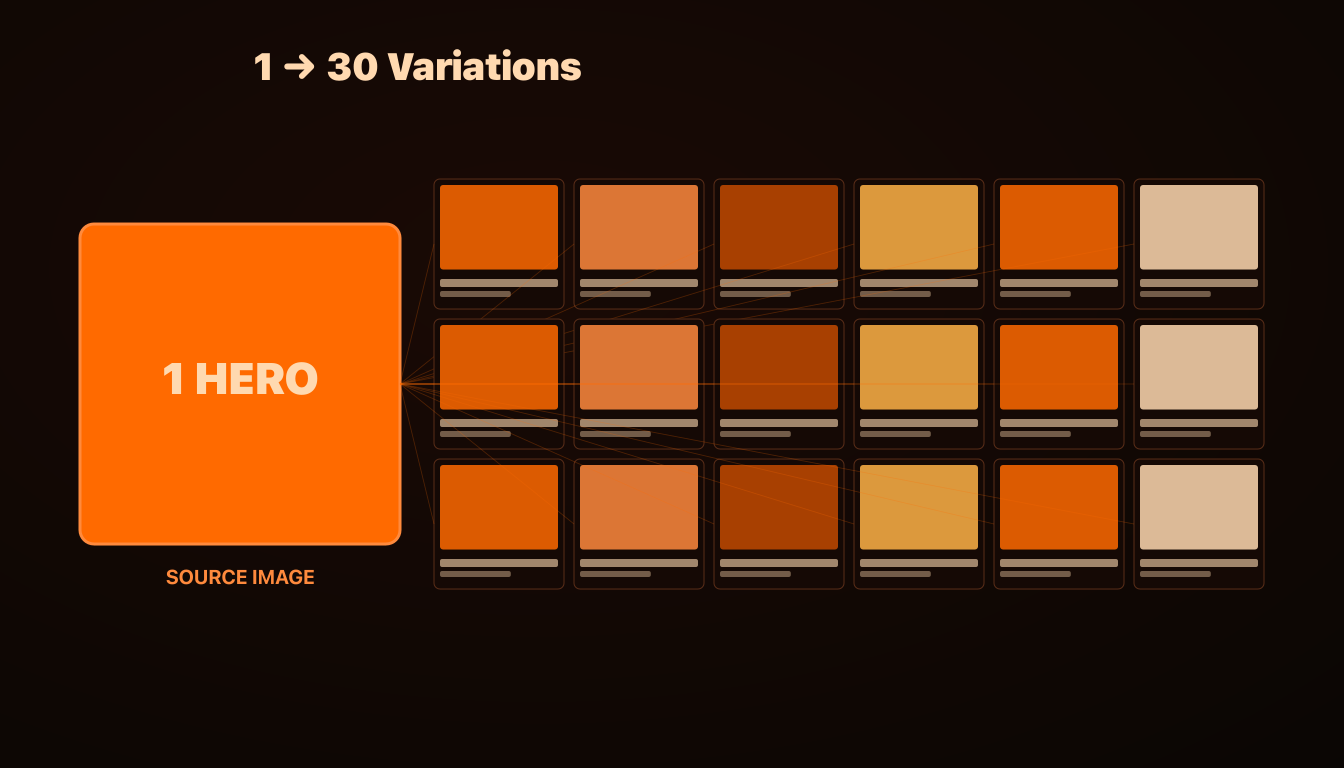
In 2023, producing 30 static Meta ads required either a 3-week studio shoot at $5-15K, or weeks of designer time at $4-8K. In 2026, the same 30 assets can be produced in about 4 hours from a single hero image using AI reframing, background replacement, composition variation, and overlay generation.
This guide is the exact step-by-step workflow we use to convert one hero into 30 ad-ready variants, what tools are involved at each step, and the limitations that still require human input.
The Mental Model: Hero Image As Source Of Truth
The workflow is built around the principle that one high-quality hero image, used as the input to AI background, composition, and overlay variation, can generate enough creative variants to feed a Meta testing pipeline for 4-6 weeks.
This works because most of the variation that matters for testing — backgrounds, compositions, hooks, CTAs — is generative on top of the hero, not a fundamental change to the hero itself. Meta recommends creative diversification, and visual variety around one product is a cheap way to get part of it. The same product in 30 visually distinct compositions gives you 30 ads to compare, and the more they differ in hook and setting, the more each test teaches you.
Step 1 — The Hero Image
The hero image is the constraint. A great hero produces 30 great variants; a poor hero produces 30 poor variants. Specs that matter:
Resolution: 2000×2000px minimum, 3000×3000px ideal.
Lighting: Even, soft, no harsh shadows. Window light works. Studio lighting works. Phone flash does not.
Background: Neutral, single color, easy to mask out. White seamless paper or a plain wall.
Composition: Product centered, fully in frame, no cropping at the edges.
Focus: Sharp across the entire product. Phone macro mode usually nails this.
A phone shot meeting these specs costs you 10 minutes; a poor shot costs you 30 variants of damaged output. Invest in the hero.
Step 2 — Background Variations (5-8)
Run the hero through AI background replacement to produce 5-8 distinct background contexts. Suggested mix:
2 lifestyle interiors — kitchen counter, bathroom shelf, bedside table, depending on use occasion.
2 outdoor or natural settings — beach, garden, hiking, urban depending on category fit.
1-2 seasonal contexts — holiday, summer, fall depending on time of year.
1 hero color background — single-color treatment that pops the product visually.
1 textured studio backdrop — marble, linen, wood for premium-feel positioning.
Tools: Photoroom, Pebblely, AdRiseLab's background engine, or Midjourney img2img with controlled prompting.
Step 3 — Composition Variations
Beyond background swap, generate compositional variations to break the "30 versions of the same shot" pattern:
Macro close-up of a product detail (texture, label, finish).
Held in hand version (AI-generated hand holding the product).
In-use version (product being applied, opened, used) — limited but improving in 2026.
Multi-product stacking or pairing for bundle ads.
Negative-space versions where the product is offset to one side with empty space for copy.
Tools: AdRiseLab's composition engine, Midjourney with detailed img2img prompts, or Recraft.
Step 4 — Overlay Layers
Visual variants are the foundation; overlay layers are what turn them into testable ads.
Headline overlays: 4-6 distinct headlines pulled from your VoC mining. Each headline becomes its own overlay treatment.
CTA cards: 2-3 closing-card styles. Brand-color CTA, white CTA, photo-led CTA.
Brand styling: 2 typography and color-palette treatments — your primary brand look and an alternate.
Trust badges: 1-2 social proof callouts ("As seen in," "10k 5-star reviews").
Step 5 — Combination Logic
With 5-8 backgrounds × 4-6 compositions × 4-6 headlines × 2-3 CTAs, the combinatorial space is well above 30 variants. The art is choosing which combinations to ship.
A practical combination pattern: 5 background contexts × 1 dominant composition × 6 headlines = 30 variants. Or: 3 backgrounds × 5 compositions × 2 headlines = 30. The right balance depends on which axis you're currently testing hardest — usually headlines for early-stage testing, backgrounds and compositions for late-stage.
Step 6 — Shipping As Test Cohort
Upload the 30 variants into Meta Ads Manager as 5-7 testing cells of 4-6 ads each. Each cell is a separate ad set with $50-100/day budget. Run for 5-7 days, kill the bottom 50% of variants, refresh with new generations from the same hero.
Don't put all 30 into one ad set — Meta's delivery will overweight 2-3 variants and never test the others fairly. The cell structure forces statistical balance across the cohort.
What AI Still Can't Do (As Of June 2026)
Three categories of creative still require human or studio production:
Genuine human-product interaction. AI-generated humans handling products are still off in subtle ways — finger positions, expression timing, micro-gestures. Real UGC creator content still wins for "human using product" creative.
Novel material rendering. AI struggles with unusual textures — engineered fabrics, specialized metals, transparent or refractive materials. These need photography of the actual material.
True creative direction. AI executes within a brief; it doesn't conceive the brief. The 4-week brand campaign concept, the new visual identity, the breakthrough creative idea — those still come from humans.
For everything else — backgrounds, composition variation, overlays, seasonal adaptation, hook testing — AI workflows in 2026 are faster, cheaper, and produce more testable volume than studio production.
Production Cost Math
Studio production of 30 static ads: $5-15K, 3 weeks.
Designer production of 30 static ads from existing assets: $4-8K, 1-2 weeks.
AI workflow from hero image: $200-600 in tool subscriptions and overlay work, 4 hours total.
The 20-30× cost-and-time savings is what makes the AI workflow the dominant approach for 2026 DTC static production.
Scale The Workflow End-To-End With AdRiseLab
AdRiseLab takes one hero image and produces the full 30-variant Meta ad cohort: background variations, composition variations, headline overlays, CTA cards, brand styling — all delivered ready to upload. Get started with AdRiseLab.
Related Reading
See the static ad anatomy with 9 layout templates for the overlay structures used in the workflow. Read about static vs video creative mix for why static volume matters in 2026. And explore the Andromeda algorithm for what Meta documents about delivery and why creative diversification still matters.