
A good creative brief for Facebook ads names one decision, one variable that changes, and everything that stays fixed, so the ads it produces can be compared with each other. This page gives you an 8-field brief template, five filled examples for the most common Meta creative tests, and free DOCX, CSV and PDF downloads with no signup.
Most briefs fail for one reason: they describe a deliverable instead of a comparison. "Three static ads for the spring range, on brand, highlighting quality" produces three ads that differ in every way at once. When one wins, nobody can say why, and the account learns nothing it can reuse.
Download the template
| File | What it is | Use it for |
|---|---|---|
| Creative brief template (DOCX) | One page, 8 fields and a variant table | Writing each brief. Opens in Word or Google Docs |
| Variant log (CSV) | 15 columns, one row per variant | Tracking every test and its result in Google Sheets |
| 5 filled briefs (PDF) | The examples below, one per page | Showing a designer or freelancer what done looks like |
The 8 fields
1. The decision this test informs
Not "increase sales". A question with a yes or no answer: does leading with the guarantee beat leading with the price?
If you cannot write the question, the brief is a production order, not a test. Production orders are fine. They just should not be mistaken for learning.
2. The one variable that changes
Name it. Everything else is held.
| Usable variable | Unusable variable |
|---|---|
| Opening claim | "Make it more engaging" |
| Offer framing: percentage or currency | "Different designs" |
| Format: static or video | "Try some variations" |
| Proof type: review or demonstration | "Fresh creative" |
| Main subject: product or person | "On brand but new" |
The right-hand column is what most briefs contain, and it is why most creative testing produces nothing transferable.
3. What is held constant
Write it down, because these drift silently: offer, audience, landing page, call to action, length or dimensions, and brand elements. A landing page changed mid-test invalidates the comparison and almost never gets recorded.
4. The audience, in one sentence
Who the ad is for and what they currently believe. "People who have compared us with the cheaper option and think the price gap is not justified" is usable. "Women 25 to 45 interested in wellness" is not, and in an account running broad targeting it is not even true.
5. The claim, and the evidence behind it
One claim per ad, then the evidence that allows it: a specification, a demonstration, a real customer quote, a certification, a guarantee. A claim without evidence in the brief becomes a claim without evidence in the ad, which is weaker and a review risk. For health, money or personal-attribute claims, check Meta's advertising standards before production, not after a rejection.
6. Deliverables, with ratios stated
List quantity, length and ratios: 9:16, 4:5, 1:1. Never write "resize as needed". Meta has removed placement selection from ad sets, so you can no longer stop an asset from appearing in a placement it was not cropped for. The crop is now the control. See Meta's placement control removal and the 2026 Meta ad specs cheat sheet.
7. The primary metric and the stopping rule
Say which metric decides, and set the stopping rule before launch.
| The decision | Primary metric |
|---|---|
| Does the opening stop the scroll? | Hook rate |
| Does the message earn a click? | Link click-through rate |
| Does the click convert? | Landing page conversion rate |
| Does the ad create profitable customers? | Cost per acquisition after margin |
Attention metrics reach a readable sample far sooner than conversion metrics, because they are measured per impression rather than per click. For most budgets a conversion-rate comparison between two creatives is out of reach. The creative testing budget calculator shows the arithmetic.
8. Rights and compliance
Music licence, voice licence, likeness release and any required disclosure. Confirm the licence covers paid social specifically, which is narrower than general commercial use. See voiceover and music licensing and creator whitelisting.
The template, as a table to copy
| Field | Your answer |
|---|---|
| Brief title, date, owner | |
| 1. Decision this informs | |
| 2. Variable that changes | |
| 3. Held constant (offer, audience, landing page, CTA, dimensions, brand elements) | |
| 4. Audience and current belief | |
| 5. Claim and supporting evidence | |
| 6. Deliverables: quantity, ratios, length | |
| 7. Primary metric and stopping rule | |
| 8. Rights and compliance |
| # | Variable value | Notes |
|---|---|---|
| 1 | ||
| 2 | ||
| 3 | ||
| 4 | ||
| 5 |
5 filled briefs for common Meta creative tests
All five are fictional. The brands, offers and figures are invented to show the format. None is a customer. The same five are in the PDF download, one per page.
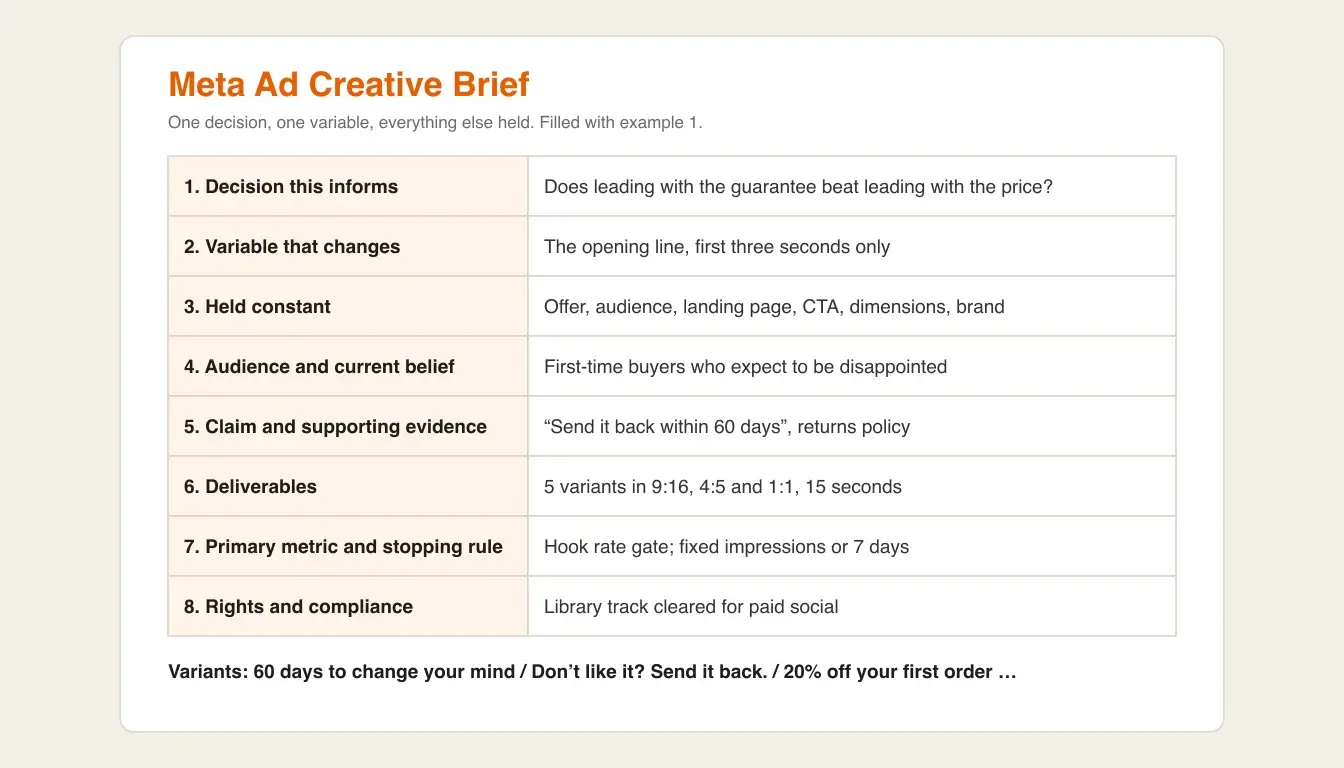
Example 1: Hook test (guarantee or price)
A cold prospecting test for a fictional home goods brand.
- Decision: Does opening on the 60-day guarantee beat opening on the introductory price for cold prospecting?
- Variable: The opening line, first three seconds only.
- Held constant: Offer (20% off first order), broad prospecting, same landing page, "Shop now", 9:16 at 15 seconds, brand palette and logo.
- Audience and belief: First-time buyers who find the category hard to judge and expect to be disappointed.
- Claim and evidence: "Send it back within 60 days." Evidence: the published returns policy.
- Deliverables: 5 variants, each in 9:16, 4:5 and 1:1, 15 seconds.
- Metric and stopping rule: Hook rate as the gate. Stop at a fixed impression count per variant or 7 days, whichever comes first. No edits mid-test. Variants that clear the gate are then judged on link click-through rate.
- Rights: Licensed library track cleared for paid social. No customer likeness.
- Variants: "60 days to change your mind" / "Don't like it? Send it back." / "20% off your first order" / "Cheaper than the one you almost bought" / "Most people keep it. You don't have to."
Example 2: Offer framing (percentage or currency)
A retargeting test for a fictional $48 bundle.
- Decision: For a $48 bundle, does "Save $12" beat "25% off"?
- Variable: How the same discount is written.
- Held constant: Same discount, same Stat Drop static layout, same audience, landing page and CTA.
- Audience and belief: Returning visitors who viewed the bundle and did not buy.
- Claim and evidence: The discount itself; evidence is the live checkout price.
- Deliverables: 4 statics, 4:5 and 1:1.
- Metric and stopping rule: Link click-through rate, fixed impression count per variant, set before launch.
- Rights: Own product photography only.
- Variants: "Save $12" / "25% off" / "$36 instead of $48" / "Save $12 (25%)"
The Stat Drop layout is one of the nine free static ad templates.
Example 3: Proof type (review or demonstration)
A durability test for a fictional everyday-carry product.
- Decision: Does a real customer review beat a product demonstration as proof of durability?
- Variable: The type of proof in the body of the ad.
- Held constant: Opening line, offer, 9:16 at 20 seconds, audience, landing page.
- Audience and belief: Buyers who think the product will break within a season.
- Claim and evidence: "Built for daily use." Evidence: a verified review quote with permission, or an unedited stress-test clip.
- Deliverables: 3 variants, 9:16 and 4:5.
- Metric and stopping rule: Link click-through rate after the hook gate; 7 days, no edits.
- Rights: Written permission for the review quote and name; no paid actor presented as a customer.
- Variants: Review quote on screen / Stress test demonstration / Review read aloud over the demonstration
Example 4: Format (static or video)
A format test for a fictional product page.
- Decision: For this product page, does a single static beat a 15-second video carrying the same message?
- Variable: Format only. Same headline, same visual, same offer.
- Held constant: Message, offer, audience, landing page, CTA.
- Audience and belief: Cold prospects who have never heard of the brand.
- Claim and evidence: One product specification shown in both formats.
- Deliverables: 1 static (4:5, 1:1) and 1 video (9:16, 4:5), built from the same frame.
- Metric and stopping rule: Cost per landing page view, fixed budget per variant, 7 days.
- Rights: Music licensed for paid social.
- Variants: Static / Video
For the video side, start from the video ad script templates.
Example 5: Main subject (product or person)
A framing test for a fictional handheld product.
- Decision: Does showing a person using the product beat a product-only shot for this audience?
- Variable: What fills the frame.
- Held constant: Headline, offer, layout, audience, landing page.
- Audience and belief: Buyers who cannot picture the product in their own routine.
- Claim and evidence: "Fits in one hand." Evidence: product dimensions.
- Deliverables: 4 statics, 4:5 and 1:1.
- Metric and stopping rule: Link click-through rate, fixed impression count per variant.
- Rights: Model release covering paid social for 12 months.
- Variants: Product on plain background / Product in hand / Person using it, face visible / Person using it, face out of frame
4 ways briefs break
Briefing a quantity instead of a question. "We need 30 creatives this month" is a capacity target. Without a question attached it produces 30 ads nobody can interpret.
Letting the variable drift in production. Usually an unrequested copy change during design. Any change to a held field should be recorded or reverted.
Changing the stopping rule after seeing results. Deciding when to stop once you know who is ahead turns a test into a story.
Treating a production order as a test. Both are legitimate. Label them, because only one should produce a conclusion.
From brief to live ad
Once the brief is written, the variants still need to be produced, checked and launched. AdRiseLab creative generation turns a product URL into editable Meta ad directions you can match to the brief's variants, and nothing is published until you approve it. It is Meta-only; plans start at $39 a month (pricing). For agencies running briefs across many clients, see AdRiseLab for agencies.
Sources
Meta advertising standards. Meta Business Help Center: create a project brief. Meta Blueprint: creative brief development course.
Related Reading
The Meta creative testing hub covers how briefs fit into a testing program, and what Meta Ad Library can and cannot tell you covers where test ideas usually come from.