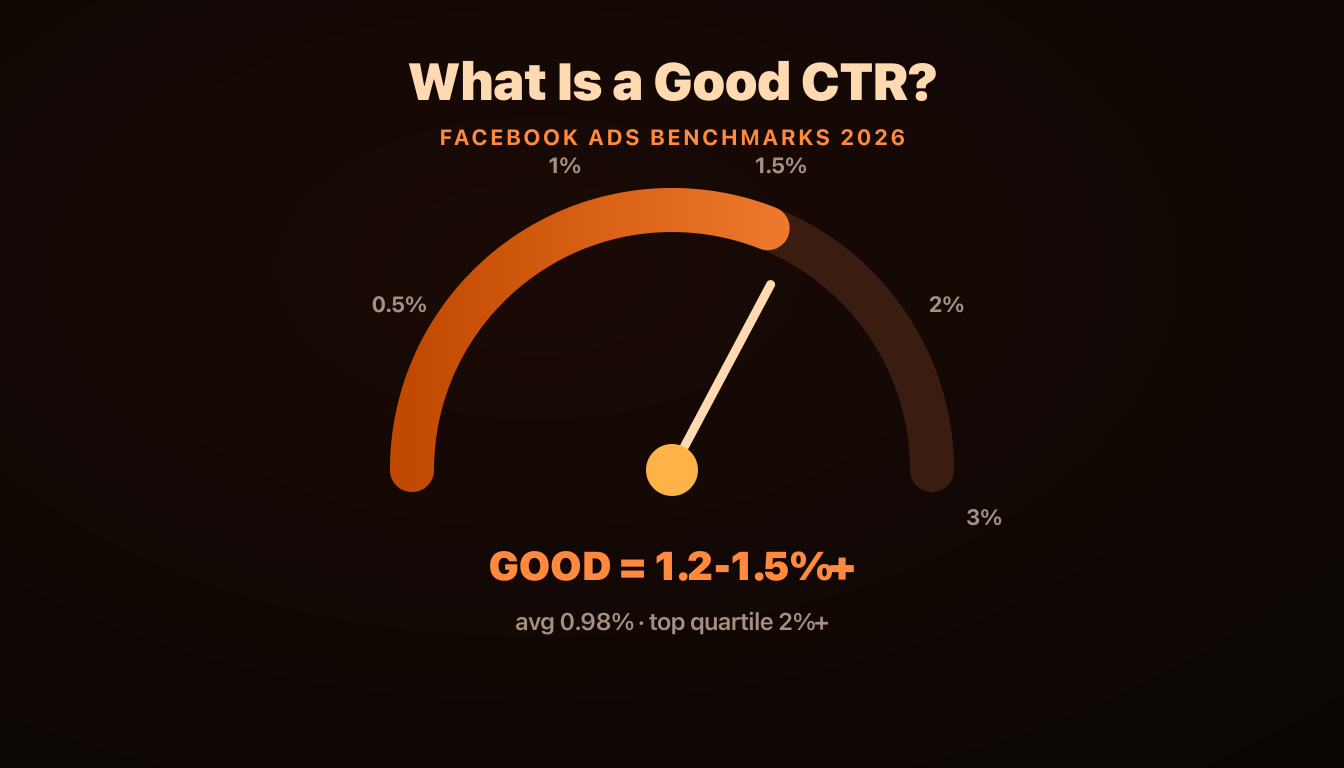
A good link click-through rate (CTR) for Facebook ads in 2026 is 1.2-1.5% or higher. The all-industry average is 0.98%, anything above 2% is top-quartile performance, and anything below 0.6% on cold traffic signals a creative problem. Those are the headline numbers — but they're only useful when you benchmark within your industry, use the right CTR metric, and pay attention to the trend rather than the snapshot. This guide covers all three.
Link CTR vs CTR (All): Make Sure You're Measuring the Right Thing
Ads Manager reports two very different click metrics. CTR (all) counts every interaction — link clicks, but also reactions, comments, shares, "see more" expansions, and profile taps. Link CTR (the metric this guide benchmarks) counts only clicks that take a user to your destination. CTR (all) runs roughly twice as high as link CTR and is the number weak ads hide behind.
Every benchmark in this article refers to link CTR (unique, outbound where relevant). When someone quotes a "3% Facebook CTR," ask which metric — it's usually CTR (all), which would correspond to roughly 1.4-1.6% link CTR.
Facebook CTR Benchmarks by Industry, 2026
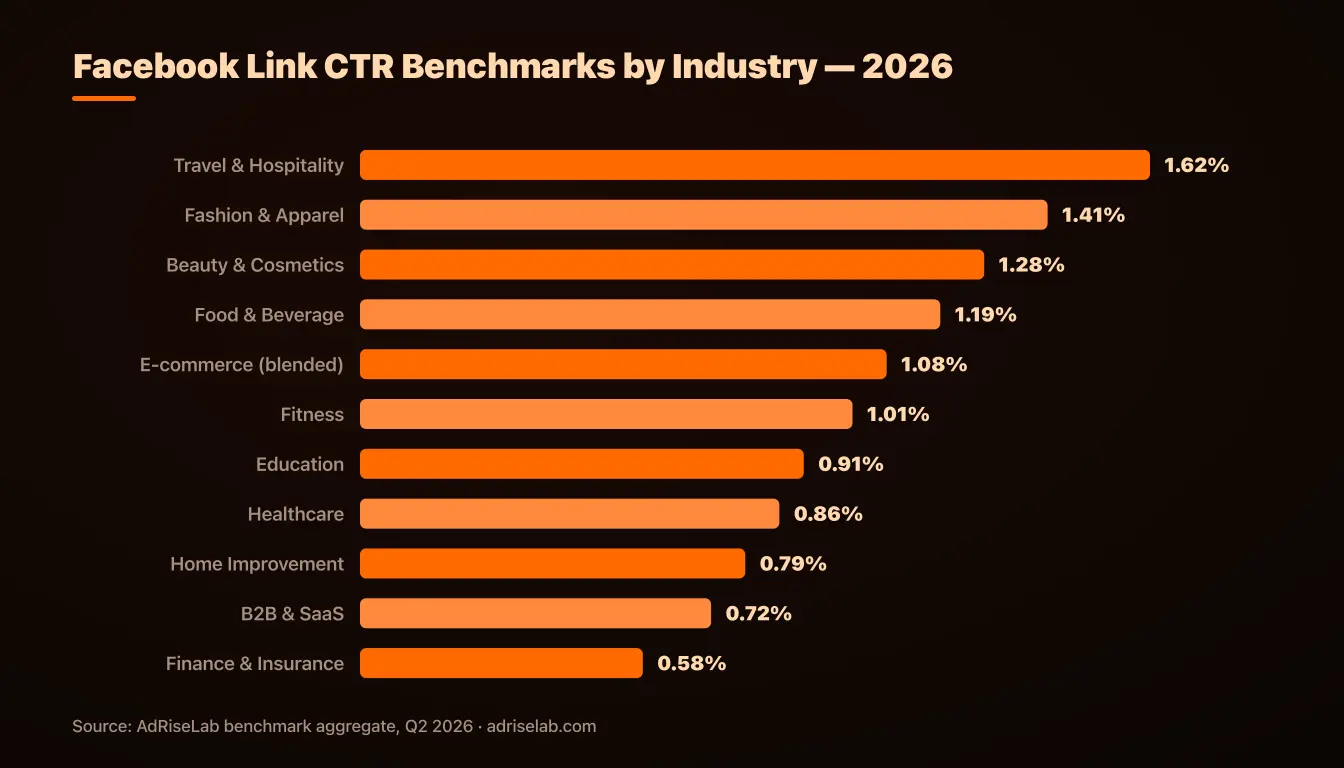
2026 average link CTRs by industry:
- Travel & Hospitality: 1.62%. Aspirational visuals earn the platform's highest engagement.
- Fashion & Apparel: 1.41%. Visual-first products with impulse appeal.
- Beauty & Cosmetics: 1.28%. Before/after and UGC formats drive outsized clicks.
- Food & Beverage: 1.19%. Broad appeal, high scroll-stopping potential.
- E-commerce & Retail (blended): 1.08%. The most common benchmark to compare against.
- Fitness: 1.01%. Strong hooks matter — transformation angles double category CTR.
- Education: 0.91%. Longer consideration tempers click impulse.
- Healthcare & Wellness: 0.86%. Policy-constrained creative limits hook aggression.
- Home Improvement: 0.79%. High-ticket considered purchases.
- B2B & SaaS: 0.72%. Professional audiences click less — judge on CPL instead.
- Finance & Insurance: 0.58%. The lowest-CTR vertical; compliance-constrained creative and high-stakes decisions.
The spread matters more than the average: a 0.9% CTR is a problem for a fashion brand and a strong result for an insurance product. Benchmark against your vertical, then against your own account history.
CTR Benchmarks by Objective and Format
Campaign objective changes who Meta shows your ad to, which changes CTR mechanically. Conversion-optimized campaigns average 0.9-1.2% link CTR (the algorithm prioritizes likely buyers, not likely clickers). Traffic campaigns average 1.3-1.8% — Meta finds serial clickers, which is exactly why traffic campaigns flatter CTR while producing worse buyers. Awareness campaigns run 0.4-0.7% and that's fine; clicks aren't their job.
Format also shifts the baseline. Carousel ads average 10-15% higher CTR than single images when the card sequence tells a story. Video and Reels-format ads typically earn higher CTR (all) through engagement but comparable link CTR. The static ad template kit provides nine editable layouts to compare against your existing creative; it does not establish a universal CTR uplift.
Why CTR Velocity Beats Absolute CTR
Here's the part most benchmark articles miss: the absolute CTR number is a lagging snapshot, and the trend is the actionable signal. A creative at 1.8% CTR that was at 2.4% three days ago is fatiguing — negative 25% velocity over 72 hours — even though 1.8% still beats every benchmark in this article. Sustained over two windows, that velocity predicts a hard performance decline within 5-10 days.
This is the core insight behind early creative fatigue detection: set up a 3-day vs 3-day comparison view in Ads Manager at the creative level, and treat any creative showing -20% or worse CTR velocity across two consecutive windows as fatiguing, regardless of its absolute number. AdRiseLab's performance reports watch connected-account creatives for the same fatigue signals.
How to Improve a Low CTR
If your CTR sits below your industry benchmark on cold traffic, work through these in order of impact:
CTR improvement levers, ranked:
- 1.Fix the first 3 seconds. The hook decides the click before the user consciously evaluates anything. Use the 12 hook formulas as prompts for openings to test; they do not carry a guaranteed lift.
- 2.Increase creative diversity. If you're running 3-5 similar creatives, the algorithm can't find the angle that clicks with each micro-audience. Use the budget-based creative planning guide to choose a batch you can evaluate.
- 3.Match format to placement. Run 9:16 in Stories/Reels, 4:5 or 1:1 in Feed. A letterboxed square in Reels placements bleeds CTR.
- 4.Rotate before fatigue, not after. A weekly refresh cadence keeps average CTR near peak instead of riding every creative down the decay curve.
- 5.Test color and contrast deliberately. Use the A/B testing guide to compare color and contrast with other variables held consistent; no universal winning palette is established here.
When a Low CTR Is Actually Fine
CTR is not a universal health metric. Retargeting campaigns run structurally lower CTRs (0.5-0.9%) with far higher conversion rates — users don't need to click an ad five times to buy once. High-AOV considered purchases earn fewer, higher-intent clicks. And conversion-optimized campaigns will always lose a CTR contest against traffic campaigns while winning on revenue. Judge every campaign on the metric its objective optimizes for; use CTR as the creative-health thermometer, not the scoreboard.
If your CTR problem is really a creative-volume problem — you know you need 15+ fresh, distinct creatives but can't produce them — AdRiseLab generates Andromeda-optimized creatives from any product URL in under 30 seconds. Get started with AdRiseLab.
Related Reading
See how much Facebook ads cost in 2026 for the CPC and CPM side of the equation. Learn the creative fatigue detection playbook that turns CTR velocity into an early-warning system. And read the creative testing framework for finding 2%+ CTR winners in 7 days.